
Deciphering the Digital Fingerprint of Illicit Drugs: SVM and Trace Element Profiling
Establishing chemical profiling for ecstasy tablets based on trace element levels and support vector machine
This study establishes a forensic chemical profiling method for ecstasy tablets seized in Brazil by combining ICP-MS trace element analysis with Support Vector Machines (SVM). Using concentrations of 25 elements, the researchers developed a classification model to distinguish the geographic origin (Campinas vs. Ribeirão Preto) of illicit samples, achieving a peak accuracy of 81.58%.
TL;DR
Researchers have developed a high-precision forensic methodology to track the origin of "Ecstasy" tablets using their elemental composition. By combining Inductively Coupled Plasma Mass Spectrometry (ICP-MS) with Support Vector Machines (SVM), the study successfully classified drug seizures from two Brazilian cities with 81.58% accuracy, identifying Selenium (Se), Molybdenum (Mo), and Magnesium (Mg) as the primary chemical markers.
Background: Tracking the Untraceable
The rise of "club drugs" in Brazil presents a significant challenge for forensic investigators. To dismantle trafficking networks, police need more than just the "what"—they need the "where" and "how." Chemical profiling acts as a biological signature; tablets from the same laboratory batch share similar mineral impurities derived from catalysts, dyes, and adulterants used during synthesis.
The Core Challenge: High Noise, Small Samples
Forensic datasets are notoriously difficult because:
- Manufacturing Variability: Clandestine labs use inconsistent precursors, leading to high variance even within the same geographic region.
- Sample Scarcity: Unlike big-data applications, forensic seizures often provide limited samples (n=38 in this study), making traditional deep learning prone to overfitting.
- Irrelevant Features: Of the 25 elements detected, many (like Cadmium or Barium) introduce more noise than value.
Methodology: The SVM Advantage
The authors utilized Support Vector Machines (SVM), a technique specifically designed to find the "maximum margin" hyperplane that separates data classes in a high-dimensional space.
1. Feature Selection (F-score)
Instead of using all 25 elements, the team applied the F-score to rank the elements by discriminative power. This measure looks at the ratio of between-class variance to within-class variance.
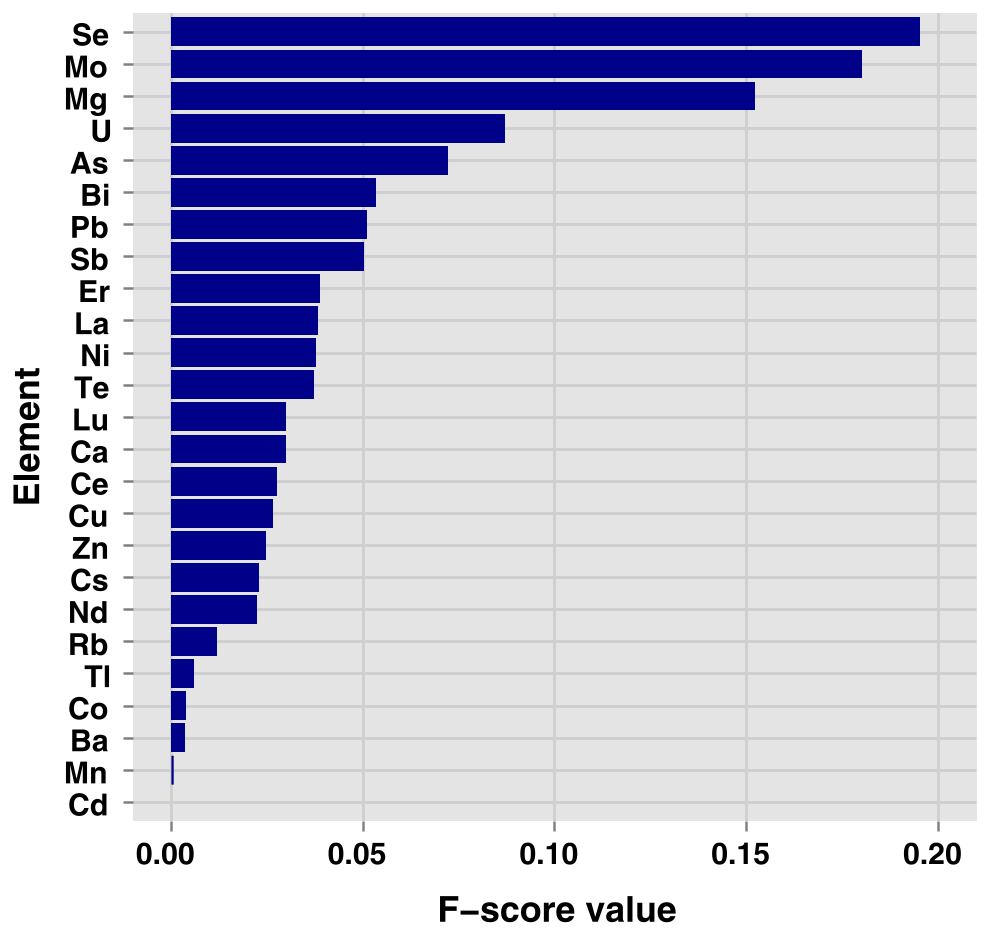 Figure 1: F-score ranking showing the dominance of Se, Mo, and Mg as discriminative features.
2. The Classification Model
The core of the model uses the Gaussian Radial Basis Function (RBF) kernel, which allows the SVM to handle non-linear relationships by projecting the elemental data into a higher-dimensional feature space where the cities (Campinas and Ribeirão Preto) become linearly separable.
Experimental Results
The study demonstrated that "less is more." Adding more chemical elements beyond the top 13 actually decreased the model's accuracy, as shown in the table below.
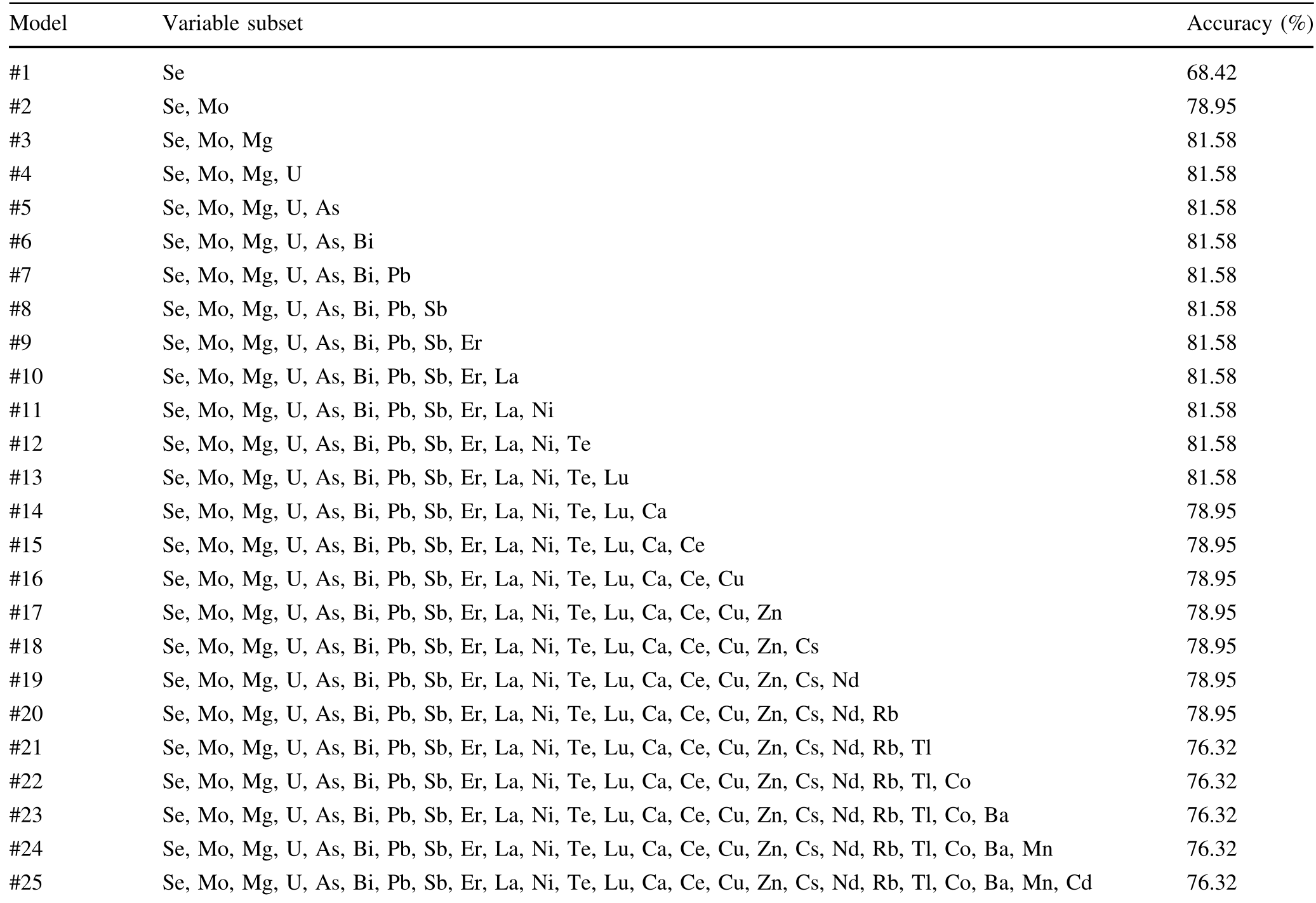 Figure 2: Model performance across different variable subsets. Model #3 achieved peak performance.
Key Findings:
- Winning Trio: Se, Mo, and Mg alone provided the highest sensitivity (95.24%).
- SVM vs. ANN: While both reached 81.58% accuracy, SVM achieved this with fewer variables (3 vs. 5) and showed greater robustness against the "curse of dimensionality."
- Chemical Insights: The presence of Mg and Zn likely stems from lubricants (stearates) used in the pill-pressing process, while trace Catalysts like Ni and Mo hint at specific synthetic pathways.
Critical Insight & Future Outlook
This work demonstrates that Support Vector Machines are superior to more complex Neural Networks for small-scale forensic datasets. The high sensitivity (95.24%) suggests that while the model is excellent at identifying samples from one city, the specificity (64.71%) indicates some overlap in supply chains or manufacturing ingredients between the two regions.
Limitations: The study is localized to São Paulo state. Future research should expand the "elemental library" to globally recognized trafficking routes to determine if these signatures hold across international borders.
Conclusion: By stripping away the noise of irrelevant chemical elements, forensic scientists can now use SVM-based models to pinpoint drug origins with high confidence, providing a powerful new tool in the global fight against narcotics.