
ChemoTF: Beyond Distance—Building High-Expertise Teams via Social Chemistry
Forming Dream Teams: A Chemistry-Oriented Approach in Social Networks YASHAR NAJAFLOU , (Member, IEEE) AND KRIS BUBENDORFER , (Member, IEEE)
Summary
Problem
Method
Results
Takeaways
Abstract
This paper introduces ChemoTF (Chemistry-Oriented Team Formation), a novel algorithm for expert team assembly in social networks. By leveraging "Chemistry Level" and "Expertise Level" within a multidimensional social graph, it optimizes for communicative effectiveness and team wisdom rather than just minimizing path-based distance.
## TL;DR
Finding the "Dream Team" is more than just connecting people who are close to each other. **ChemoTF** shifts the paradigm of Team Formation (TF) from minimizing "communication distance" to maximizing "social chemistry." Tested on nearly half a million scientists, this method boosts team expertise by over 80% while keeping personnel costs strictly within budget.
## The Problem: The "Shortest Path" Fallacy
In the world of social network analysis, team formation has traditionally been treated as an optimization problem where "Communication Cost" is the enemy. Previous SOTA methods (like RarestFirst or EnSteiner) focus on finding experts who are just 1 or 2 hops away from each other.
However, the authors of this paper argue that this is fundamentally flawed because:
1. **Communication is Dynamic**: Specialists communicate differently depending on the project domain. A "node distance" of 2 in a graph doesn't capture the nuance of collaborative synergy.
2. **The Wisdom Gap**: By obsessed-over path lengths, current algorithms ignore "wiser" experts who might be slightly further away but significantly more qualified.
## Methodology: The Chemistry-Oriented Insight
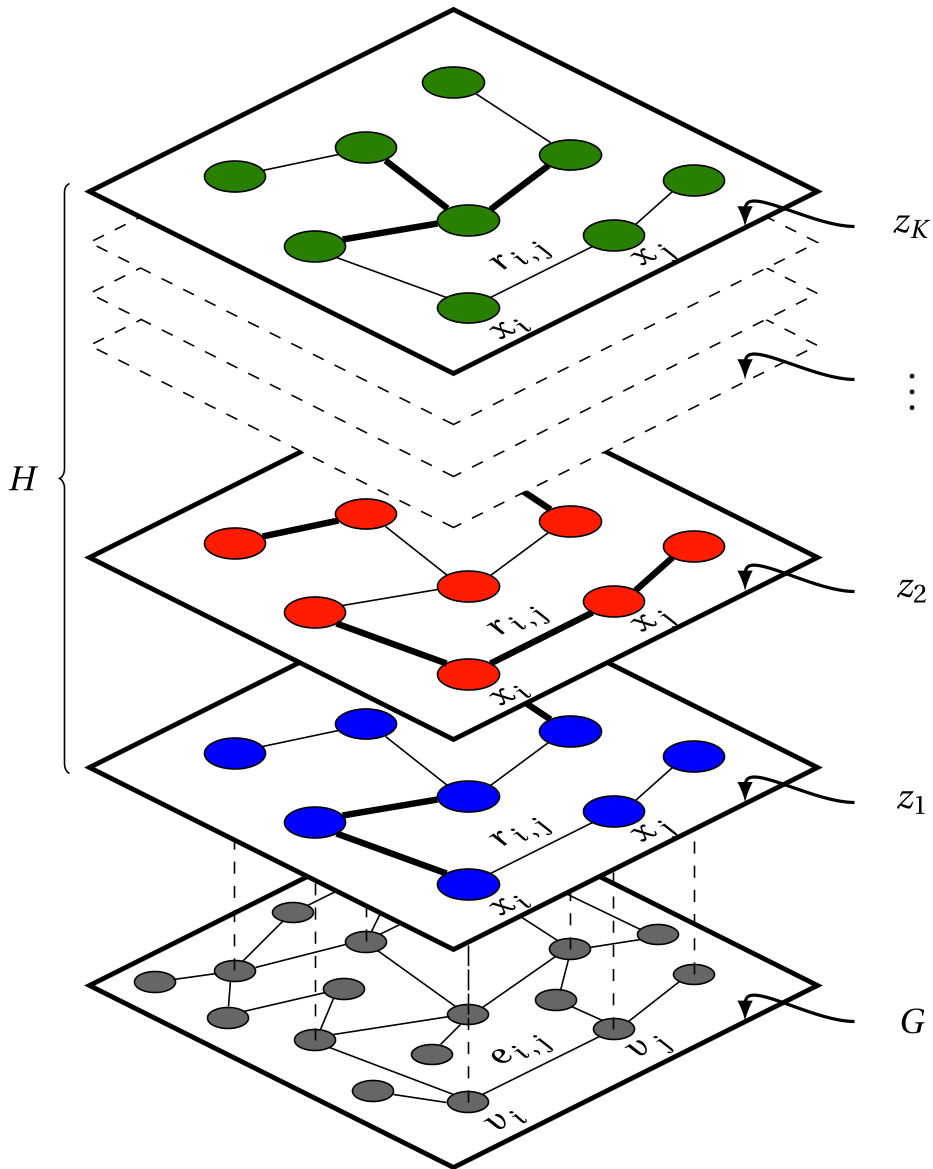
The core of **ChemoTF** lies in treating the social network as a **Multidimensional Graph**.
### 1. Mapping the Latent Space
Using **Latent Dirichlet Allocation (LDA)** on a massive corpus of abstracts and keywords, the researchers mapped out 160 "Areas of Expertise." This allows the model to understand not just *that* two experts collaborated, but *in what capacity* they collaborated.
### 2. The ChemoTF Metric Suite
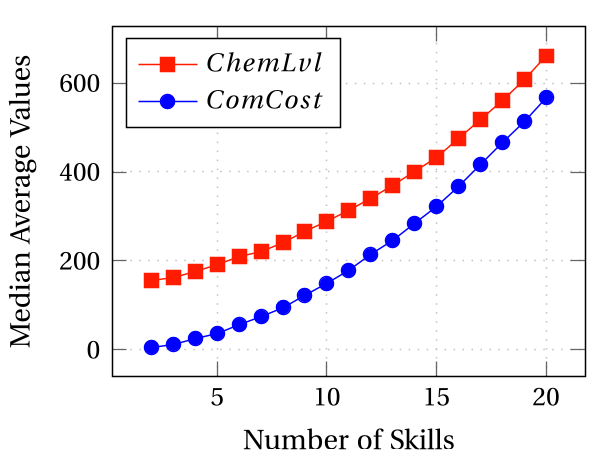
* **Chemistry Level (ChemLvl)**: Reflects the expected amount of communication needed between two skills based on their historical co-occurrence in successful projects.
* **Dynamic Communication Cost (dCC)**: Measures how effectively two specific experts can communicate based on their shared expertise dimensions.
* **Expertise Level (ExpLvl)**: A quantified measure of an individual's experience in a specific skill.
## Experimental Setup: CompScholarCorp
To prove their point, the authors built **CompScholarCorp**, a massive dataset of 1,044,454 publications. Unlike standard DBLP datasets, this includes abstracts, citations, and keywords, providing the "semantic glue" needed for chemistry modeling.
### Visualizing the Collaboration Network
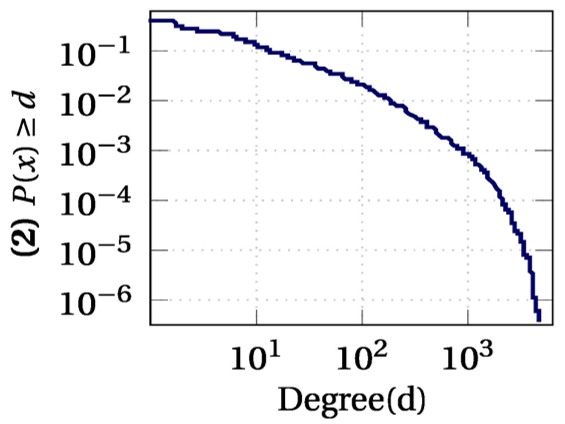
The network follows a **Power Law distribution** (exponent 3.12). A key finding: 51% of the network is tightly clustered, suggesting that "Chemistry" is a natural property of high-performing research communities.
## Performance: How ChemoTF Stacks Up
The algorithm was benchmarked against three seminal baselines: **RarestFirst, EnSteiner, and MinSD**.
### 1. Expertise Dominance
ChemoTF achieved **ExpLvl scores 81.1% to 87.2% higher** than the competition. While other algorithms settled for "available" experts to minimize path length, ChemoTF successfully recruited higher-tier experts who still met the "Chemistry" threshold.
### 2. Budgetary Control
ChemoTF was the only algorithm that reached a **100% success rate** in keeping team costs (Expertise Cost) below the average market rate for the required skills.
## Critical Insights & Takeaways
* **The "7 ± 2" Rule**: The paper respects organizational psychology by noting that teams larger than 7-9 people suffer from decision-making decay. ChemoTF remains tractable and effective up to 16 members, covering the vast majority of real-world use cases.
* **Predictability**: One major advantage of ChemoTF is its stability. Its results are roughly **46% more predictable** across different task complexities compared to NP-hard approximations used in prior work.
### Conclusion
ChemoTF proves that "wisdom" doesn't have to be expensive or hard to find. By shifting the objective from "minimizing distance" to "maximizing chemistry," organizations can form teams that are not just connected, but truly compatible and highly expert. As scientific collaboration becomes increasingly interdisciplinary, this multifaceted approach to team building will be the cornerstone of future R&D platforms.