
Chic or Social: Decoding the DNA of Fashion Popularity
Chic or Social: Visual Popularity Analysis in Online Fashion Networks
This paper presents a quantitative analysis of visual popularity within the "Chictopia" fashion social network, utilizing a multi-modal approach that combines state-of-the-art clothing parsing with social and textual features. The study employs regression and classification models to disentangle the influence of "chic" (visual style) versus "social" (network status) factors across in-network and crowd-sourced out-of-network scenarios.
TL;DR
What makes a fashion post go viral? Is it the impeccable style of the outfit (the "Chic") or the uploader's social status (the "Social")? By analyzing over 300,000 posts from Chictopia, researchers discovered that while social networks are dominated by "who you know," the highest accuracy in predicting true aesthetic value comes from combining deep visual parsing with social history.
Problem & Motivation: The Popularity Paradox
In online communities like Instagram, Pinterest, or Chictopia, we like to believe that "content is king." However, a central problem in multimedia research is the social bias. A mediocre outfit posted by a "fashion icon" with 100k followers often receives more engagement than a masterpiece from a newcomer.
Existing research has struggled to quantify this gap. Why is one image popular? Is it because the image is good, or because the network's algorithm and social structure amplify certain users? This paper seeks to separate these variables by looking at a niche, visual-heavy domain: Online Fashion.
Methodology: Parsing the "Look"
The authors didn't just use global image features; they treated fashion as a structured data problem.
1. Visual Parsing (The "Chic" Factor)
Beyond simple color and texture, the paper utilizes Clothing Parsing—assigning labels (like "outer top," "dress," "footwear") to every pixel.
- Style Descriptor: Captures patches across the body to understand overall aesthetic.
- Parse Descriptor: A novel feature that focuses on the specific appearance of individual garment items.
2. Social Metrics (The "Social" Factor)
The model looks at three main pillars:
- User Identity: Who is posting?
- Node Degree: How many followers/friends do they have?
- Expertise: How many posts have they successfully shared before?
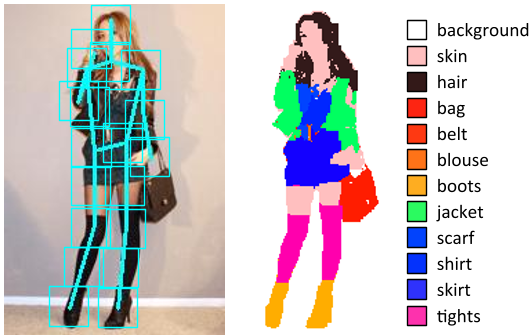 Figure: Style vs. Parse descriptors. While style looks at patches, parsing segments the specific garments to understand the "outfit" structure.
In-Network vs. Out-of-Network: The Ground Truth
To truly test if "Chic" matters, researchers used a brilliant experimental design:
- In-Network: Checking what makes a post popular on Chictopia.
- Out-of-Network: Using Amazon Mechanical Turk to show the same photos to people who have no idea who the users are. This creates a "socially isolated" condition to measure pure visual appeal.
Key Findings
The results (Table 2) reveal a striking asymmetry:
- Inside Chictopia: Social factors (: 0.491) are twice as influential as content factors (: 0.248). If you want to be popular inside the app, focus on your follower count.
- Outside Chictopia: When the crowd votes without bias, content quality becomes just as important as social metrics (: 0.428 vs 0.423).
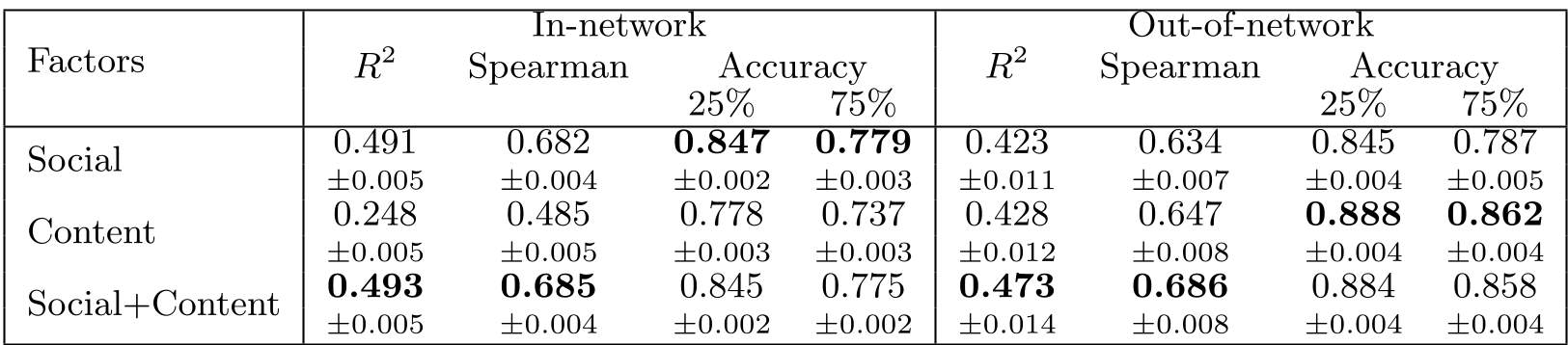 Table: Comparison of In-network vs Out-of-network performance. Note how Content factors gain significant ground when social bias is removed.
Critical Analysis & Conclusion
The most profound takeaway is that Social Identity is a proxy for Quality. The reason social factors still helped predict popularity in the "isolated" crowd-sourced experiment is that influential users, over time, develop better taste and higher production values. They aren't just famous for being famous—they are famous because they consistently produce "chic" content.
Limitations
Published in 2014, the paper uses linear regression and "traditional" computer vision features (HOG, Lab colors). Today, a Vision Transformer (ViT) would likely capture "style" more holistically. Furthermore, the dataset doesn't account for the "Initial Boost" effect where platform algorithms (like the "Explore" page) create a feedback loop of popularity.
Future Outlook
This work serves as a foundational warning for anyone building Recommendation Systems or Aesthetic Scoring models: Do not trust your labels blindly. Any model trained on "likes" or "votes" is actually training on a mixture of visual quality and social network dynamics. To build a system that truly understands "Style," we must learn to see past the followers.
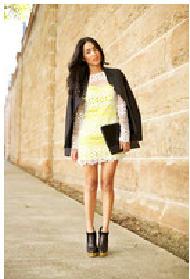 Visualizing results: The model successfully distinguishes between high-composition, "chic" outfits and low-quality, poorly lit captures.