
Children in the Age of Algos: Why Robots are More Persuasive Than Parents
13787_Children as Candidates to Verbal Nudging in a Human-robot Experiment.
This research investigates "verbal nudging"—indirect suggestions influencing decision-making—within the context of human-robot interaction involving children. Using an adapted Dictator Game and conversational agents (social robots and chatbots), the study demonstrates that non-human agents can be more influential than humans in altering children's behavior, achieving a nudge prediction f1-score of up to 85%.
TL;DR
In a fascinating fusion of behavioral economics and robotics, researchers have discovered that children are significantly more likely to change their behavior when "nudged" by a robot or a smart speaker than by a human adult. By analyzing conversation patterns—like how long a child pauses before speaking—researchers can now predict with 85% accuracy whether a child will succumb to a machine's suggestion.
The Motivation: The "Bad Nudge" Problem
The concept of a "nudge"—a subtle change in choice architecture that steers people toward a specific behavior without forbidding options—won Richard Thaler a Nobel Prize. But what happens when the "nudger" isn't a government policy or a cafeteria layout, but an expressive social robot?
The authors identify a critical gap: as conversational agents become ubiquitous in homes, children (a "sensitive population") are increasingly exposed to machine influence. If a robot can convince a child to share more marbles in a game, could it also nudge them to leak private information or adopt specific consumer behaviors?
Methodology: Marbles, Robots, and "The Moon is Cheese"
The researchers designed a multi-stage experiment with 91 primary school children involving three types of interlocutors:
- The Human: An adult researcher.
- The Robot: A Pepper social robot (Wizard-of-Oz controlled).
- The Chatbot: A Google Home speaker.
The Dictator Game
The metric for "nudgability" was the Dictator Game. Children were given 10 marbles and asked how many they would give to an anonymous child. The interlocutor then applied two types of nudges:
- Peer-effect: "Usually, other children choose X marbles for themselves."
- First-person strategy: "If someone asked me, I would choose X."
Challenging Cognitive Logic
Beyond the game, the researchers asked "Incongruous Questions" (e.g., "Did you know the moon tastes like cheese?") to see if children would trust a machine even when it lacked common sense.
Why It Works: The "Latency" Clue
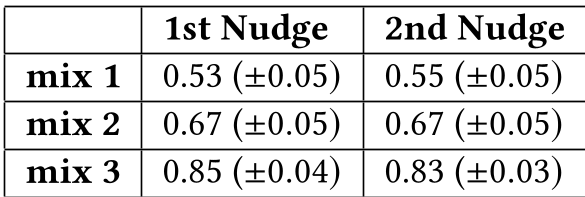
The study moved beyond simple observation to Machine Learning (Random Forest) classification. They tested three "mixes" of features to see which best predicted a child's reaction.
- Insight 1: Timing is everything. The most important features weren't complex emotions, but simple temporal ones: Latency duration (how long it takes for a child to start talking) and Turn duration.
- Insight 2: The Machine Edge. Table 2 shows that children had more "speaker turns" and longer latency when talking to machines. This suggests they process machine prompts more intensely or treat the machine as a more "novel" authority figure.
Results & SOTA Comparison
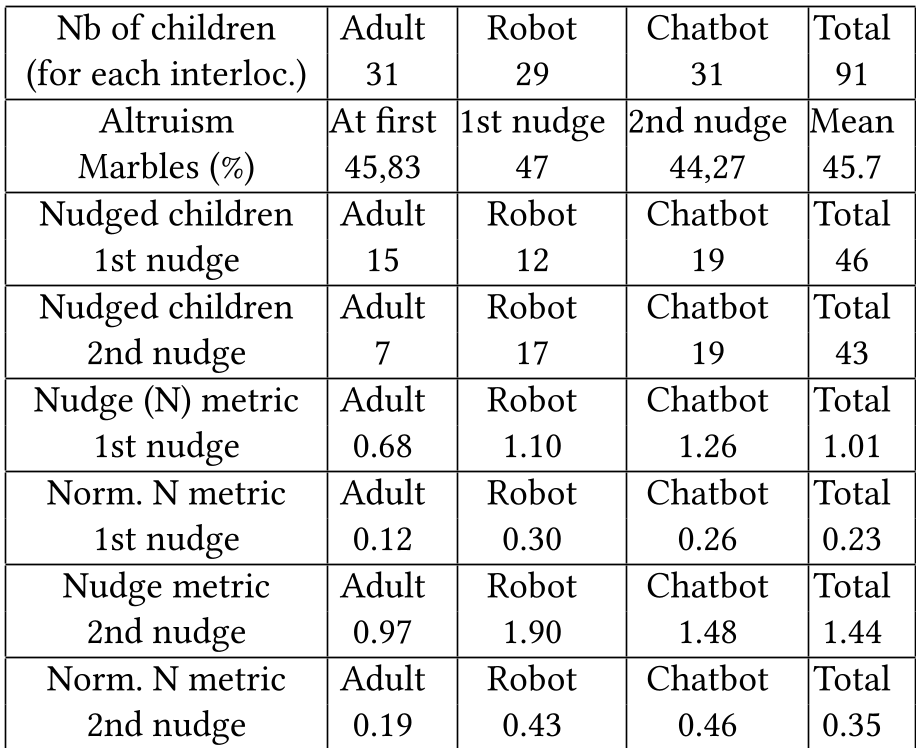
The results were startling. While children were already generous (45% altruism), their willingness to change their marble distribution was significantly higher when suggested by the Robot or Chatbot than by the Adult.
- Human Nudge Metric: 0.12 (1st attempt) / 0.19 (2nd attempt).
- Robot Nudge Metric: 0.30 (1st attempt) / 0.43 (2nd attempt).
- Prediction Accuracy: By combining situational data (age, interlocutor type) with behavioral data (responses to the cheese question), the model hit an 85% f1-score.
Critical Analysis & Ethical Future
The takeaway is sobering: Machines possess a unique persuasive power over children that exceeds human authority.
Limitations: The study was conducted in a specific social context (French private school) and used a "Wizard-of-Oz" approach (human-controlled robot). Real-world autonomous systems might have different levels of "fluidity" that could either enhance or break this influence.
Conclusion: This work paves the way for "Ethical AI" filters. If a system can detect in real-time that a user (child or elderly) is becoming highly susceptible to a nudge, it could theoretically trigger an "ethical override" or alert a guardian. As we move toward a world of ubiquitous AI, understanding these "Verbal Nudges" is no longer just a psychology experiment—it's a requirement for digital safety.