
The Double-Edged Sword of Interest Rate Hikes: A System Dynamics Perspective on China's Economy
Research on Chinese Economic Effect of Central Bank Raising Interest Rates Based on System Dynamics
This paper utilizes System Dynamics and Self-Organization Theory to analyze the macroeconomic effects of the People's Bank of China (PBoC) raising interest rates. It constructs a non-linear simulation model using Vensim to evaluate how rate hikes intended to curb inflation simultaneously impact RMB exchange rates, "hot money" inflows, and GDP growth.
TL;DR
By applying Self-Organization Theory and System Dynamics, this research demonstrates that while the Central Bank’s interest rate hikes effectively curb inflation by reducing loan investment and increasing savings, they trigger a dangerous side effect: a massive influx of speculative "hot money" due to RMB revaluation. The study warns that the "dissipative structure" of the Chinese economy limits the effectiveness of aggressive tightening.
Contextual Positioning
This work sits at the intersection of Thermodynamical Physics (Entropy) and Macroeconomics. Rather than viewing interest rates through a simple linear lens, the author treats the economy as an open, non-linear system far from equilibrium. It provides a technical simulation of the 2007-2008 economic climate, offering timeless insights into the "policy trilemma" (the impossibility of having a fixed exchange rate, free capital movement, and an independent monetary policy).
Problem & Motivation: The Inflation vs. Hot Money Dilemma
In 2007, the PBoC raised rates six times to fight rising CPI. However, the author identifies a critical feedback loop often ignored in basic models:
- Rate Hike Increased Savings and Reduced Loan Investment (Desired).
- Rate Hike RMB Revaluation vs. USD Massive "Hot Money" Inflow (Undesired).
The research asks: How much room does the Central Bank actually have to move?
Methodology: The Dissipative Structure of Economics
The core innovation is viewing the economic effect as a Dissipative Structure. For a system to transform from disorder (chaos) to a new stable order, it must satisfy:
- Openness: Exchanging matter/energy (capital/trade) with the outside world.
- Non-linearity: Small changes in rates leading to disproportionate shifts in capital flow.
- Entropy Balance: . The internal entropy production () must be offset by negative entropy from the outside (, i.e., the influence of the US Dollar trend).
Model Architecture
The author uses Vensim to map these relations. The model treats the Central Bank rate as the "Source" and GDP as the "Sink."
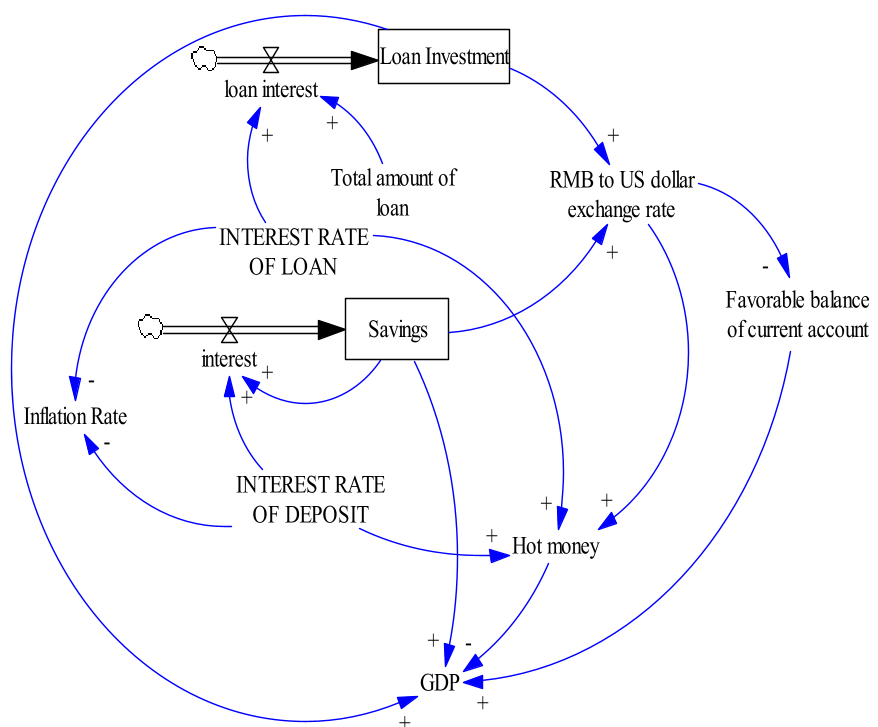 Figure 1: The system dynamics model illustrating interactions between rates, investment, and exchange rates.
Experiments & Results: Simulating the Eight-Hike Scenario
The simulation (labeled run2) assumes a future scenario where benchmark rates are hiked 8 times (Deposit to 6.30%, Loan to 9.27%).
Key Findings:
- Investment Suppression: The slope of the Loan Investment curve flattens significantly in run2, proving the policy's effectiveness in cooling the economy.
- The Feedback Trap: The simulation reveals that the drop in the Favorable Balance of Current Account is accompanied by a dramatic surge in the Hot Money curve.
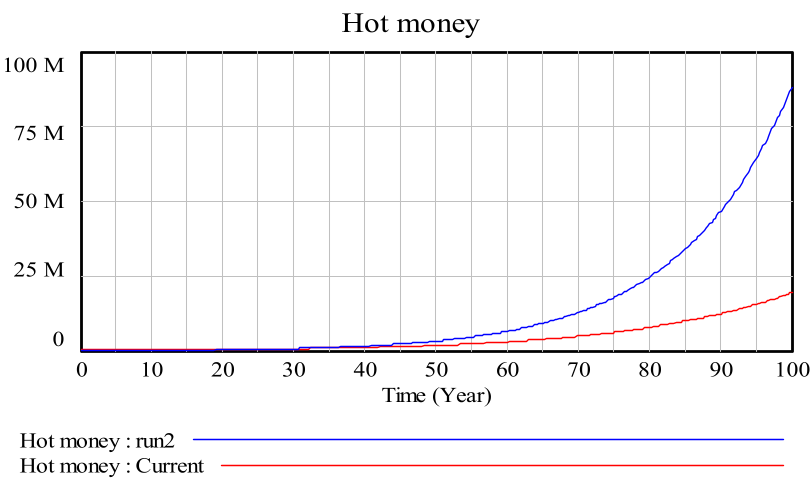 Figure 2: The exponential-like increase in Hot Money under the high-interest rate scenario (run2) vs. the current state.
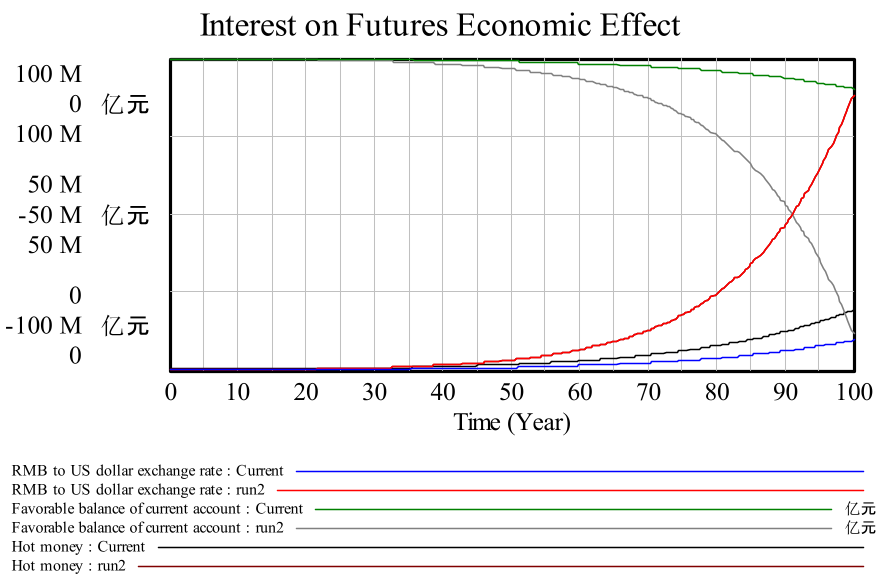 Figure 3: Comparative analysis showing RMB revaluation and the corresponding decrease in the current account balance.
Critical Analysis & Conclusion
Takeaway
The paper proves that the "space" for interest rate hikes is constrained by the Global Interest Rate Differential. If the US Federal Reserve enters a rate-cutting cycle while China raises rates, the resulting "positive entropy" (disorder) from hot money inflows can destabilize the local financial market.
Limitations & Future Work
While the model is robust in its non-linear logic, it relies heavily on historical 2007 data. Future research should apply this System Dynamics framework to the current era of digital currency and algorithmic trading, where "Hot Money" moves even faster than in 2008.
Final Verdict: A sophisticated blend of physics-based systems theory and monetary policy that highlights why central banking is as much about "balancing the system" as it is about "fighting inflation."