
Chinese News Event 5W1H Extraction: Structuralizing Information Overload
Chinese News Event 5W1H Semantic Elements Extraction for Event Ontology Population
This paper presents a comprehensive framework for extracting 5W1H (Who, What, Whom, When, Where, How) semantic elements from Chinese news to populate event ontologies. The method utilizes a multi-stage pipeline involving machine learning-based key event identification, Semantic Role Labeling (SRL), and Named Entity Recognition (NER) to automate the construction of event-centric knowledge bases.
TL;DR
This paper introduces a specialized framework designed to extract 5W1H (Who, What, Whom, When, Where, How) elements from Chinese news articles to build structured event knowledge bases. By combining title classification, Semantic Role Labeling (SRL), and a custom News Event Ontology Model (NOEM), the system transforms unstructured text into semantically rich data, significantly improving how we navigate news information.
Problem & Motivation: Beyond the "Bag of Words"
In the era of information explosion, "News Information Overload" is a critical pain point. While classification and recommendation systems exist, they often treat news articles as a "Bag of Words," ignoring the underlying event logic.
The authors identify a gap in the granularity of Event Extraction (EE):
- Atomic Events: Too granular (operating at a single sentence level).
- Thematic Events: Too coarse (integrating multiple documents).
The core insight is that for efficient news browsing, users don't need documents—they need events. The paper argues that capturing the "Key Event" of a single story using the journalistic 5W1H structure is the optimal middle ground for knowledge base construction.
Methodology: The Three-Stage Pipeline
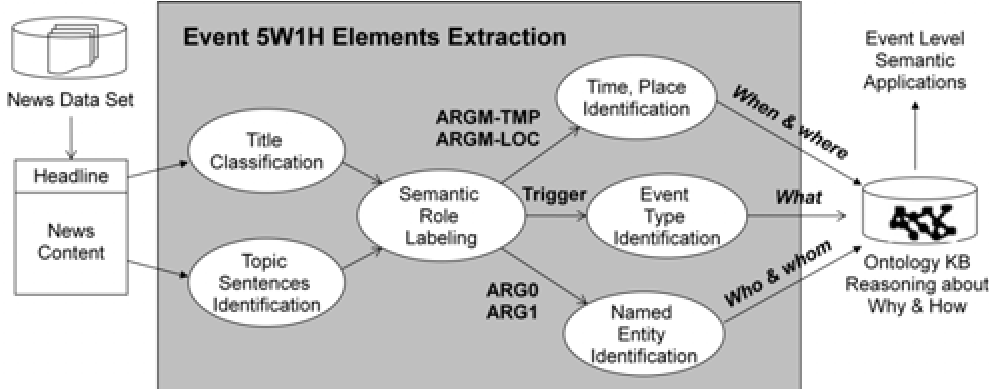
The proposed framework operates like a high-precision filter, moving from document-level identification to element-level extraction.
1. Key Event Identification
News articles typically state the most important information first. However, some titles are "non-informative" (sensationalist). The authors use a binary classifier to determine title informativeness and then rank sentences based on:
- Term weight (TF-IDF).
- Sentence location and length.
- Presence of Named Entities (NEs).
- Headline overlap rate.
2. Semantic Extraction (The Core)
The system leverages the HKUST Chinese Semantic Parser to assign labels like Agent, Patient, Time, and Location. Since SRL can be "noisy," the authors refine it using:
- Trigger Word Filtering: Using 687 trigger words from the ACE2005 dataset to narrow down events of interest.
- Rule-based Mapping: Heuristic rules convert semantic roles (ARG0, ARGM-TMP) into the intuitive 5W1H format.
3. Ontology Population
The final stage maps these elements into NOEM (News Event Ontology Model). This model is built on OWL (Web Ontology Language) and organizes data into RDF triples (e.g., <Subject, Predicate, Object>), making the news data machine-readable and interoperable.
Experiments & Results
The framework was evaluated on three datasets: ACE05, BJRB (Beijing Daily), and XAWB (Xi’an Evening News).
- Headline Accuracy: Using a TF-IDF approach, the system achieved a classification accuracy of 99.4% on the ACE05 dataset.
- Topic Sentence Precision: The "TC" (Title Classified) strategy significantly outperformed the baseline (FS - First Sentence selection), especially in datasets with complex news structures like XAWB.

The results demonstrate that considering whether a title is informative (TC) provides a substantial boost in identifying the core sentence of a news story compared to simply picking the first sentence (FS).
Critical Analysis & Conclusion
Takeaway
The power of this work lies in its domain-specific logic. By mimicking how a human journalist or reader identifies a story's gist, the authors created a pipeline that is more effective than generic NLP models of the time.
Limitations
- Accumulated Error: The extraction of "Who" and "Whom" is secondary to "What" (the predicate). If the SRL fails to identify the correct trigger, the entire 5W1H structure collapses.
- Language Dependency: The heuristic rules and trigger words are heavily optimized for Chinese, requiring significant retuning for other languages.
Future Outlook
As we move into the era of Large Language Models, the structured approach of NOEM remains relevant. Modern LLMs can be used to improve the extraction phase, but the Ontology Populating framework provides the necessary "Source of Truth" structure that prevents hallucination in automated news synthesis systems.