
ChoiceGAPs: Mastering Competitive Diffusion as a Massive Multi-player Game
ChoiceGAPs: Competitive Diffusion as a Massive Multi-player Game in Social Networks
This paper introduces ChoiceGAPs, a novel game-theoretic framework combining Generalized Annotated Programs (GAPs) and choice logic to model competitive diffusion in social networks. By treating every node as a player in a massive multi-player game, it achieves state-of-the-art predictive accuracy (AUROC > 0.76) on real-world Facebook data from the 2013 Italian elections.
TL;DR
Diffusion in social networks isn't a lonely process; it's a battleground. Whether it's iOS vs. Android or political candidates, choices are often mutually exclusive. ChoiceGAPs is a new framework that models this competition as a massive multi-player game. By combining annotated logic with game theory, the authors successfully predicted 2013 Italian election trends on Facebook with high accuracy and polynomial-time efficiency.
The Motivation: Why Traditional Models Fail at Competition
Most diffusion models (like Independent Cascade or Linear Threshold) focus on the spread of a single "virus" or idea. When researchers do look at competition, they usually assume:
- Submodularity: That the marginal gain of adding a node always decreases (not always true in social contexts).
- Common Knowledge: That every user knows the entire network structure and every other user's strategy to reach a Nash equilibrium—a total impossibility in real-world platforms like Facebook.
The authors realized that for a model to work at scale, it needs to treat diffusion as a local game where utilities are influenced by neighbors, leading to a "stable" state without requiring global oversight.
Methodology: The ChoiceGAP Framework
ChoiceGAPs merge two powerful logical tools:
- Generalized Annotated Programs (GAPs): These handle the "probability" or "confidence" of a state using annotations (e.g.,
buyMac(v): 0.7means user is 70% likely to buy a Mac). - Choice Rules: These enforce mutual exclusivity. If you have a choice between
buyMacandbuyAsus, the choice rule ensures you don't pick both, even if your utility for both is high.
The Innovation: Strong Equilibrium
Standard Nash equilibria are mathematically "heavy." The authors introduce Strong Equilibrium, a model-theoretic concept where a state is stable if every player’s choice aligns with their maximum utility derived from the diffusion process.
Note: The system integrates social network structure, local diffusion rules (GAPs), and vertex choice rules to derive coherent models.
Making it Fast: The VIC Class
Checking for equilibria is normally NP-complete. However, the authors identified a specific class called Vertex Independent Choice (VIC2). In these programs:
- Choices are influenced by diffusion but not directly by the conflicting decisions of others in a circular way.
- Result: A strong equilibrium is guaranteed to exist and can be found in polynomial time (Algorithm 1).
Experiments: Predicting the Italian Election
The researchers tested ChoiceGAPs on a Facebook dataset of 65,000 users during the 2013 Italian elections. They categorized users based on "likes" for political pages into three competing alliances.
Key Results
- Accuracy: The model achieved an average AUROC of 0.762. To put that in perspective, 0.5 is a random guess, and 1.0 is a perfect prediction.
- Robustness: Even when the training data was reduced to only 20% of the nodes, the AUROC stayed remarkably stable at ~0.75.
- Scalability: Unlike previous logical frameworks that took hours to process 10k nodes, ChoiceGAPs efficiently handled 65k nodes using the VIC2 optimization.
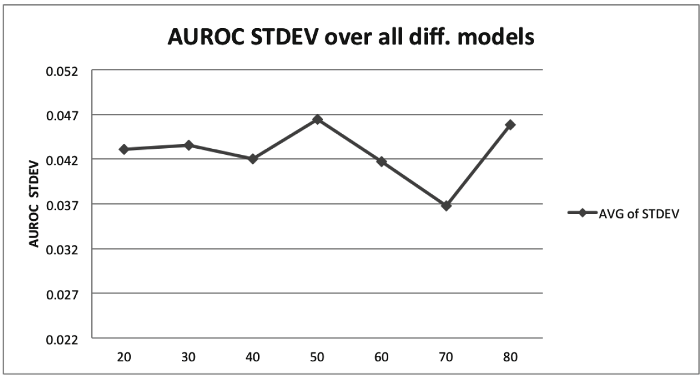 Fig 1: The AUROC remains high and the standard deviation remains low across varied training set sizes, proving the model's reliability.
Critical Analysis & Future Outlook
ChoiceGAPs represent a bridge between Symbolic AI (logic programs) and Social Dynamics.
Strengths
- Theoretical Grounding: It provides a concrete link between logical entailment and game-theoretic Nash equilibria.
- Flexibility: It can express almost any diffusion model (Cascade, Tipping, etc.) just by changing the GAP rules.
Limitations
- Interaction Complexity: While VIC2 is fast, it limits certain types of "back-and-forth" influences between conflicting choices.
- Static Attributes: The current model treats the network structure as static during the diffusion process, whereas real networks evolve.
Conclusion
As we move into an era of increasingly polarized social media, ChoiceGAPs provide a scalable way to understand how competing ideas reach a "truce." It’s an essential read for anyone moving beyond simple "viral" models toward a more nuanced, competitive view of human behavior.