
Predicting Developer Choices: How Machine Learning Can Build Better OSS Teams
Choose a Job You Love: Predicting Choices of GitHub Developers
The paper introduces a link prediction framework for GitHub, aiming to predict which developers will join which projects. Using a Random Forest classifier trained on the GHTorrent dataset, the authors achieve a peak precision of 0.888 for established users and 0.729 for "cold start" scenarios involving new contributors.
TL;DR
Joining an Open Source Software (OSS) project is a high-commitment decision. This paper tackles the challenge of predicting these "links" on GitHub using a Supervised Learning approach. By analyzing over 60,000 users and 9,000 projects, the researchers developed a model capable of predicting project joins with up to 88.8% precision, providing a foundation for automated, high-quality project recommendations.
Background: The Social Network of Code
GitHub is more than a code host; it is a dynamic bipartite network where nodes are Developers and Repositories. Predicting links in this environment is crucial for project management—imagine being able to invite the perfect contributor to your project before they even find it. However, the "Cold Start" problem (new users with no history) and the "Long Tail" (millions of tiny projects) make this a non-trivial task.
The Core Drivers: Why Do Developers Join?
The authors analyzed the data through the lens of Link Prediction. They identified two primary competitive forces:
- Preferential Attachment: The "Rich get Richer." Popular projects (high R_degree) attract more people simply because they are visible and established.
- Assortative Mixing (Skill Alignment): Developers gravitate toward projects that match their existing "tech stack" (programming language similarity).
Methodology: Feature Engineering & Random Forests
The researchers extracted 50+ features from the GHTorrent dataset. These were categorized into:
- Developer Features: Gender, followers, account age, and past activity levels.
- Repository Features: Number of stars, forks, commits, and existing member count.
- Relational Features: Programming language similarity (Jaccard index) and the "Co-worker" effect (do my friends work there?).
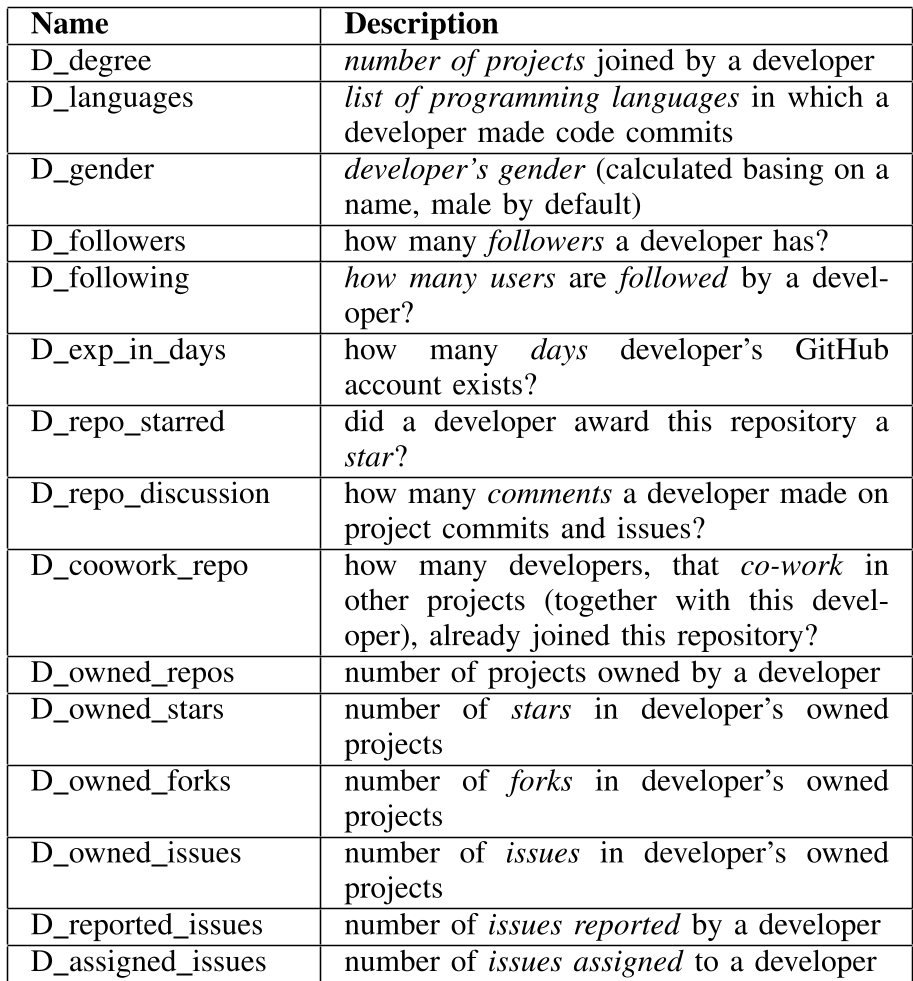 Key developer-side features used in the classification model.
The engine behind the prediction is a Random Forest classifier (50 trees). This model is robust against the non-linear relationships often found in social data.
Experimental Results: High Precision in a Noisy World
The results prove that developer behavior is surprisingly predictable:
- Best Case (All Features): 0.888 Precision.
- Cold Start (New Users): 0.729 Precision using only language similarity and project popularity.
Interestingly, the most powerful predictors were D_degree (how many projects a user is already in) and R_degree (how many members a project has). This confirms that active developers are likely to stay active, and popular projects act as "magnets."
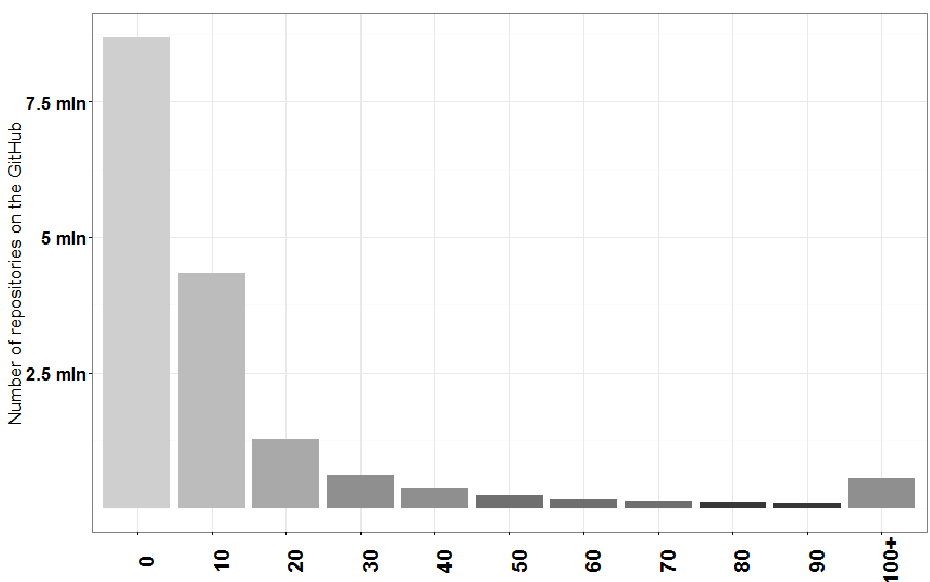 A plot showing the average number of new joins over a project's lifecycle, highlighting initial formation and eventual maturity peaks.
Critical Insight: The "Rich Get Richer" Risk
While the model is technically successful, the authors raise an important philosophical point for the OSS ecosystem. If recommendation systems primarily rely on project popularity (R_degree), they might exacerbate the "Long Tail" problem. New, innovative projects might struggle to get noticed if the algorithms keep funneling talent into "The Big Five" repositories.
Conclusion
This work demonstrates that technical skill alignment (Languages) and social signals (Followers/Friends) are sufficient to build a professional-grade recommendation tool for GitHub. For the future, the authors suggest integrating external data—like Stack Overflow reputation or social media sentiment—to refine these predictions even further.
Key Takeaway: If you want your project to grow, focus on "onboarding" signals: make your language requirements clear and leverage the social networks of your existing members.