
Beyond Fixed T-Norms: Optimizing Linguistic Connectors in Fuzzy Logic Systems
On Choosing Models for Linguistic Connector Words for Mamdani Fuzzy Logic Systems
This paper investigates ten linguistic connector models (including compensatory and, S-OWA) within Mamdani Fuzzy Logic Systems (FLS). It identifies (Product Multiplicative Compensatory And) as the only viable model for nonsingleton FLS that maintains computational separability and differentiability.
TL;DR
In fuzzy logic, the word "AND" is usually locked into a rigid mathematical t-norm (like Product or Minimum). This paper breaks that rigidity by analyzing ten "Compensatory" models that bridge the gap between "AND" and "OR". The authors prove that for complex Nonsingleton FLS, only the Product Multiplicative Compensatory And () is mathematically viable for high-performance engineering tasks.
The Problem: The Rigidity of "AND"
In natural language, the way humans aggregate information isn't always a strict intersection () or a strict union (). There is a "compensatory" nature where a high value in one variable can partially offset a low value in another.
Existing Fuzzy Logic Systems (FLS) struggle with this because:
- Fixed Bounds: Standard t-norms and t-conorms cannot reach the "middle ground" of human reasoning.
- Computational Complexity: Most compensatory operators couple input variables, making the calculation of the "firing degree" (the strength of a rule's activation) an -dimensional optimization nightmare.
- Non-Differentiability: Many models lack the smooth gradients needed for modern back-propagation tuning.
Methodology: The "Usability" Filter
The authors define a Usable model as one that satisfies two strict criteria:
- Separability: The firing degree must be computable as a product of individual input dimensions. This allows parallel processing and avoids the "curse of dimensionality."
- Design Utility: The model must have a closed-form, piecewise-differentiable derivative for parameter tuning.
The Core Insight
By analyzing the Log-likelihood of the connector functions, the authors proved a fundamental theorem: If an operator involves addition (like S-OWA or Additive Compensatory And), it destroys separability in nonsingleton systems.
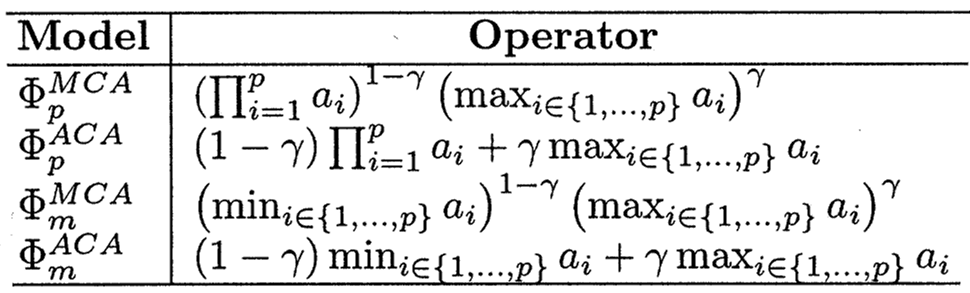 The table above lists the models tested. Only (the first row) survived the transition to nonsingleton systems.
The Winner:
The Product Multiplicative Compensatory And () is defined as: where is the product t-norm and is the maximum.
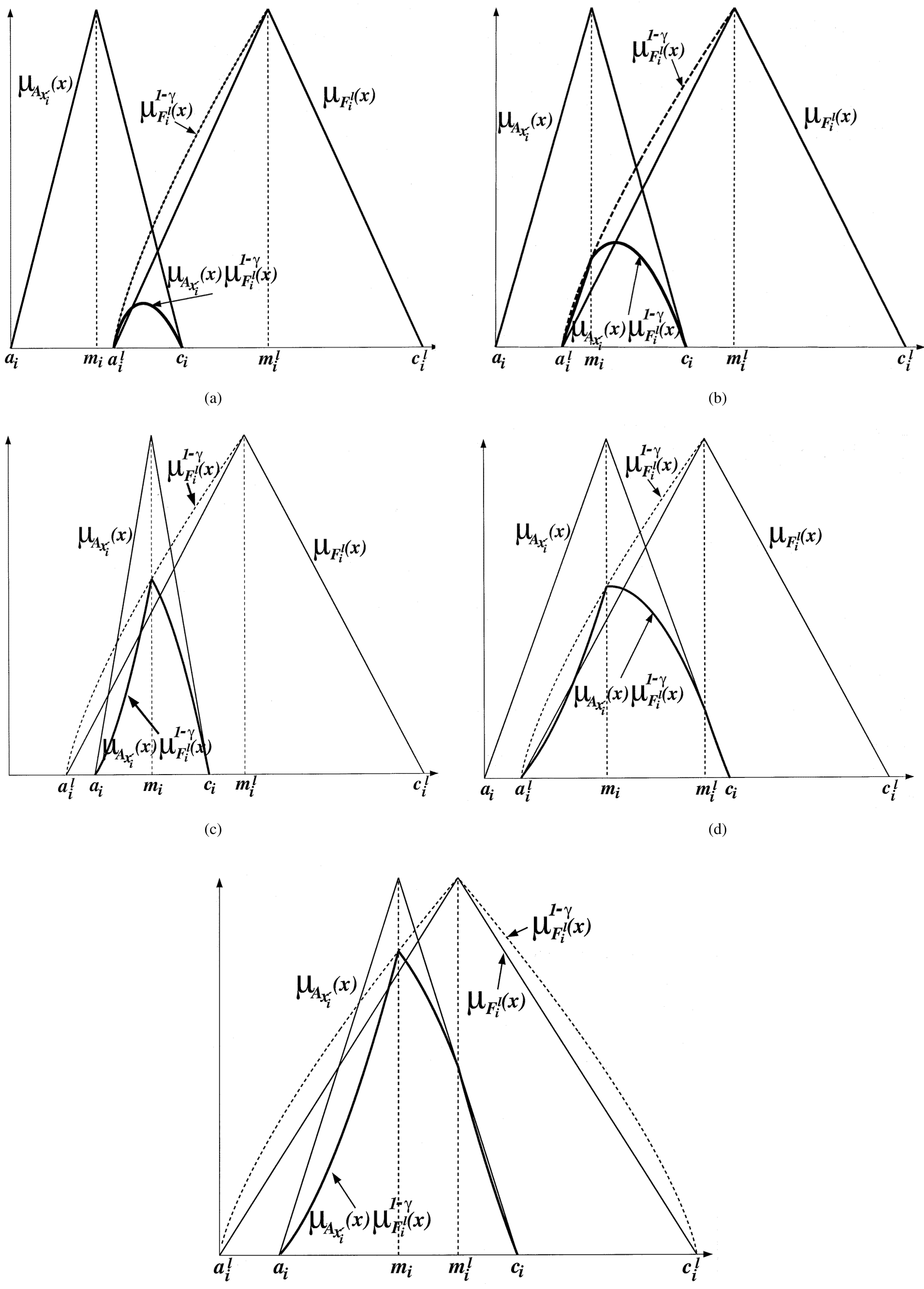
Why does it work? Because the product structure allows the exponentiation to distribute across variables, keeping the equations for each input independent. This allows for a unique "novelty" in FLS: the measurement itself determines which Membership Function (MF) is prioritized for each antecedent.
Experimental Results: Chaotic Time-Series Prediction
The authors tested their usable model on the Mackey-Glass time-series, a benchmark for chaotic systems, under noisy conditions (SNR 0dB to 5dB).
 The results demonstrate that FLS using (solid lines) consistently achieve lower Mean Squared Error (MSE) than traditional systems (dashed lines) across multiple training epochs.
Key Findings:
- New Degree of Freedom: The parameter allows the model to "learn" how much compensation is needed for a specific dataset.
- Robustness: The proposed model showed lower standard deviation in errors, meaning it is more stable in noisy environments.
Critical Analysis & Conclusion
Takeaway
The research successfully narrows down the myriad of theoretical fuzzy operators to a single, engineering-ready model () that works for nonsingleton inputs. This is a vital step for moving Fuzzy Logic from "heuristic" rules to "learnable" architectures.
Limitations
- Computational Overhead: While "usable," still significantly increases the math required per iteration compared to a simple product t-norm.
- Selective Improvement: The performance boost, while statistically significant, is described by the authors themselves as "modest."
Future Outlook
The next frontier is extending this "linguistic connector" logic to Type-2 Fuzzy Sets, where both the membership values and the connectors themselves are uncertain. This would lead to a "Fully Uncertain FLS" that could theoretically handle the highest levels of linguistic vagueness.