
Choosing the Right Crowd: Expert Finding via Social Behavioral Traces
Choosing the Right Crowd: Expert Finding in Social Networks
The paper introduces a multi-platform framework for expert discovery in social networks. By integrating data from Facebook, Twitter, and LinkedIn, it utilizes a vector space model that combines traditional text analysis with semantic entity recognition (using Wikipedia cross-linking) to rank users based on their likelihood of satisfying specific expertise needs.
TL;DR
When you need an expert, looking at their LinkedIn bio is rarely enough. This paper presents a sophisticated framework that mines personal "behavioral traces" across Facebook, Twitter, and LinkedIn. By analyzing not just what people say, but the entities they interact with and the people they follow, the system outperforms traditional profile-matching benchmarks by a significant margin.
Background & Motivation
The rise of "crowd-searching" has shifted the focus from anonymous platforms like Amazon Mechanical Turk to trusted social circles. However, finding the right person in a network of hundreds of contacts is a needle-in-a-haystack problem.
The authors identify a major bottleneck in existing Expert Finding (EF) systems: The Profile Sparsity Problem. Most users do not update their skills list regularly. To solve this, the researchers propose shifting from a "Who they say they are" model (Profile-based) to a "What they do" model (Activity-based).
Methodology: Beyond the Profile
The core innovation lies in the Social Resource Meta-Model, which categorizes expertise evidence by "distance" from the user:
- Distance 0: Static User Profiles.
- Distance 1: Direct actions (tweets, posts, followed accounts).
- Distance 2: Indirect influence (content from followed users or posts within "liked" groups).
The Semantic Pipeline
The system doesn't just look for keywords. It processes resources through a multi-stage pipeline:
- Enrichment: Extracting content from URLs shared in posts.
- Semantic Annotation: Using entity recognition to link text to Wikipedia URIs (e.g., recognizing "Phelps" as the entity "Athlete" in "Swimming").
- Hybrid Ranking: A scoring function that balances raw text frequency () with entity disambiguation confidence scores.
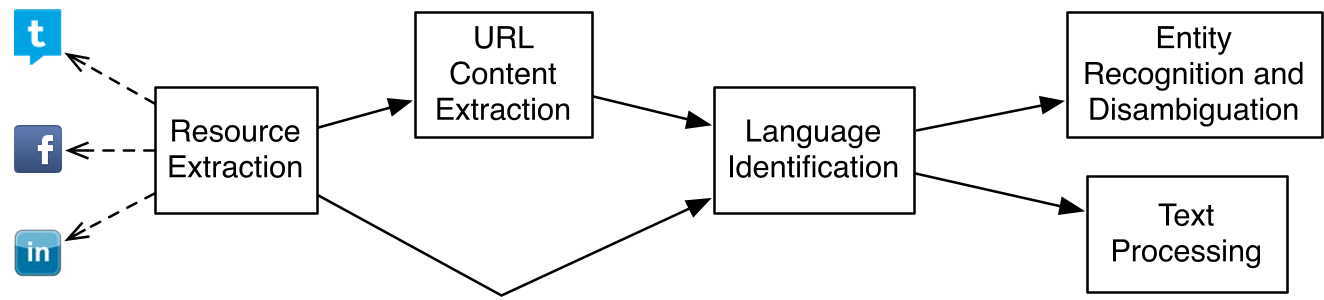 Figure 1: The analysis flow from raw social data to semantic entity extraction.
Experimental Insights: Twitter vs. The Rest
The team conducted a study with 40 active users across 30 query domains (from PHP functions to Michael Jackson songs).
Key Findings:
- The Profile Failure: Distance 0 (Profiles only) actually performed worse than random selection in many cases.
- The Power of Distance 2: Adding "followed users" and group content (Distance 2) provided a massive boost in Precision and Mean Reciprocal Rank (MRR).
- Platform Specialization:
- Twitter is the "King of Expertise" for Science and Tech.
- Facebook is superior for local knowledge (restaurants) and pop culture.
- LinkedIn is surprisingly weak for general EF, likely due to lower user interaction frequency compared to "leisure" networks.
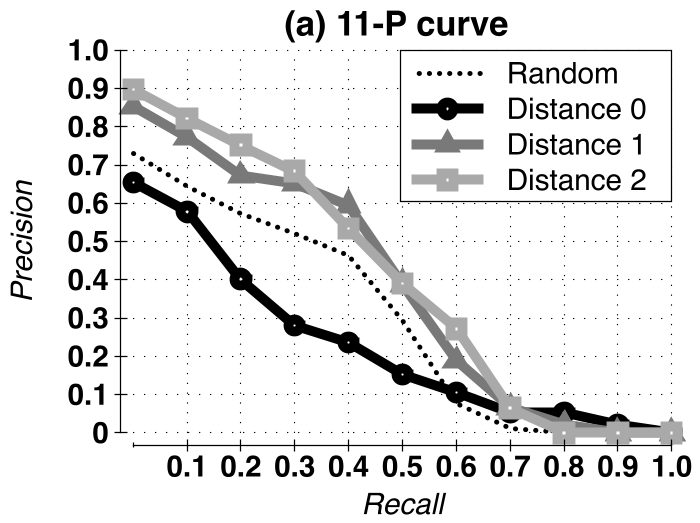 Figure 2: Precision-Recall curves showing that combined social data (Distance 1 & 2) significantly outperforms the baseline.
Critical Analysis & The "Hidden Expert"
The study highlights a fascinating correlation: The more you post, the more the system "knows" you are an expert. As shown in Figure 10 of the paper, there is a direct regression between resource count and F1-score.
However, this reveals a potential bias: "Loud" users might be ranked higher than quiet but more knowledgeable experts who rarely post. This "Privacy vs. Utility" trade-off remains a challenge for future iterations of social search engines.
Conclusion
This work marks a transition from "People Search" to "Expertise Mining." By demonstrating that our social graph and behavioral trail are better indicators of knowledge than a CV, the authors provide a roadmap for more intelligent, context-aware crowdsourcing and recommendation engines.
Takeaway for Devs: If you're building a recommendation or Q&A system, stop indexing profiles and start indexing activity streams.
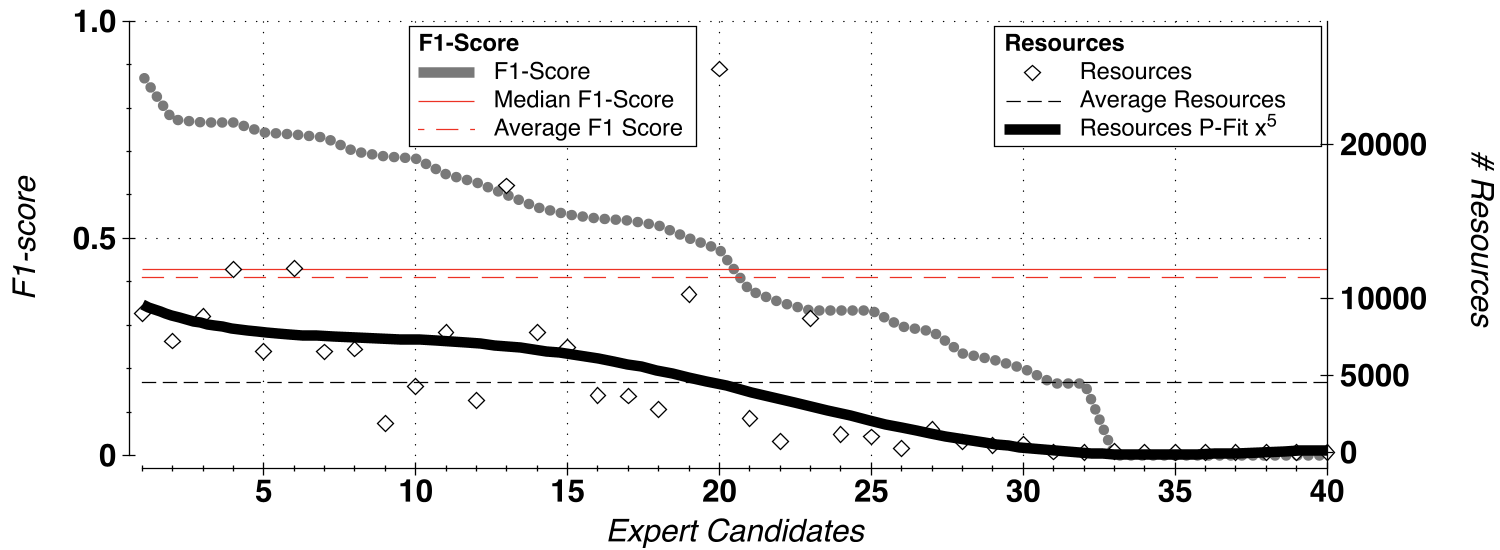 Figure 3: Correlation between the volume of social resources and the accuracy of expertise assessment.