
Choosing Which Message to Publish: A Contextual Bandit Approach to Social Media Diffusion
1163_Choosing which message to publish on social networks a contextual bandit approach.
This paper introduces a contextual bandit-based model to automate content selection for social network accounts, aiming to maximize message spread (retweets). By utilizing the Thompson Sampling algorithm, the system learns to select the most "retweetable" message from a candidate set based on message content and structural features.
Executive Summary
TL;DR: This paper tackles the "Publisher's Dilemma"—choosing the single most impactful piece of content from a pool of candidates to maximize audience engagement (retweets). The authors formalize this as a Contextual Multi-Armed Bandit problem, using Thompson Sampling to balance the exploration of new content types with the exploitation of known viral trends. By combining simple structural features (hashtags, length) with content analysis and Prior Knowledge transfer, the model significantly outperforms traditional heuristics.
Positioning: This work is a foundational application of online reinforcement learning to the sender's side of social media. While most research focuses on the receiver (recommender systems), this paper provides a framework for publishers to adaptively optimize their broadcast strategy in real-time.
Problem & Motivation: The Publisher's Dilemma
Social media accounts, from the New York Times to independent bloggers, operate in an environment of "information entropy." Publishing too much leads to audience fatigue; publishing the wrong content leads to irrelevance.
The Pain Points:
- Dynamic Preferences: Audience interests shift rapidly; what went viral yesterday might be ignored today.
- Offline Limitations: Traditional collaborative filtering requires massive historical data and offline retraining, making it too slow for the "real-time" nature of Twitter or Facebook.
- Cold-Start Bias: New accounts have no data on what their specific audience likes, making initial content strategy a guessing game.
The authors' Insight is that every "publication event" is a trial. By viewing the selection process as a bandit problem, the system can treat every retweet as a reward signal to refine its internal model of "what works" for a specific audience.
Methodology: Putting the Bandit to Work
The core of the system is the Thompson Sampling algorithm adapted for contextual data.
1. The Arm Selection Process
At each time step , the publisher has candidate messages. Each message is transformed into a feature vector :
- Content Features: Term frequencies (Normalized histograms).
- Structure Features: Discrete counts of hashtags, @-mentions, and binned message length (tiny to very large).
- Combined (C+S): The concatenation of both.
2. The Learning Mechanism
The model maintains a weight vector following a Gaussian distribution .
- Sample: It draws a possible from the current distribution.
- Act: It selects the message that maximizes the inner product .
- Learn: It observes the reward (actual retweets) and updates the mean and variance using a perceptron-like update rule.
 Figure 1: The conceptual framework where the publisher chooses the most impactful message based on context and feedback.
3. Solving Cold-Start with Prior Knowledge
To prevent the model from being "clueless" initially, the authors suggest a Prior Knowledge setting. They pre-train a global linear regressor on a massive multi-account dataset. When a new account starts, it inherits these weights as its starting point (), effectively "transferring" general social media wisdom before personalizing it to a specific follower base.
Experiments & Results
The authors tested their approach on a dataset of 2,748 Twitter accounts with over 1.2 million messages.
Key Observations:
- Structure vs. Content: Interestingly, structural features (hashtags/length) often outperform pure content features early on because they are lower-dimensional and easier to learn.
- The Power of Priors: Integration of prior knowledge (C+S CB Prior) showed a massive jump in performance, virtually doubling the reward in the 10-arm selection task compared to starting from scratch.
- Adaptability: Unlike "Naive" strategies (like always picking messages with the most hashtags), the bandit model eventually learns when hashtags don't matter for a specific account, allowing it to pivot.
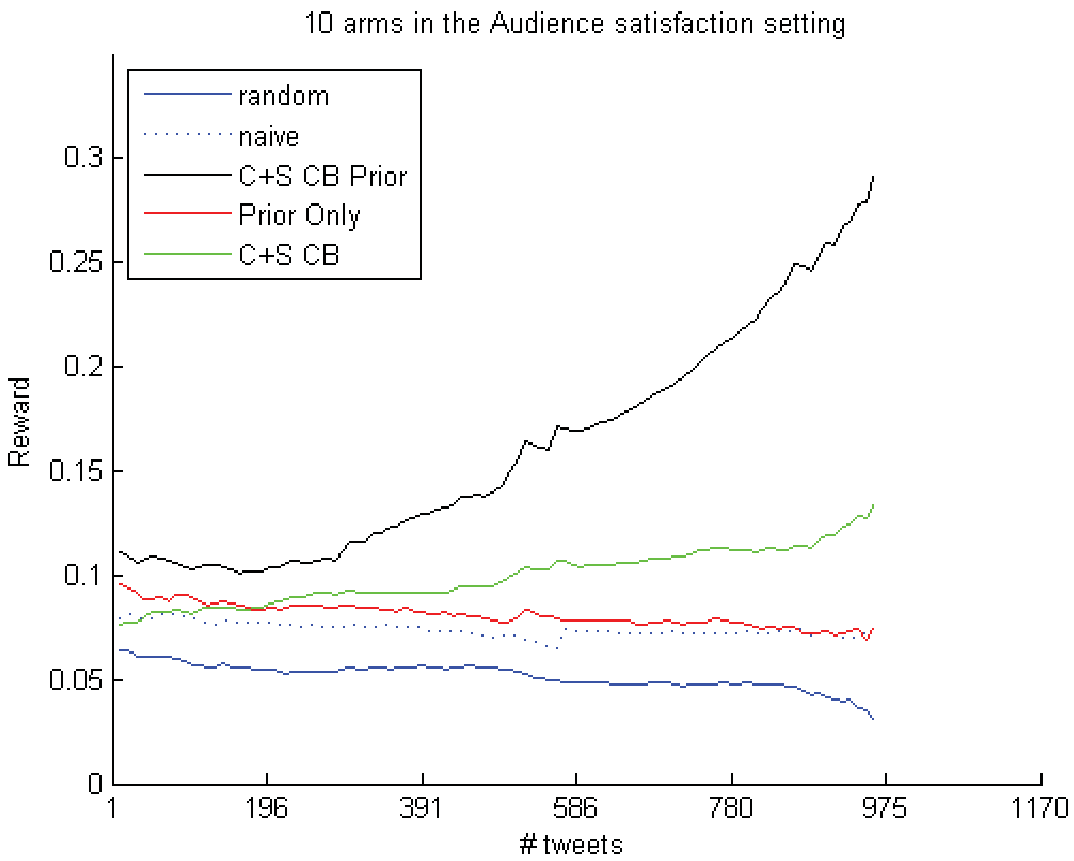 Figure 2: Performance comparison in the Cold-start setting. Note how the C+S model (blue line) gains momentum as it accumulates more published tweets.
Critical Analysis & Conclusion
Summary: The paper successfully demonstrates that content selection is not just an editorial art but an optimization problem solvable via contextual bandits. The ability to "warm-start" a bandit with global data is particularly relevant for industrial applications where "time-to-value" for a new user is critical.
Limitations:
- Feature Complexity: The term-histogram approach for content is quite basic by modern standards (pre-dating Word2Vec and Transformers).
- Engagement Proxy: Retweets are used as the sole reward, but "audience satisfaction" might be more complex, involving sentiment or long-term follower retention.
Future Outlook: The transition from choosing messages to generating them (via LLMs) using RLHF (Reinforcement Learning from Human Feedback) is the natural evolution of this work. This paper laid the groundwork for the automated, feedback-driven content pipelines we see in modern digital marketing.