
Inside the Digital Sanctuaries: How Crohn’s Patients Shape Medical Intelligence
Inside chronic autoimmune disease communities: A social networks perspective to Crohn's patient behavior and medical information
This study presents a social network analysis of Crohn's Disease (CD) patients on Facebook and Twitter, identifying behavioral patterns and medical information trends. Using sentiment analysis and Granger causality, the researchers pinpointed Infliximab as the primary treatment influencing community mood.
TL;DR
This research investigates the online behavior of Crohn's Disease (CD) patients, analyzing over 70,000 posts across Facebook and Twitter. It identifies a clear divide between Facebook’s patient support role and Twitter’s information-sharing nature. Most importantly, it utilizes advanced statistical methods to prove that discussions surrounding the drug Infliximab are primary drivers of community sentiment, offering a new lens for "online-centered" healthcare design.
The "Copilot" Crisis in Chronic Care
Chronic disease management is often compared to a pilot flying a plane with only a few hours of "copilot" (doctor) assistance per year. In the digital age, patients have found a "myriad of copilots" online. However, the medical community has long been skeptical of this digital noise, fearing inaccurate advice. This paper argues that instead of dismissing online chatter, we must mine it as a "health heritage" to understand the collective experience of living with chronic autoimmune conditions.
Methodology: Mapping the Ecosystem
The researchers categorized data into four pillars: Causes, Symptoms, Treatments, and Side Effects. By building specialized dictionaries, they could filter the massive stream of data from Facebook (where patients share deep personal experiences) and Twitter (where scientific articles and slogans prevail).
Architecture of Sentiment Tracking
The core of the study lies in its use of Subjectivity Analysis. By identifying "speech events" and "sentiment expressions," the authors mapped how the mention of a specific medication (like Prednisone or Humira) correlates with the user's emotional state over time.
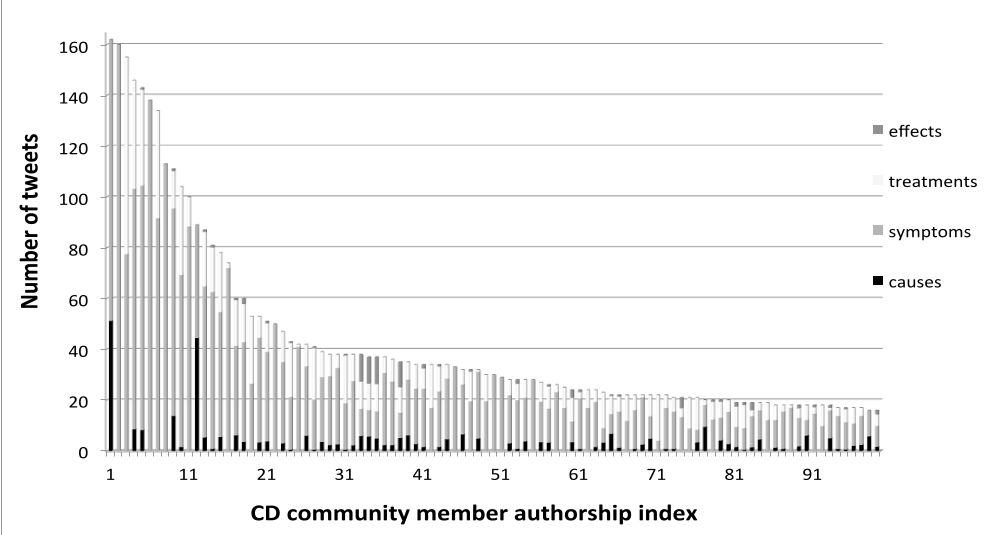 Figure 1: Comparison of topic distribution, highlighting the heavy focus on symptoms and treatments within the Facebook community.
Why Infliximab Matters: Proving Causality
The most striking technical contribution is the application of Granger Causality. Many papers show correlation (e.g., "people who talk about pain seem sad"), but this study sought causality: Does participating in a discussion about a specific drug predict a future change in a patient's mood?
Using the Toda-Yamamoto method to handle non-stationary signals, the authors discovered that while many drugs are discussed, only Infliximab reached statistical significance. This suggests that Infliximab acts as a "sentinel" topic—when it appears, the community's collective psychological needle moves.
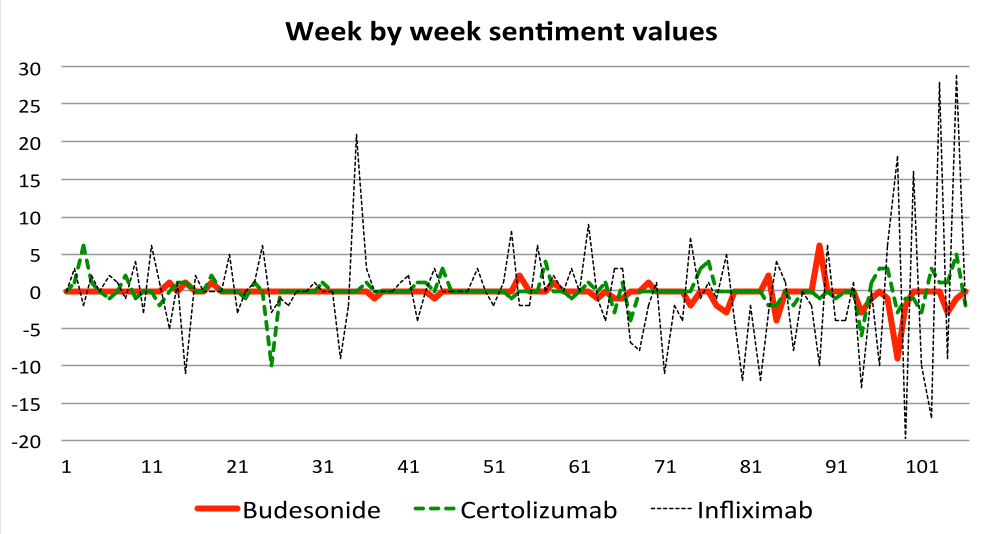 Figure 2: Sentiment evolution for Budesonide, Certolizumab, and Infliximab, showing the late-stage positive surge for Infliximab.
Deep Insight & Conclusion
Key Takeaways
- Platform Divergence: Patients use Facebook for peer-to-peer survival strategies and emotional venting, while Twitter serves as a news aggregator.
- Medical Insight: Infliximab is not just a biological treatment; it is a social phenomenon within the CD community that dictates mood swings and engagement levels.
- The Shift: Healthcare must pivot from treating individuals in isolation to monitoring "community sentiment" to catch early signs of treatment dissatisfaction or psychological distress.
Limitations & Future Work
The study relies on English-speaking populations and publicly available pages, which may introduce a selection bias. Future research could integrate State Space Models (SSM) or Large Language Models (LLMs) to capture even subtler nuances in patient sincerity and medical accuracy, ultimately bridging the gap between the "pilot" and the "digital copilot."
Summary Citation: Roccetti, M., Casari, A., & Marfia, G. (2015). Inside Chronic Autoimmune Disease Communities. ASONAM '15.