
Beyond the Exit Button: Decoding User Churn in Social Networks
Churn in Social Networks: A Discussion Boards Case Study
This paper explores "churn" in social networks, specifically discussion boards, departing from traditional binary (leave/stay) definitions. It introduces a flexible, activity-based churn metric and demonstrates how network effects and social roles influence user attrition using data from boards.ie.
TL;DR
Unlike Telecom customers who "cancel" a service, social media users rarely leave officially—they simply fade away. This paper redefines Churn as a significant drop in activity rather than a binary exit. By analyzing discussion board data (boards.ie), the authors demonstrate that churn is "contagious" and varies significantly depending on a user's Social Role.
Background: The Shift from Contracts to Social Capital
In the "Old Economy" (Telecom, Banking), churn is simple: a customer stops paying. In the "Gift Economy" of online forums, the loss is not just revenue, but Social Capital. When a "Popular Initiator" leaves, the community's health declines. The challenge is that there are no switching costs; a user can be active, then dormant, then return.
Motivation: Why Activity Trumps Status
The authors argue that the binary "active vs. inactive" status is too blunt for social networks. They introduce the concept of Partial Defection, where a user’s engagement drops below a critical threshold.
- Intrinsic Features: Service quality, UI/UX (Well-studied).
- Extrinsic Features: Social influence, peer behavior, and community sentiment (The focus of this work).
Methodology: The Sliding Window Definition
The core contribution is a robust mathematical definition of churn based on activity windows.
The Formula
A user has churned if: Where:
- : Average activity in the Previous Activity window ( weeks).
- : Average activity in the Churn window ( weeks).
- : A threshold factor (e.g., 0.2 for an 80% drop).
Visualizing Churn Types
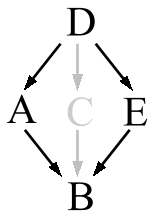
By varying the window sizes ( and ), the authors identify a "hierarchy" of churn:
- Typical Churn: Long-term high activity followed by long-term low activity.
- Holiday Churn: Short 2-4 week drops (likely vacations) mistaken for churn in short windows.
- Bursty Behaviour: Short spikes of activity that make subsequent "normal" behavior look like churn.
Experiments: The Contagion of Leaving
Does your friend's inactivity make you less active? Yes.
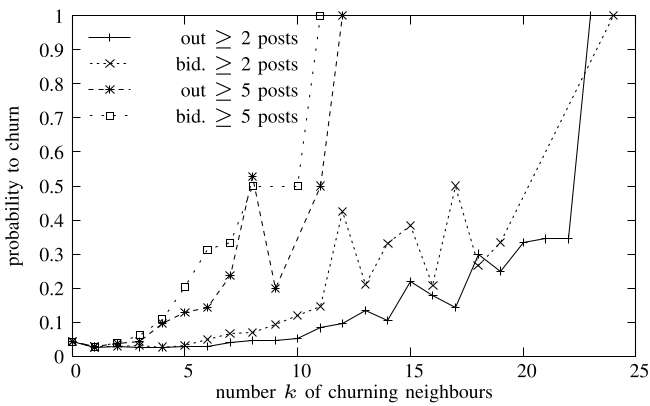
The authors mapped the "Reply-to" network and found a direct correlation between the number of "Churned Neighbors" () and an individual's probability of churning.
Key Insights from the Graphs:
- Network Effects: The probability of churning increases as increases.
- Weight Matters: Influence is stronger between users who interact frequently (edges with posts).
- Social Roles: Not all users are equal. An "Elitist" or "Popular Initiator" churning has a far greater "ripple effect" than a "Grunt" or "Taciturn" user.
Critical Analysis & Conclusion
Takeaway
The paper successfully shifts the churn paradigm from Revenue Loss to Activity Decay. It proves that in social environments, churn is a collective phenomenon driven by diffusion.
Limitations
- Data Aging: The study uses 2006 data. Modern platforms (TikTok, X/Twitter) have much higher "noise" settings and algorithmic feeds that might alter these diffusion patterns.
- Sentiment Blindness: The model treats all interactions equally. A "reply" could be a toxic argument, which might actually increase churn in a different way than simple inactivity.
Future Work
The authors propose a hybrid approach: combining Feature-based AI (predicting who is likely to leave) with Diffusion Models (predicting when the community will collapse). For community managers, this means targeting "Influence Leaders" for retention, rather than just any churning user.