
CINEMA: Bridging Social Psychology and Greedy Optimization for Influence Maximization
CINEMA: Conformity-Aware Greedy Algorithm for Influence Maximization in Online Social Networks
This paper introduces CINEMA (Conformity-aware INfluEnce MAximization), a novel greedy algorithm for identifying top-K influential seed nodes in social networks. It utilizes a new Conformity-aware Cascade () model that incorporates both an individual's influence and their neighbor's inclination to be influenced (conformity) to achieve state-of-the-art influence spread quality.
Executive Summary
TL;DR: CINEMA is a high-performance greedy algorithm that redefines the Influence Maximization (IM) problem by introducing a "conformity-aware" perspective. By combining a novel cascade model with a network-partitioning architecture, it achieves superior seed quality and scalability compared to traditional models like IC or LT.
Background Positioning: This work bridges the gap between social psychology and discrete optimization. It moves beyond the "influence-only" paradigm and provides a scalable, partitioning-based framework that makes rigorous greedy algorithms viable for networks with millions of nodes—a space previously dominated by faster but less reliable heuristics.
The Missing Variable: Why Conformity Matters
Most IM research focuses on a node's "power" to influence. However, as social psychologists like Solomon Asch famously demonstrated, influence is a two-way street. A "powerful" influencer (e.g., a celebrity) might fail to move an audience with low conformity (the inclination to adapt to others' beliefs).
The paper identifies two critical pain points in SOTA work:
- Conformity-Obliviousness: Existing models ignore the target's predisposition, leading to seeds that look good on paper but fail in real-world scenarios.
- The Scalability Wall: Standard greedy approaches (like CELF or MixGreedy) suffer from the "curse of global updates," where every seed selection requires reconsidering the entire network's marginal gains.
Methodology: The Model and Partitioned Optimization
1. The Conformity-Aware Cascade () Model
The authors redefine propagation probability. In the model, the probability of node influencing node is proportional to the product of 's influence and 's conformity : This ensures that influence only flows easily when the source is powerful and the target is receptive.
2. The MAG-list Architecture
To solve the scalability issue, CINEMA partitions the graph into subnetworks .
- -sublists: Each subnetwork maintains its own sorted list of nodes based on local marginal gains.
- MAG-list: A global list containing only the "best" node from each subnetwork.
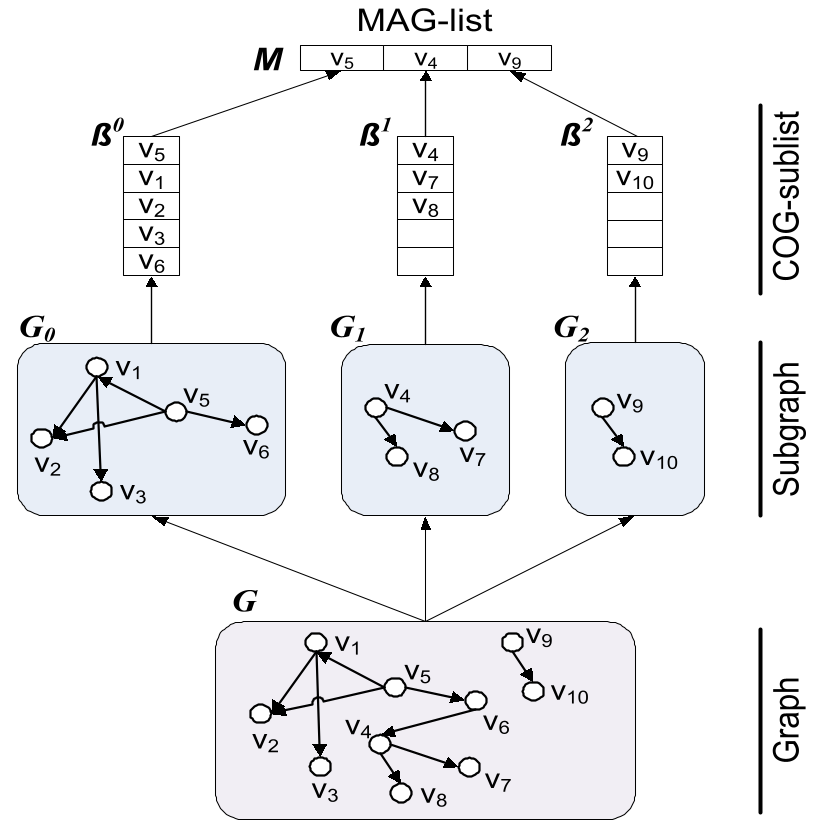 Figure: The hierarchical relationship between the global MAG-list and local component gain sublists.
By selecting seeds through this hierarchy, CINEMA limits property updates to the specific subnetwork where a node was chosen, fundamentally reducing the computational complexity from to , where is the size of the largest partition.
Experiments & Results
The authors validated CINEMA on academic collaboration networks (Phy, Hep) and the massive Wiki-talk dataset.
Performance Gains
CINEMA-c² consistently generated 30-60% better influence spread than traditional heuristics. Even when compared to heavy-duty greedy algorithms like MixGreedy, CINEMA maintained a quality lead by leveraging the more realistic propagation model.
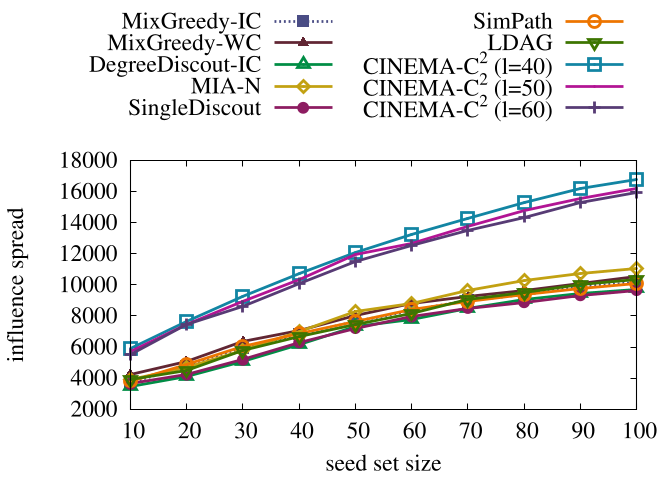 Figure: Influence spread of CINEMA compared to various baselines. Note the significant gap over heuristic-based methods (LDAG, SimPath).
Efficiency and Scaling
While the "On-demand Update" strategy ensures that marginal gains are only recalculated when a node is a candidate for the seed set, the partitioning strategy allows the algorithm to handle the Wiki-talk network (2.3M nodes, 5M edges) efficiently. The study shows that as the number of partitions () increases, the execution time decreases significantly without a drastic loss in seed quality.
Critical Analysis & Conclusion
Takeaway
The core contribution of CINEMA is the realization that locality matters. Social influence is often a community-level phenomenon. By partitioning the network, we don't just gain speed; we align the algorithm with the natural "cluster-like" structure of human organizations.
Limitations
- Edge Cuts: Partitioning inevitably removes cross-component edges. While the authors argue these are "weak ties" in many cases, in extremely dense networks, this could lead to an underestimation of global influence.
- Data Requirement: Calculating and indices requires sentiment-aware edges (positive/negative), which may not be present in all raw social datasets.
Future Outlook
CINEMA’s architecture is "embarrassingly parallel." The move to a distributed platform (e.g., Spark/GraphX) where each subnetwork is handled by a different worker node is the natural next step, potentially allowing for IM on billion-node graphs in near real-time.