
Architect or Mechanic? Unpacking the Antecedents of CIO Effectiveness
13025_The antecedents of CIO role effectiveness in Organizations An empirical study in the healthcare sector.
This empirical study explores the multidimensional roles of Chief Information Officers (CIOs) in the healthcare sector and identifies the antecedents of their role effectiveness. It defines six salient CIO roles—Business Strategist, Integrator, Relationship Architect, Utility Provider, Information Steward, and Educator—and demonstrates that CIO capabilities are the primary drivers of effectiveness in strategic dimensions.
Executive Summary
TL;DR: In the high-stakes environment of healthcare, a CIO's success isn't just about keeping the servers running—it's about mastering six distinct "hats." This study proves that while "engagement" with the C-suite is necessary, it is the CIO's personal capabilities (political savvy, business knowledge, and communication) that translate that engagement into true strategic impact.
Placement in the Field: This is a seminal empirical study that moves the conversation from normative prescriptions ("CIOs should be strategic") to evidence-based validation of what actually makes them effective in the eyes of their peers.
The Problem: The "Prescription" vs. "Reality" Gap
For decades, management gurus have told CIOs to become "business partners." Yet, many CIOs remain trapped in a "Utility Provider" silo. Previous research failed to provide a rigorous metric for CIO Role Effectiveness or explain why some CIOs failed despite having a direct reporting line to the CEO. This study tackles the "Why" and "How" of executive perception.
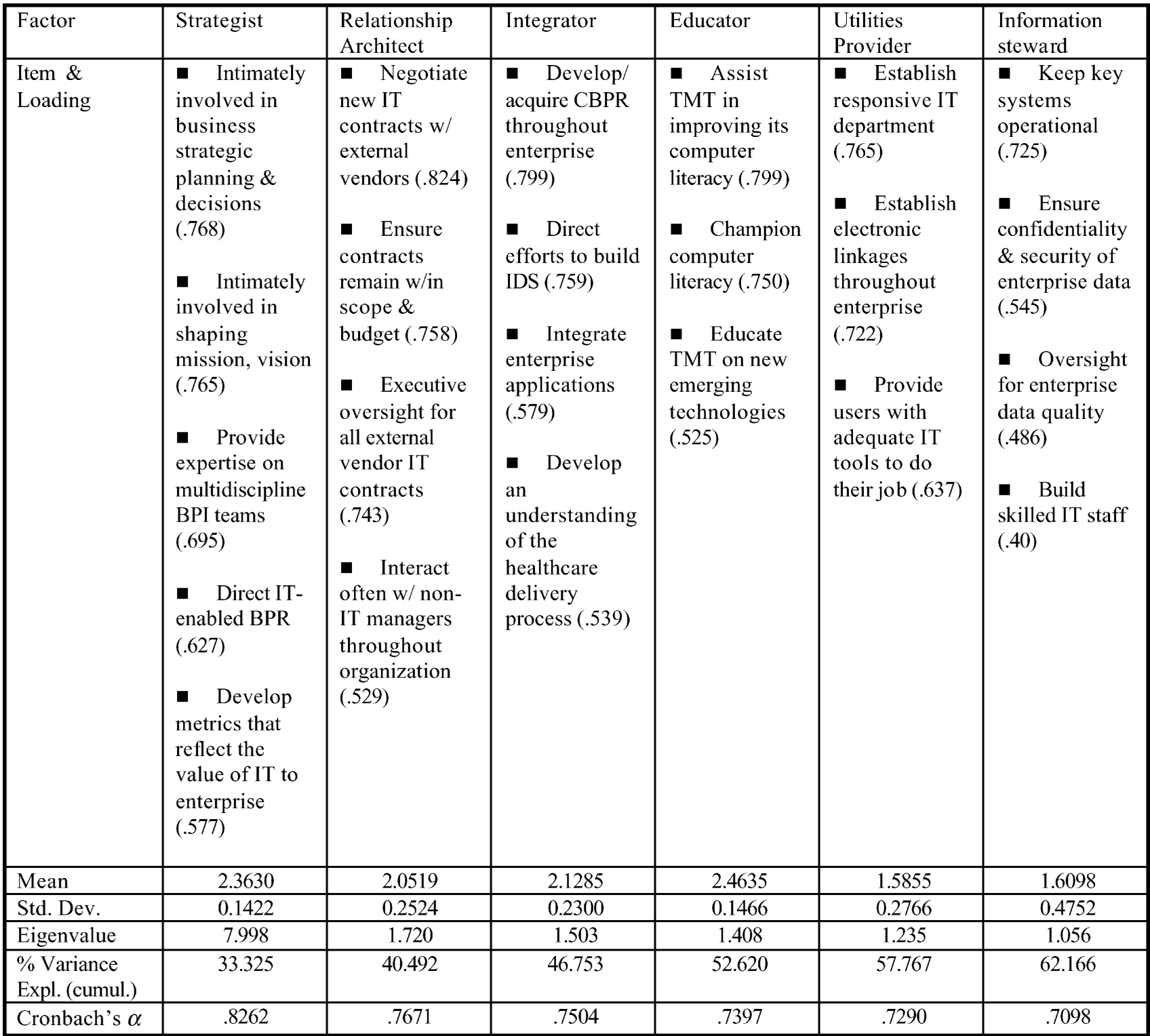
Methodology: Mapping the Six Faces of the CIO
The researchers moved beyond simple checklists. by surveying both CIOs and TMT members, they identified a six-dimensional structure of the CIO role:
- Strategist: The innovation catalyst.
- Relationship Architect: The internal and external bridge-builder.
- Integrator: The leader of enterprise-wide process flows.
- Educator: The missionary for IT literacy in the C-suite.
- Utility Provider: The guardian of the responsive IT department.
- Information Steward: The protector of data quality and security.
The Conceptual Model
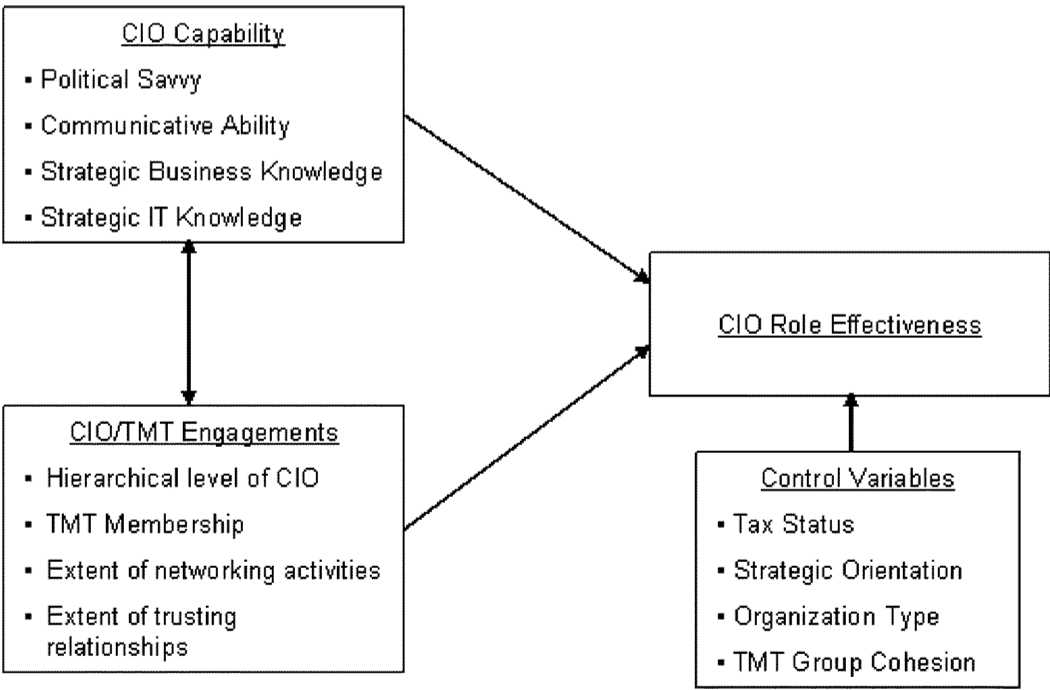
The authors hypothesized that CIO Capabilities and TMT Engagements would be the twin engines of effectiveness.
Core Insight: Capabilities as the Great Mediator
The most striking finding of the paper is the mediation effect. Many believe that if a CIO reports to the CEO or joins the TMT, they will automatically become more effective. The data says otherwise.
- The Engagement Paradox: High frequency of interaction and formal membership (Engagement) did not directly correlate with effectiveness scores.
- The "Secret Sauce": Engagement only works if it builds the CIO’s Capability. Interacting with the TMT allows a CIO to gain "Political Savvy" and "Strategic Business Knowledge." It is these skills that then drive effectiveness in the Strategist and Integrator roles.
Performance on Salient Roles
The study highlights that "Strategic" roles require a different set of muscles than "Utility" roles.
Deep Dive: Why "Political Savvy" Matters
The researchers found that Political Savvy (the ability to read situations and act with tact) and Communicative Ability (using "English" instead of "Technobabble") were critical. In healthcare, where physician autonomy often cluthes with enterprise integration, a CIO who cannot navigate political minefields will fail as an "Integrator," no matter how good their technical architecture is.
Critical Analysis & Conclusion
Takeaways
- For the CIO: Stop worrying about who you report to and start worrying about your "seat at the table." Use that seat to learn the business language and build trust.
- For the CEO: Providing a CIO with TMT membership is a development tool. It’s an opportunity for them to build the business acumen they need to eventually lead strategic change.
Limitations & Future Work
The study focused on the Healthcare Sector, which is uniquely fragmented. Whether these same six roles hold true in a more centralized industry like Finance remains to be seen. Furthermore, the "Utility Provider" and "Steward" roles were less influenced by the measured capabilities—suggesting that "Supply-side" excellence might rely on operational management skills not captured by the "Upper Echelon" focus of this study.
Final Thought: The CIO is no longer a technician in a suit; they are a "Relationship Architect." The future of the role belongs to those who can transition from managing machines to managing meanings.