
CIorg: Engineering Collective Intelligence for the Professional Enterprise
CIorg: Collective Intelligence In Organizations Tools and Studies
This paper outlines the "CIorg" workshop at ACM Group 2010, focusing on Collective Intelligence (CI) within organizations. It explores how Web 2.0 paradigms—like wikis, social bookmarking, and tagging—can be transitioned from consumer platforms to structured enterprise environments to enhance decision-making and knowledge reuse.
TL;DR
Collective Intelligence (CI) is no longer just for Wikipedia or Reddit. The "CIorg" framework investigates how the "wisdom of crowds" can be systematically engineered within the rigid, high-stakes environments of modern corporations. By moving beyond voluntary consumer-web behaviors, this paper explores the tools and social engineering required to turn individual worker outputs into shared organizational capital.
The Challenge: Why Organizations Aren't the "Public Web"
The paradox of CI in organizations lies in the structure. On the public web, content emerges "naturally" from massive populations of hobbyists. In a corporation, however:
- Mandatory Tools: Workers don't choose their stack; tasks are assigned, not sought.
- High Accountability: Contributions are monitored, evaluated, and tied to job security.
- Different Goals: While consumer CI values "fun" and "social benefit," enterprise CI must demonstrate ROI, productivity, and security.
Historically, groupware often failed because it added "work to be done" without immediate benefit to the worker. CIorg aims to fix this by capturing the by-products of work.
Methodology: The Core of Organizational CI
The authors identify two primary engines for CI in the workplace:
1. Task Forces (Short-term CI)
These are temporary, ad-hoc units assembled for specific projects. The goal here is Expertise Location—finding the right person for the right job at the right time. CI tools help visualize current activities and bridge silos across departments.
2. Communities of Practice (Long-term CI)
Persistent social designs focused on professional development. Tools like wikis and social bookmarking (e.g., IBM’s Dogear) allow workers to leave "breadcrumbs" of their research, which eventually coalesce into a searchable, intelligent organizational memory.
 Note: The workshop brought together researchers from PARC, IBM, and Xerox to define these cross-organizational collaboration patterns.
Key Tools and Experimental Evidence
The paper highlights several successful "CI-native" enterprise tools:
- Dogear: Redirects personal bookmarking into a shared social resource.
- Social Blue/Beehive: An enterprise-grade "Facebook" designed to build social capital rather than just kill time.
- Mail2Tag: A lightweight way to turn emails into annotated, searchable community resources.
Accepted Workshop Contributions
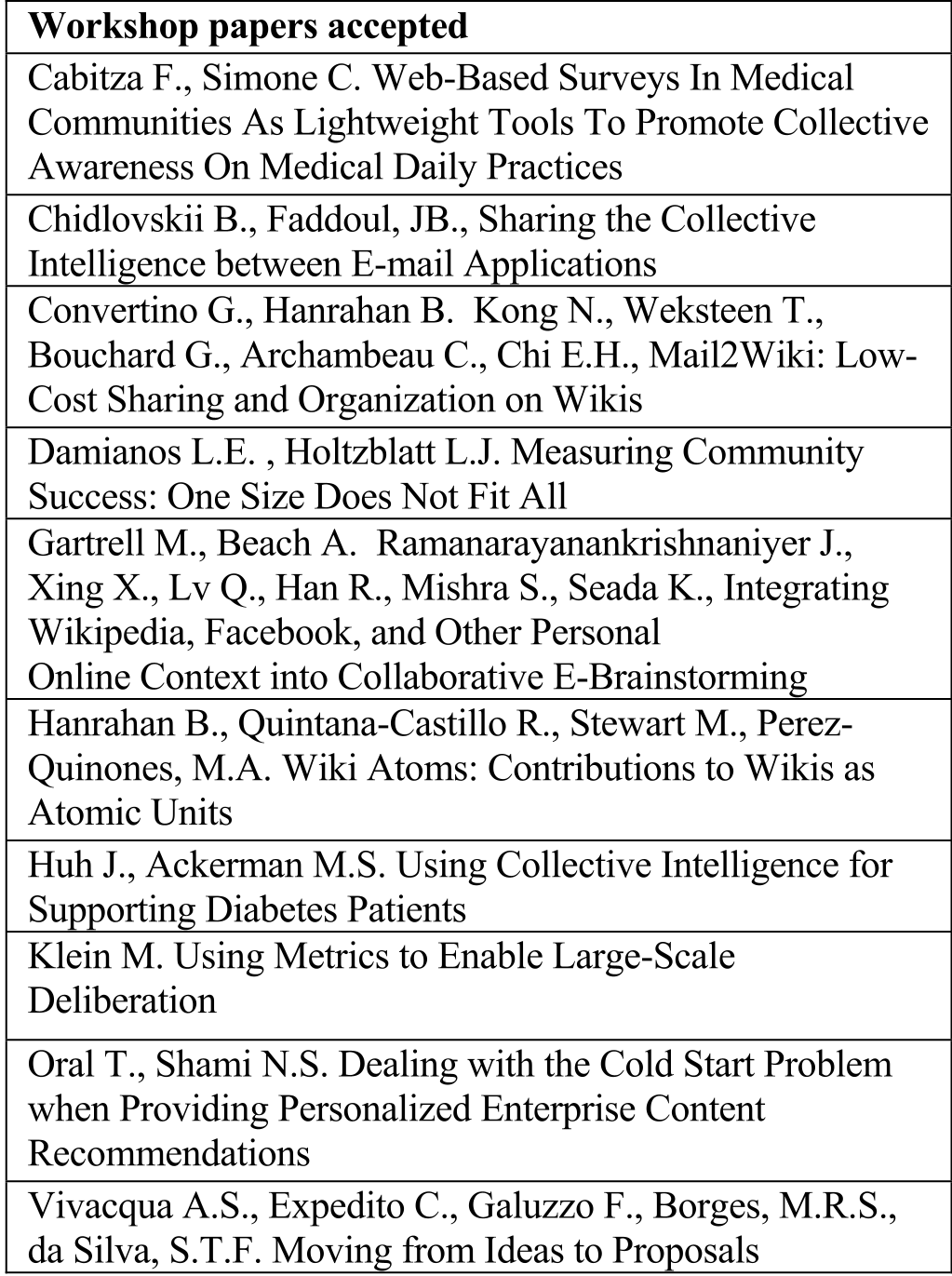
The workshop reviewed various case studies, ranging from medical communities to e-brainstorming. The table below illustrates the breadth of CI applications:
Deep Insight: "Designed-In" Intelligence
The critical takeaway is that organizational CI cannot be accidental. It must be "designed-in" by considering:
- Traceability: Who said what? Trust is built on attribution.
- Domain Modeling: Systems must understand the specific context (e.g., medical vs. engineering) to make sense of shared data.
- Incentive Alignment: The tool must provide immediate value to the individual while building the collective.
Critical Analysis & Conclusion
While the 2010 perspective focused heavily on Web 2.0, the core principles—Task Force coordination and Knowledge Capitalization—are the direct ancestors of today’s AI-powered knowledge graphs and Slack-based collaborations.
Limitations: The paper reflects an era before widespread remote work and LLMs. The "noise" in modern digital workplaces is now a greater threat than the "lack of participation" described here.
Future Outlook: The next generation of CIorg will likely focus on Human-AI Collective Intelligence, where digital agents synthesize the millions of "breadcrumbs" left by knowledge workers to suggest real-time organizational strategies.