
Harmonizing Space and Society: Solving the Circle of Friend Query in Geo-Social Networks
Circle of Friend Query in Geo-Social Networks
This paper introduces the Circle of Friend Query (CoFQ) for Geo-Social Networks (GSNs), a novel query type that identifies a group of friends who are both socially close and geographically clustered. The authors propose an ε-approximate algorithm to solve this NP-hard problem, achieving high-quality results with polynomial time complexity.
TL;DR
Planning a group outing is a multi-dimensional optimization problem: you want people who actually like each other and live close enough to meet up. This paper formalizes this as the Circle of Friend Query (CoFQ). Since finding the optimal group is NP-hard, the authors deliver an ε-approximate algorithm that cuts through the exponential search space, providing near-optimal results (95%+ accuracy) in polynomial time.
Context: The Gap Between Virtual and Physical Links
As Location-Based Services (LBS) like Foursquare and Facebook Check-ins matured, a gap emerged. We had social graphs (who knows whom) and spatial data (who is where), but we lacked an efficient way to query cohesive groups.
Previous works focused on "group nearest neighbors" (finding a point close to everyone) or "keyword queries." This paper attacks a harder problem: finding a subgraph of nodes where the diameter—the distance between the two furthest members—is minimized across both social and geographic dimensions.
The Core Problem: Why it's NP-Hard
The researchers prove that finding the "Circle of Friends" is NP-hard by reducing it to the Max-Clique problem. Essentially, if you want a group where everyone is within a certain distance of everyone else, you are searching for a complete subgraph in a potential sea of candidates. In large-scale social networks with tens of thousands of nodes, a brute-force search is impossible once the group size exceeds 7.
Methodology: Pruning the Search Space
To make this query feasible, the paper introduces a unified distance metric:
1. Tight Bounds
The algorithm doesn't search the whole graph. It uses the -Nearest Neighbors (NN) of the query point to establish an Upper Bound () and Lower Bound (). Any node further than from is immediately pruned.
2. The -Approximate Binary Search
Instead of calculating every combination, the algorithm performs a binary search on the diameter value. It asks: "Is there a group with diameter ?"
- It uses a Stack-based approach to build candidate groups.
- If adding a person makes the group diameter exceed , that branch is pruned.
- The search continues until the gap between the upper and lower bounds is less than .
 Figure 1: Illustration of the pruning mechanism and search space limitation.
3. "Useful Space" Optimization
The authors noticed that as the binary search tightens , large portions of the distance matrix become irrelevant. By only computing the "useful space" (the sub-matrix of nodes within the current diameter bound), they significantly reduce CPU and memory overhead.
Experimental Insights
Testing on a Foursquare dataset (20k+ nodes, 580k edges), the results were striking:
- Scalability: While the baseline (brute force) hits an "exponential wall" at , the optimized -approximate algorithm handles larger with linear-to-polynomial growth in CPU time.
- Precision vs. Speed: By tuning , users can trade a tiny bit of accuracy for massive speed gains. At an approximate ratio of 0.3, the system achieved 100% correct answers.
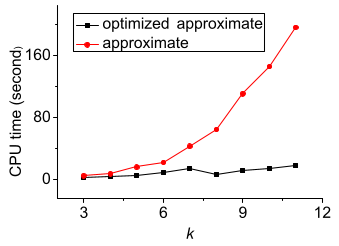 Figure 2: Runtime comparison between Baseline and Approximate algorithms as group size increases.
Critical Perspective
The weight is the "hero" of this approach—it allows the query to adapt. Setting high prioritizes geographic proximity (good for quick sports games), while low prioritizes social bonds (good for intimate weddings).
Limitations: The current model assumes static locations. In a real-world mobile environment, users move. The authors acknowledge this, suggesting that future work should incorporate trajectories rather than single GPS points. Furthermore, the NN-based pruning assumes that the optimal group will be relatively near the query point, which might not hold in highly fragmented social graphs.
Conclusion
This paper bridges the gap between graph theory and spatial databases. By transforming an NP-hard problem into a bounded approximation task, it enables GSNs to provide "smart" group recommendations that respect both our social circles and our physical constraints.