
Visualizing Privacy: Bridging the Gap Between Math and Social Intuition in OSNs
Circles, posts and privacy in egocentric social networks: An exploratory visualization approach
This paper introduces an exploratory visualization tool for managing social privacy in Egocentric Social Networks (EOSN). It utilizes a hierarchical modularity-based community discovery algorithm (H-MOD) to automatically generate and visualize "friend circles," allowing users to make fine-grained visibility decisions for their online posts.
TL;DR
Managing who sees your posts in Online Social Networks (OSNs) is a cognitive nightmare. This paper presents an exploratory tool that uses Hierarchical Modularity (H-MOD) to group friends into interactive circles. By allowing users to "zoom" into their social structures, the tool makes setting post visibility faster and more accurate than traditional list-based methods like Facebook Smart Lists.
Context Management and the Discrepancy Problem
In social science, the "Context Collapse" occurs when different social spheres (work, family, friends) collide on a single platform. While OSNs like Facebook provide grouping tools, they are often too tedious for manual use.
The authors identify a critical Discrepancy: Community discovery algorithms group people based on link density or shared attributes, but human social circles are subjective and usage-dependent. A "work friend" might stay in the "friend" circle for a dinner party post but move to a "professional" circle for a technical update.
Methodology: High-Speed Clustering meets Interactive Design
1. The Algorithm: From MOD to H-MOD
The authors compare a Generative Model for Friendships (GMF) with Newman’s Modularity-based (MOD) algorithm. While GMF is accurate, it is computationally heavy. MOD, however, is nearly instantaneous. The authors adapted MOD into H-MOD, a hierarchical version that recursively divides communities into sub-communities, mirroring the nested nature of human social groups.
2. The Visualization: The Canvas and the Handle
The UI design is centered on an "ego" (the user).
- The Canvas: Circles are positioned based on size, avoiding overlapping layouts common in standard graph visualizations.
- The Handle: A central dot in each circle acts as a "master switch," allowing users to toggle visibility for the entire group at once.
- Semantic Zooming: Users can zoom into a circle to trigger the H-MOD algorithm, breaking a large group into more specific sub-groups.
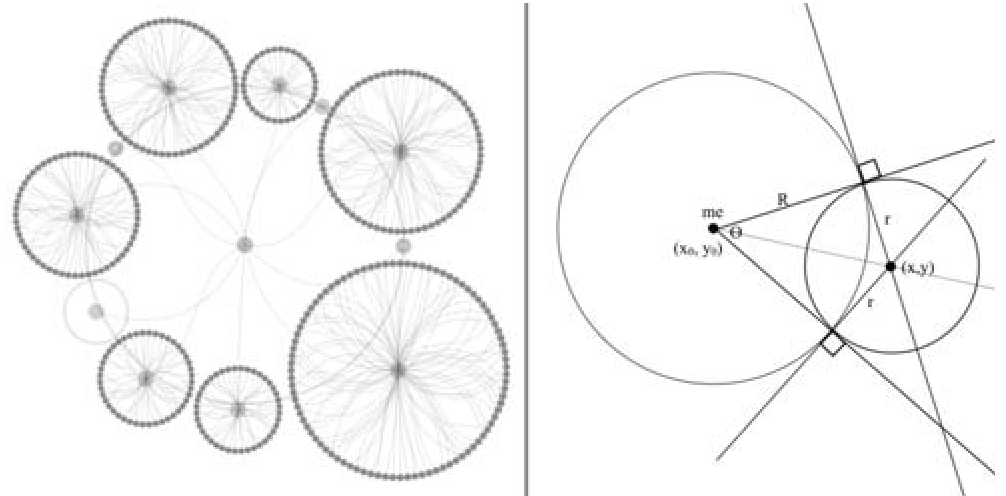 Figure: The overview of the circle layout (left) and the hierarchical exploration via zooming (right).
Experimental Results: Proving Effectiveness
The study compared this tool against Facebook Smart Lists. The researchers used two sophisticated metrics:
- Accordance: Measures how consistently members of a circle share the same visibility status.
- Entropy: Measures the information "cost" to determine visibility; lower entropy means the circles align better with the user's intent.
Performance in "Hard" Decisions
The tool's advantage became even more pronounced during "partial regrets"—tasks where users had to carefully filter who saw a sensitive post. When the task was difficult (defined by a higher value, meaning excluding/including more than just a few people), the H-MOD tool maintained high accordance while the baseline's performance dropped significantly.
 Figure: Comparison of Accordance and Entropy. Group A (H-MOD tool) consistently outperforms Group B (Smart Lists).
Critical Insight: Why This Matters
The core achievement here isn't just a better clustering algorithm; it's the shift toward Exploratory AI. Instead of the algorithm "telling" the user who their friends are, the tool provides a "good enough" starting point (modularity) and gives the user the interactive "lenses" (zooming/handles) to refine that structure according to the current post's context.
Limitations
- Identity Cues: Participants wanted photos instead of just name labels to recognize friends faster.
- Explainability: Users wanted to know why the algorithm put certain people together—suggesting a need for automated labeling (e.g., "These people all work at X").
Conclusion
This work highlights that social privacy is not a static set of lists, but a dynamic, hierarchical process. For future social platforms, the path to better privacy lies in Fine-Grained Control and Interactive Exploration, moving away from the static, "black-box" lists of today.