
+Your Circles: Moving Beyond "Friend" or "Not Friend" in Social Privacy
+Your Circles: Sharing Behavior on Google+
This study investigates user perceptions and sharing behaviors on Google+, specifically focusing on the "Circles" mechanism for group-based privacy. Through 27 qualitative interviews, the research explores how the first major social network with integrated, highly visible grouping tools impacts information flow and privacy management.
TL;DR
Google+ might be a relic of the past, but its core innovation—Circles—provided a landmark case study in usable privacy. This research reveals that while users loved the ability to group friends, they used it more to avoid being "annoying" (targeting content) than to hide secrets. However, even with great UI, the "mental tax" of sorting hundreds of people remains a massive barrier to true digital privacy.
The Problem: The "Oxygen" of Context Collapse
In the physical world, you don't talk to your grandmother the same way you talk to your college buddies at a bar. Online, however, social networks historically collapsed these boundaries into a binary "friend" relationship. This Context Collapse forces users into a defensive crouch: they self-censor, sharing only the "lowest common denominator" content that won't offend anyone.
The researchers point out that while Facebook had "Lists," only ~5% of users used them because they were buried in menus. Google+ changed the game by making grouping (Circles) the mandatory first step of the experience.
Methodology: Peering into the Circle
The authors interviewed 27 users across two phases (early adopters and mainstream users). They didn't just ask "Do you like it?"; they had users log in, walk through their last few posts, and explain exactly who they thought could see them.
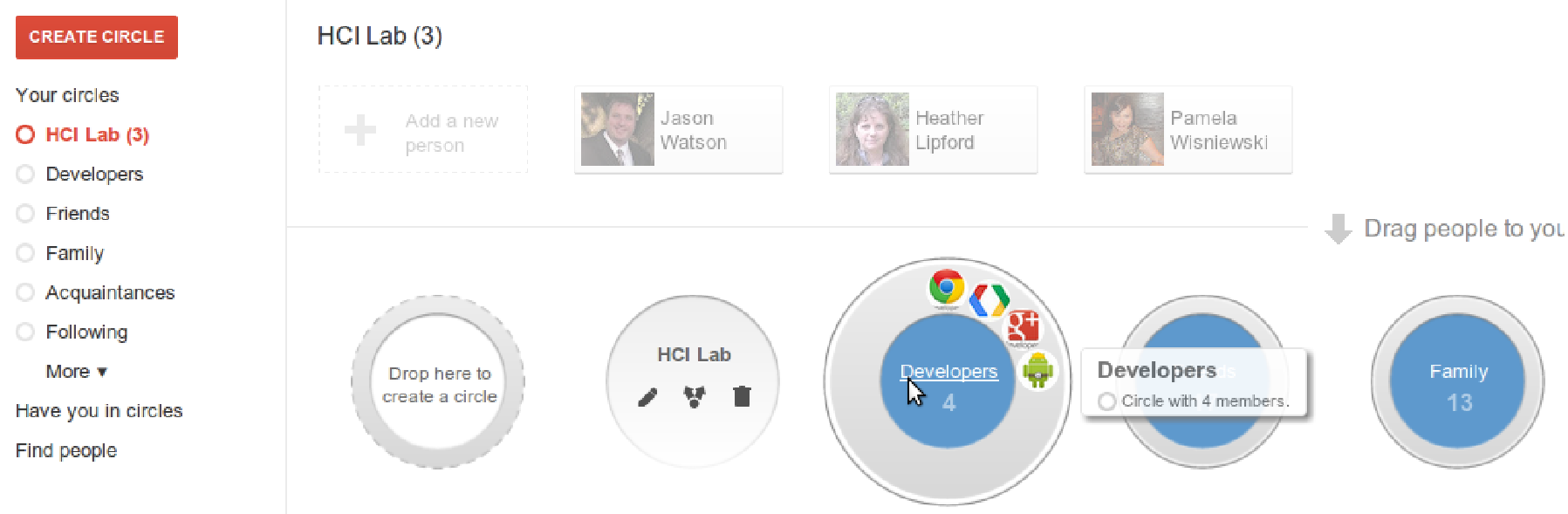 Figure 1: The drag-and-drop interface of Google+ Circles, designed to make friend grouping a primary interaction.
Key Insight: Relevance Over Privacy
The most striking finding was the shift from Privacy-seeking to Relevance-seeking.
- Privacy-seeking: "I don't want my boss to see my party photos."
- Relevance-seeking: "My high school friends don't care about my technical SEO tips; I'll only send this to my 'Tech' circle."
Participants reported using Circles to "filter the firehose." By directing posts to specific groups, they felt they were providing value rather than noise. This suggests that the incentive for using privacy tools might actually be social etiquette rather than a fear of data leaks.
The "Broken" Mental Model: Comments and Resharing
Even when users felt they had "locked down" a post to a specific Circle, the study found a dangerous gap in understanding.
- The Leakage: Most users did not realize that if they shared a post with a "Limited" circle, someone in that circle could reshare it or tag (+Name) someone else, potentially expanding the audience beyond the original creator's intent.
- The Findings: Over half of the participants had an incorrect mental model of who could see comments on their posts.
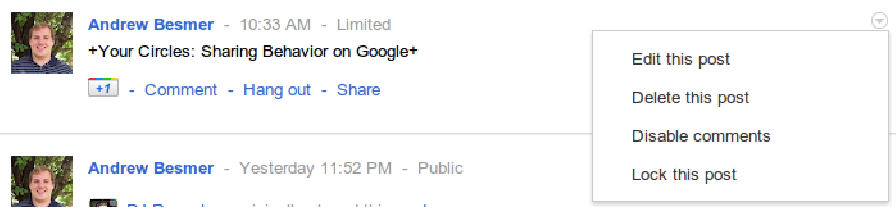 Figure 2: Fine-grained controls like "Disable reshare" existed but were largely ignored or unnoticed by users.
Conclusion: The Maintenance Tax
The study concludes with a sobering reality: Social entropy is real. Even with a beautiful "drag-and-drop" UI, users eventually found it exhausting to keep Circles updated as their lives changed. When the "mental effort" exceeded the perceived benefit, users reverted to "posting to everyone" or "self-censoring."
Takeaway for Designers: If you want users to manage privacy, you can't just give them a tool; you have to reduce the "maintenance tax." This paved the way for the automated, algorithmic grouping we see in today's social platforms.
Critical Analysis: This paper remains a cornerstone because it highlights that usability ≠ usage. Even a SOTA (at the time) privacy interface cannot overcome the inherent social complexity of human relationships unless there is a recursive, automated way to handle group evolution.