
Beyond the Journal: Mapping the Intellectual Fabric of the Information Society
A comparison of citation distributions of journals and books on the topic “information society”
This study presents a comparative bibliometric analysis of 84 seminal works in the "information society" field, evaluating their citation and co-citation distributions in both journals and books using Web of Science data (2005-2012). It identifies a high correlation between journal and book citations while revealing that co-citation density is significantly higher in books.
TL;DR
Is the "Information Society" just a buzzword, or a rigorous academic discipline? This study dives into the citation DNA of the field, comparing how 84 foundational texts—ranging from Marshall McLuhan’s era to modern internet theorists—are cited in journals versus books. It reveals that while journals are faster, books are the true connective tissue of social science, holding twice the "co-citation density" of journal articles.
The "Book Gap" in Academic Prestige
For decades, academic "impact" has been synonymous with the Journal Impact Factor. If you wrote a groundbreaking book in the 1980s, its influence was often invisible to the automated counting machines of the Science Citation Index.
The authors of this paper argue that this creates a fundamental "unfairness" in social sciences and humanities. By leverage the Book Citation Index (BKCI), they finally bridge the gap, proving that seminal works by thinkers like David Harvey or Jürgen Habermas exert a massive gravitational pull that journals alone cannot measure.
Methodology: Mapping Intellectual Space
The researchers didn't just count citations; they looked at Co-citations.
- The Logic: If a third author cites both Paper A and Paper B, those two papers likely share a conceptual bond.
- The Tool: Using UCINET and Multidimensional Scaling (MDS), they transformed 3,486 pairs of document relationships into a "Knowledge Map."
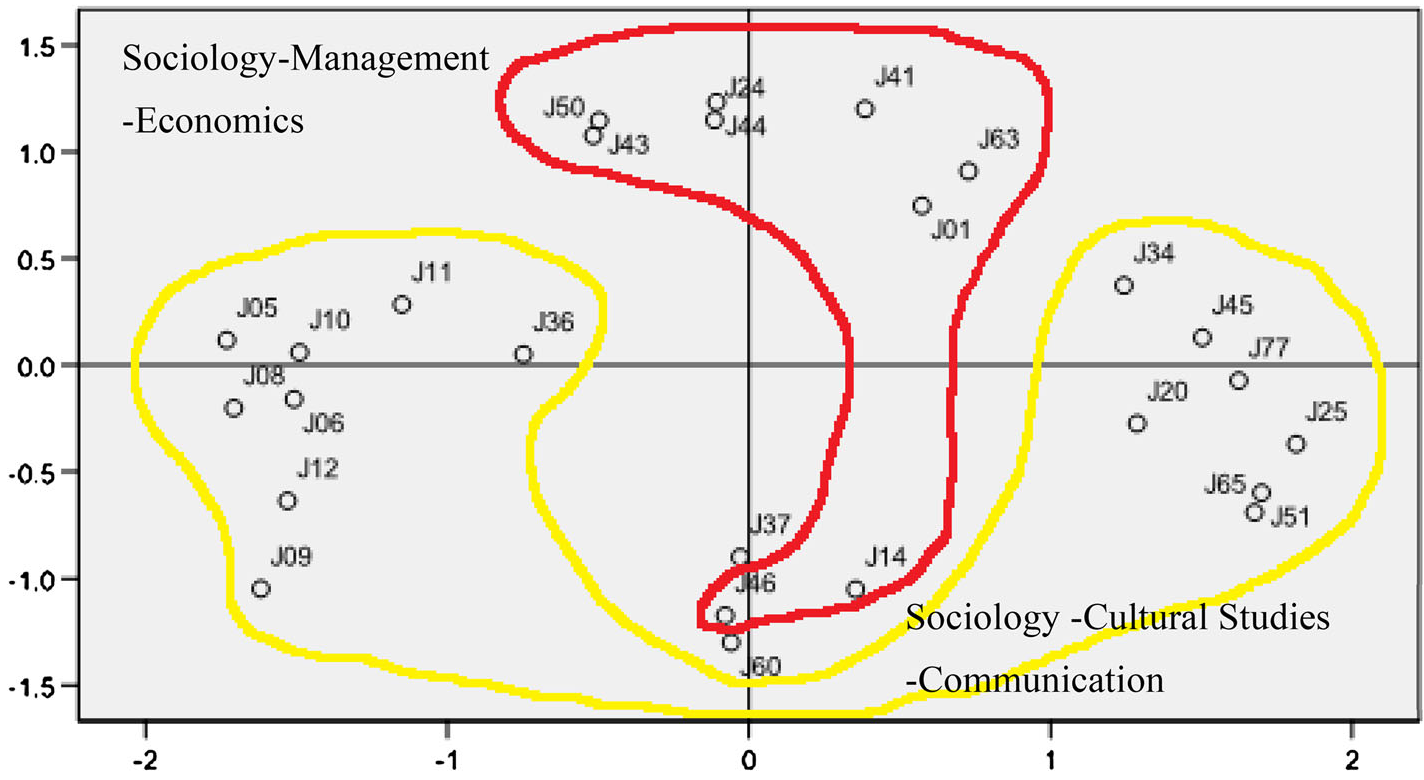 Figure 1: MDS Mapping showing the subject clusters in journal citations. Note the central "Sociology-Political Science-Economics" core.
Key Findings: Journals vs. Books
1. The High Correlation of "Greatness"
The study found an astonishing 0.99 Pearson correlation between book and journal citations. If a work is a "hit" in the journal world, it is almost certainly a "hit" in the book world. The "Big Three" of the Information Society field were identified as:
- David Harvey, The Condition of Postmodernity
- Jürgen Habermas, The Structural Transformation of the Public Sphere
- Jean-François Lyotard, The Postmodern Condition
2. Network Density: The "Deep Work" of Books
While journals had more total citations (9,450 vs. 5,073), books had significantly more co-citations (3,166 vs. 1,458).
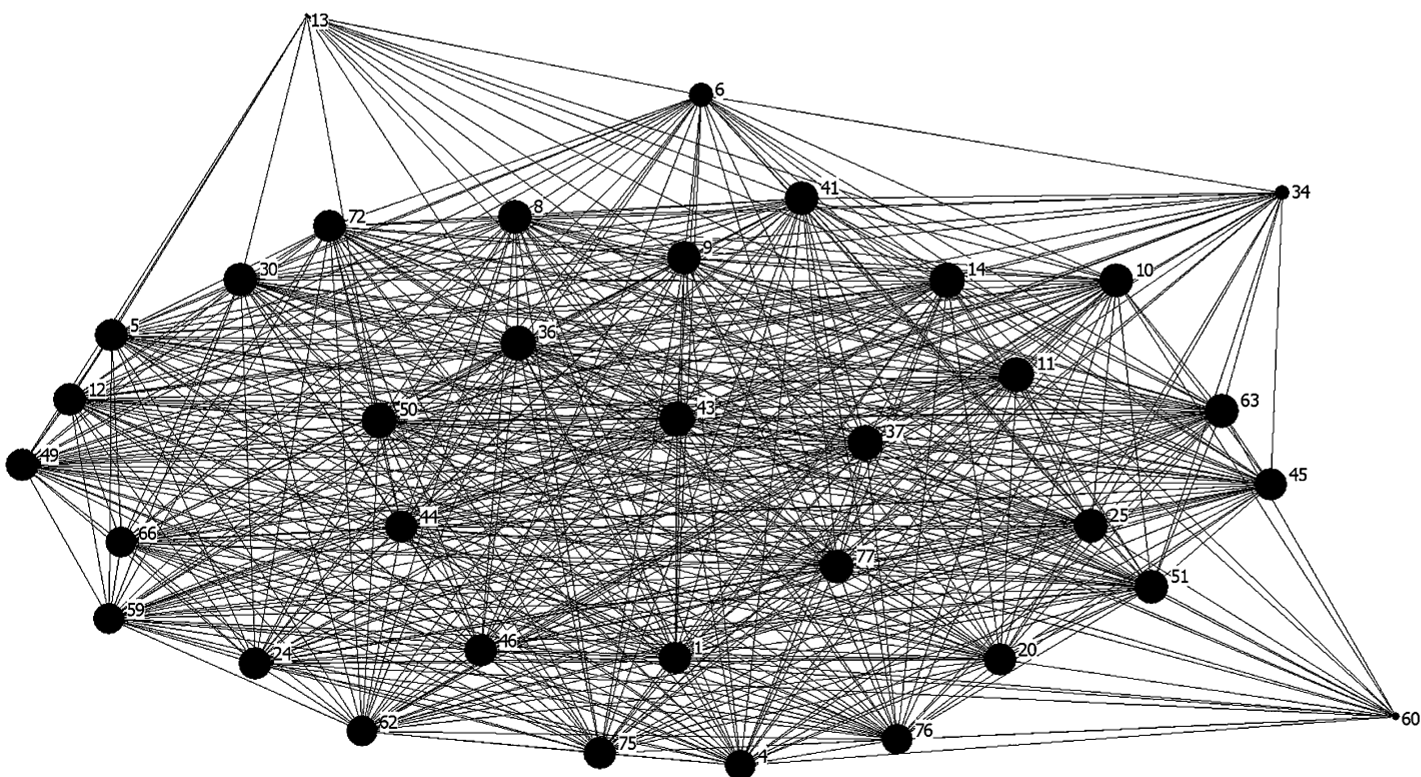 Figure 2: Social network visualization via UCINET. The book network (right) is visibly denser and more interconnected than the journal network (left).
This suggests a fundamental difference in "Scholarly Communication":
- Journals often cite a single core theory to solve a specific, narrow problem.
- Books synthesize multiple theories, creating a "tighter" and more complex subject relationship between core works.
3. Sociology as the "Mother Discipline"
Across both media, Sociology accounted for roughly 9% of all citations. However, journals showed a wider "spread" (160 subject categories) compared to books (120 categories). Interestingly, fields like Geography and Urban Studies were dominant in journal citations but less so in books, where History and Literary Theory took a stronger hold.
Critical Insight: Why This Matters
The "Information Society" is inherently multidisciplinary. It touches on economics, tech, culture, and politics. This paper proves that limiting research evaluation to journals provides a "flattened" view of academic influence.
If we only look at journals, we see the "speed" of ideas (how they spread across 160 niche subjects). But if we look at books, we see the "depth" of ideas (how they are synthesized together to build massive ideological frameworks).
Limitations & Future Outlook
The primary limitation is the 2005 cutoff for the Book Citation Index. Because many "Information Society" classics were written in the 60s and 70s, their early book-to-book influence remains a "dark matter" that pre-dates digital indexing.
Takeaway for the Future: As we move into an era of AI-driven research, these "Knowledge Maps" will become essential for navigating the overwhelming sea of information. This study reminds us that a book is not just a longer article—it is a node in a much denser, more resilient intellectual network.