
ML for Democracy: Solving Information Overload in Digital Participation
Citizen Participation and Machine Learning for a Beer Democracy
The paper presents a framework integrating Natural Language Processing (NLP) and Machine Learning into the "Consul" digital democracy platform. It utilizes Non-Negative Matrix Factorization (NMF) and TextRank to automate proposal categorization, recommendation, and comment summarization, achieving significant improvements in user navigation efficiency.
TL;DR
Massive citizen participation often leads to information paralysis. This paper introduces an NLP-augmented version of the Consul platform, using Non-Negative Matrix Factorization (NMF) and TextRank to help citizens find relevant proposals 60% faster and summarize thousands of comments into digestible insights.
Background: The Paradox of Participation
Digital democracy platforms like "Decide Madrid" were built to empower the "wisdom of the crowds." However, they faces a scaling wall: as participation grows, it becomes harder for users and officials to see the "big picture." In Madrid, out of 26,000 proposals, only two reached the support threshold for action. The culprit? Information Overload. When a platform is a "noisy, overcrowded forum," meaningful conversation dies, and democratic trust erodes.
The "Consul" Enhancement: Methodology
To bridge the gap between "cacophony" and "collective intelligence," the authors introduced four core NLP modules:
1. Automatic Tagging & Proposal Clustering
Instead of relying on inconsistent user-generated tags, the system uses NMF. By factorizing a document-term matrix into topics, the model assigns 40 distinct labels across all proposals.
- The Intuition: It maps proposals into a high-dimensional "topic space." Similarity isn't just about keyword matching; it's about the Euclidean distance between the semantic vectors of two proposals.
2. Comment Summarization via TextRank
Evaluating 1,000+ comments manually is impossible for most citizens. The authors utilized TextRank, a graph-based ranking algorithm.
- How it works: Sentences are nodes in a network. Edges represent semantic similarity (determined by GloVe embeddings). The PageRank algorithm then identifies the most "central" or representative sentences to create an extractive summary.
3. User Clustering
The system groups users based on the content they produce. Crucially, it clusters based on interest rather than sentiment, encouraging debate between people with differing views on the same topic—a vital feature for preventing "opinion bubbles."
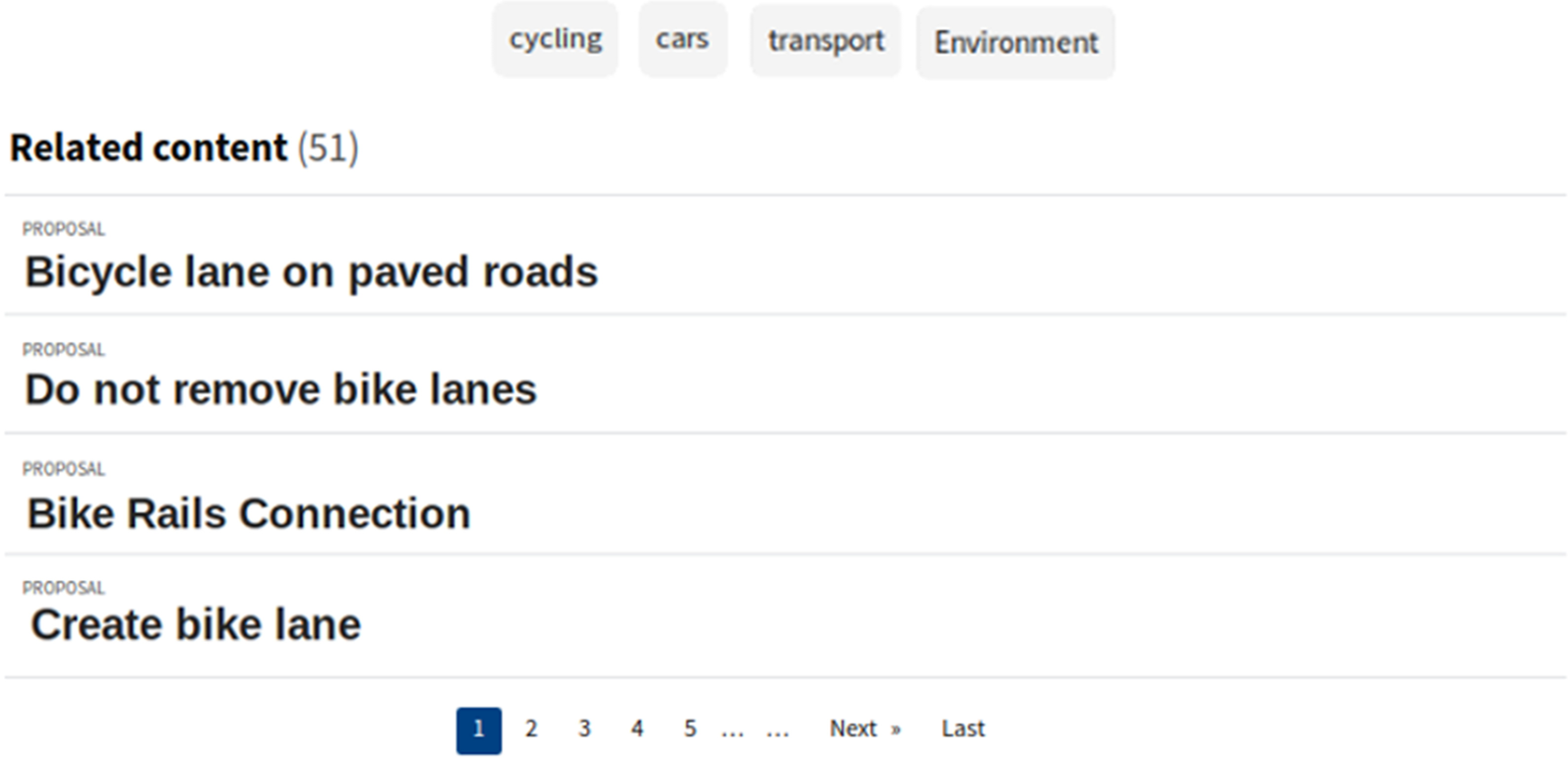 Figure 1: The enhanced Consul interface showing the integration of related proposals and automated tagging.
Experimental Evidence
The researchers conducted a within-subjects laboratory study. The results were stark:
- Efficiency: Finding similar proposals took 225 seconds on the enhanced platform vs. 381 seconds on the original (a 40.9% improvement).
- Discovery: Using the "Related Proposals" list (driven by NMF distance) reduced search time by 58.7%.
- Ease of Use: Users rated the NLP-enhanced tasks as significantly easier (p < 0.02), noting that the original platform often made it "impossible" to find overlapping ideas.
 Figure 2: Statistical comparison between the Original and Enhanced platform versions across time, similarity, and ease.
Critical Insights & Future Outlook
While the tagging and clustering were highly successful, summarization remains a challenge. The relevance score for summaries was 3.11/5, indicating that extractive methods (picking existing sentences) can sometimes feel disjointed. The authors suggest moving toward abstractive summarization (using models like BERT or GPT) in future iterations.
Key Takeaways for the Field:
- Semantic over Syntactic: Relying on folksonomies (user tags) fails at scale. Vector-based similarity is a necessity for modern civic platforms.
- Privacy-First AI: By clustering users based on public content rather than private "likes" or support votes, the system maintains high ethical standards while fostering connection.
- Broad Applicability: While tested in Madrid, the NMF approach is language-agnostic, relying on term frequency patterns rather than deep linguistic structures.
Conclusion
This project proves that AI is not just a tool for commercial recommendation; it is a vital pillar for Direct Democracy. By alleviating the cognitive load on citizens, machine learning allows "the rule of the many" to finally function with the precision once reserved for small committees of experts.