
E-Democracy in Monteria: Leveraging Data Mining to Bridge the Governance Gap
Citizen participation through web: e-democracy in Monteria
This paper presents a socio-political and technological feasibility study for implementing an e-democracy web portal in Montería, Colombia. By applying Data Mining techniques (K-Means and A Priori) to demographic surveys, the authors establish a foundational framework for citizen participation via Information and Communication Technologies (ICT).
TL;DR
This study investigates the readiness of Montería, Colombia, for an e-democracy revolution. By employing K-Means Clustering and A Priori Association Rules on survey data, the researchers mapped the socio-technical landscape, finding high potential for digital participation despite existing barriers in ICT literacy among older demographics.
Problem & Motivation: The Participation Paradox
In Colombia, as in much of Latin America, democratic participation is often more rhetorical than actual. While laws exist to promote citizen involvement, the physical and bureaucratic distance between the "governor and the governed" remains vast. The authors identify a critical "out of phase" institutional status: governments are not yet benefiting from the ICT tools that have already transformed business and education.
The challenge isn't just building a website; it’s understanding if the heterogeneous population—ranging from tech-savvy youth to skeptical elderly citizens—will actually use it.
Methodology: From Surveys to Data Science
The core innovation of this work is the application of Data Mining to public policy planning. The researchers segmented the population into three age-based cohorts and several institutional groups (councilors, community leaders, and cyber-café owners).
The Clustering Approach (K-Means)
The team used the Simple K-Means algorithm to group individuals based on their "Disposition to support the project," "Internet frequency," and "ICT knowledge." This allowed them to see which characteristics were shared by the "Early Adopters" of digital democracy.
The Association Logic (A Priori)
By using the A Priori algorithm, they identified hidden patterns. For instance, they discovered that knowledge of "participation mechanism objectives" was a stronger predictor of support than mere technical skill.
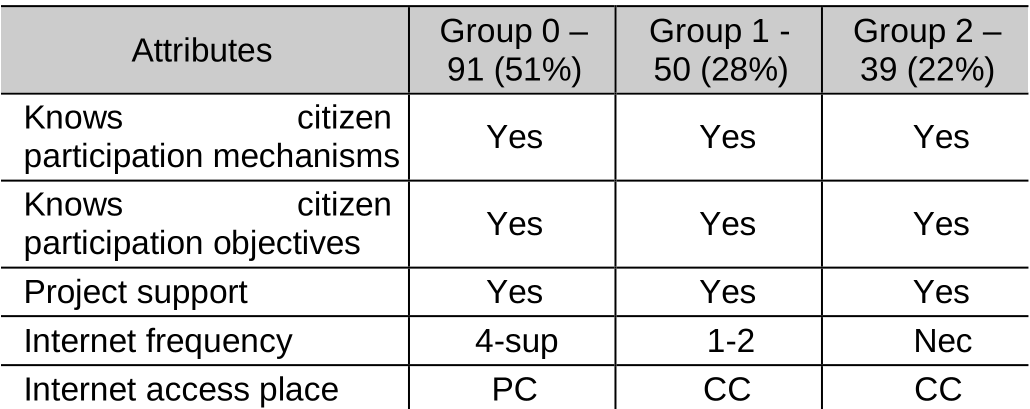 Table 1: Clustering results for Segment 1 (Ages 15-29), showing a dominant cluster (91%) with high internet frequency and project support.
Key Results and Findings
The study provided a quantitative green light for the project:
- Youth Engagement: 91% of the 15-29 demographic are ready for immediate portal adoption.
- Political Alignment: 100% of the city's councilors expressed willingness to support "Participatory Budgets" through the ICT portal.
- Physical Infrastructure: A study of local "cyber-cafés" (Internet Provider Centers) confirmed that the city has the latent hardware capacity to support the portal's rollout.
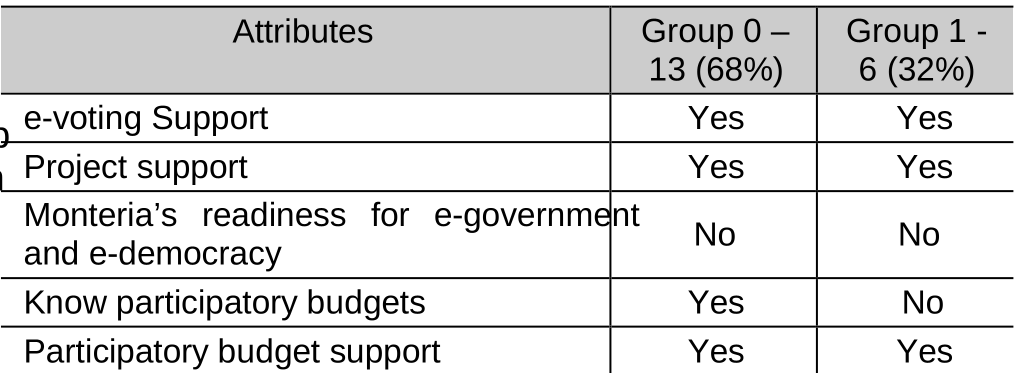 Table 4: Even though councilors felt the city wasn't "ready" for e-government (No in row 3), their support for the project itself was unanimous (Yes in row 2).
Critical Analysis & Conclusion
Takeaway
The research concludes that Montería is fertile ground for e-democracy, provided the platform is designed with "Inclusive UX." For younger users, the portal should focus on transactionality and speed. For older adults, the study highlights a need for educational campaigns and accessibility features (like adjustable text sizes and high-contrast visuals) to overcome "ICT anxiety."
Limitations & Future Work
The study admits a significant limitation: the Digital Divide in rural areas. While the urban center is ready, the rural population risks further marginalization without specific infrastructure partnerships. Future work will involve the actual development and deployment (Phase 3 and 4) of the portal, incorporating the "Participatory Budget" module which the data suggests is a high-demand feature.
Ultimately, this paper serves as a blueprint for how Data Mining can transform "gut-feeling" governance into evidence-based democratic design.