
Digital Democracy or Digital Divide? The Surprising Success of 311 Crowdsourcing
Citizen Representation in City Government-Driven Crowdsourcing
This study investigates citizen representativeness in government-driven crowdsourcing via 311 systems in San Francisco. Using longitudinal survey data from 2011 to 2015, the authors demonstrate that digital reporting platforms successfully achieve demographic parity, effectively reaching parity with or exceeding traditional phone-based systems in representing disadvantaged groups.
TL;DR
Is digital governance leaving marginalized citizens behind? A longitudinal study of San Francisco's 311 system suggests the opposite. By analyzing years of citizen data, researchers found that barriers to participation—like income, race, and education—have largely vanished, turning mobile service requests into a powerful tool for equitable urban management.
Background: The Fear of Technological Elitism
For decades, the "Digital Divide" has been a bogeyman in public administration. The logic was simple: if cities move service reporting (potholes, graffiti, broken lights) to apps and websites, only the "empowered"—the wealthy and tech-savvy—will be heard. This would theoretically lead to a "squeaky wheel" effect where resources flow to affluent neighborhoods while disadvantaged areas remain silent and neglected.
The Core Insight: Crowdsourcing as "Individual Opinion"
The authors frame 311 systems not just as call centers, but as a specific type of Public Sector Crowdsourcing. Within their typology, 311 represents Individual Opinion crowdsourcing.
- Low Administrative Expertise Required: Anyone can identify a trash overflow.
- Low Diversity of Thought: The solution is usually binary (fix it or don't).
This low barrier to entry is precisely what allows it to become a representative tool.
Methodology: Measuring Representation in the "Golden City"
The study analyzed random sample surveys from San Francisco residents in 2011, 2013, and 2015. They tracked how different groups used three channels:
- Traditional Phone (311)
- Web Portals
- Smartphone Applications
By using logistic regression, they could isolate whether a person's race or income was a statistically significant predictor of whether they would report a problem to the city.
 The figure above illustrates the massive scale of 311 operations, showing a steady climb in engagement and the diverse array of urban issues managed by the crowd.
Key Findings: Breaking the Divide
The results provide a robust rebuttal to the "tech-bias" hypothesis:
- Race & Ethnicity: While Asians and Blacks initially used 311 less than Whites in 2011, these differences disappeared by 2013 and 2015. In fact, in some models, African Americans participated at higher-than-predicted rates.
- Education & Income: There was no significant evidence that wealthier or more educated residents dominated the system. In 2015, those with "Some College" were actually less likely to use the system than the lowest education group.
- The "Self-Reinforcing" Effect: The study highlights that as users see the city responding (fixing the pothole they reported), they are more likely to use the system again. This creates a "virtuous cycle" of engagement.
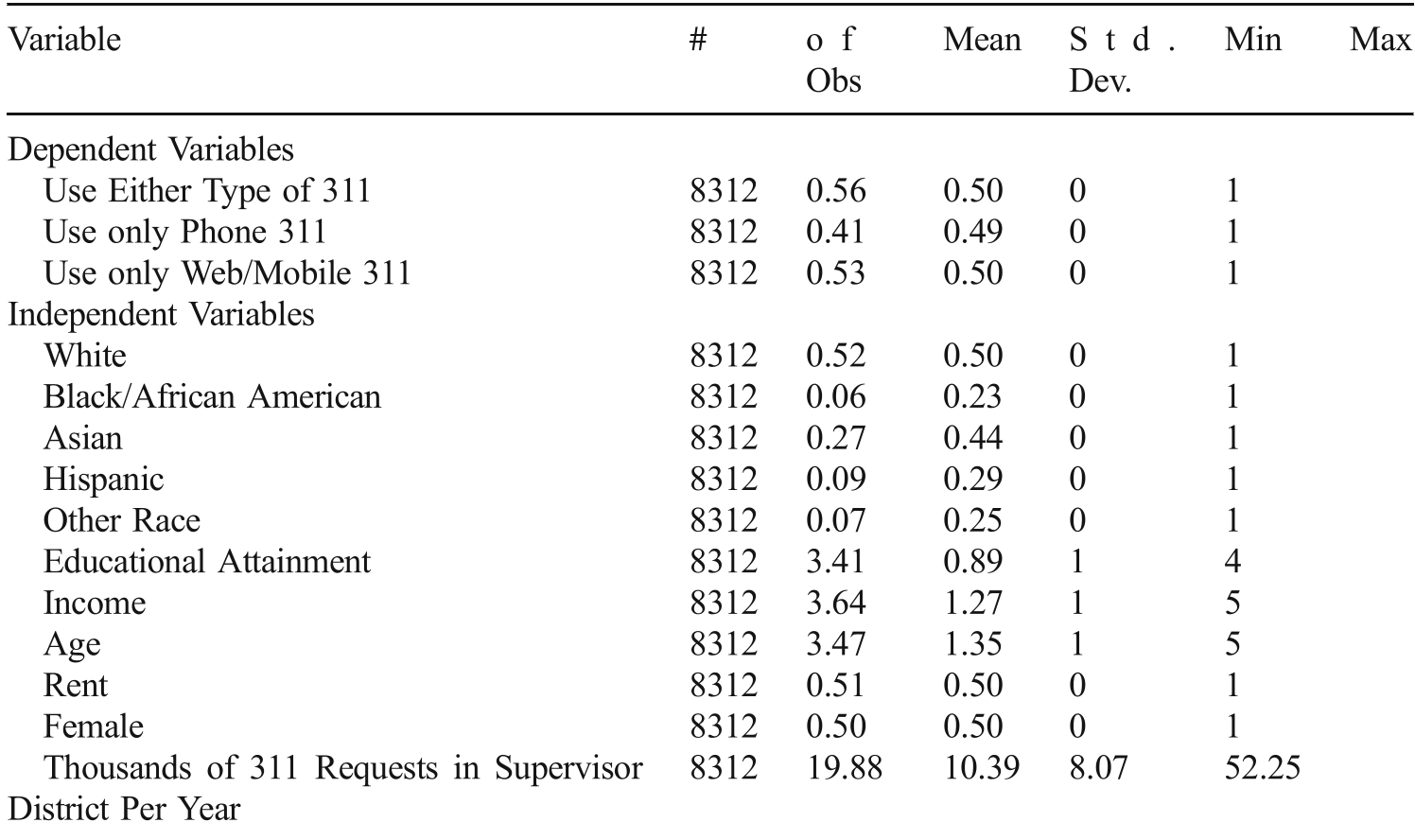 Table 2 shows the demographic breakdown of the study, highlighting the diversity of the 8,312 observations utilized to ensure statistical validity.
Critical Insight: Why Does This Work?
Why did San Francisco succeed where others feared failure? The authors suggest that digital platforms can be "blind" to personal characteristics. Unlike attending a city council meeting—which requires physical presence, flexible work hours, and public speaking confidence—submitting an app request is anonymous, asynchronous, and takes 30 seconds. This drastically lowers the "transaction cost" of being a good citizen.
Limitations and Future Outlook
While the findings are optimistic, the authors offer two warnings:
- Responsiveness is Mandatory: If a city stops fixing the problems reported via 311, the "virtuous cycle" breaks, and participation will collapse, likely starting with the most marginalized.
- The "San Francisco" Context: As a city adjacent to Silicon Valley, the residents may be uniquely "tech-ready." Whether these results hold in less tech-centric cities remains a vital area for future study.
Conclusion
Governing by the "wisdom of the crowd" is no longer a futuristic concept—it is the daily reality of modern cities. This research proves that when designed correctly, digital crowdsourcing doesn't just make government more efficient; it makes it more equitable.