
The Digital Commons: How Facebook Communities Reclaim the City
City as Commons: Study of Shared Visions by Communities on Facebook
This paper explores "expanded participation" in urban governance by analyzing two Facebook-based communities: "Il Giardino in Movimento" (Italy) and "Canteiros Coletivos" (Brazil). Using complex semantic network analysis, the study identifies shared visions and themes regarding the "city as commons" and public space reclamation.
TL;DR
This study investigates how digital social networks (DSN) facilitate "expanded participation" in urban spaces. By analyzing semantic networks of Facebook groups in Italy and Brazil, the research uncovers that while digital platforms are vital for organizing "The City as Commons," the actual deliberation is often fragmented and heavily reliant on visual cues rather than textual debate.
Background: From Liquid Modernity to Expanded Participation
In an era described by Zygmunt Bauman as "liquid modernity," public spaces frequently transition into spaces of mere consumption rather than civic education. This paper positions the city as a common good—a resource produced and defended collectively. The researchers shift the focus from traditional parliaments to "subactivism," where politics is practiced through everyday digital interactions.
Motivation: Why Analyze Words as Networks?
Conventional statistics often fail to capture the "spontaneous text" of digital talk. The authors argue that by treating associations between words as a complex semantic network, we can see beyond what people are saying and identify the "force" and "fidelity" of their shared visions. They aim to bridge the gap between virtual interaction and real-world urban intervention.
Methodology: Mapping the Semantic Topology
The researchers analyzed two primary cases:
- Il Giardino in Movimento (Italy): A "wikiplanning" initiative focused on a city park.
- Canteiros Coletivos (Brazil): A grassroots movement for the cultural and environmental occupation of residual urban spaces.
The Pipeline
- Data Extraction: Using Netvizz to scrape posts and engagement metrics (likes, comments).
- Text Cleaning: Converting verbs to infinitives and removing "noise" (articles/pronouns).
- Network Generation: Creating links between word pairs within sentences to calculate Degree Centrality.
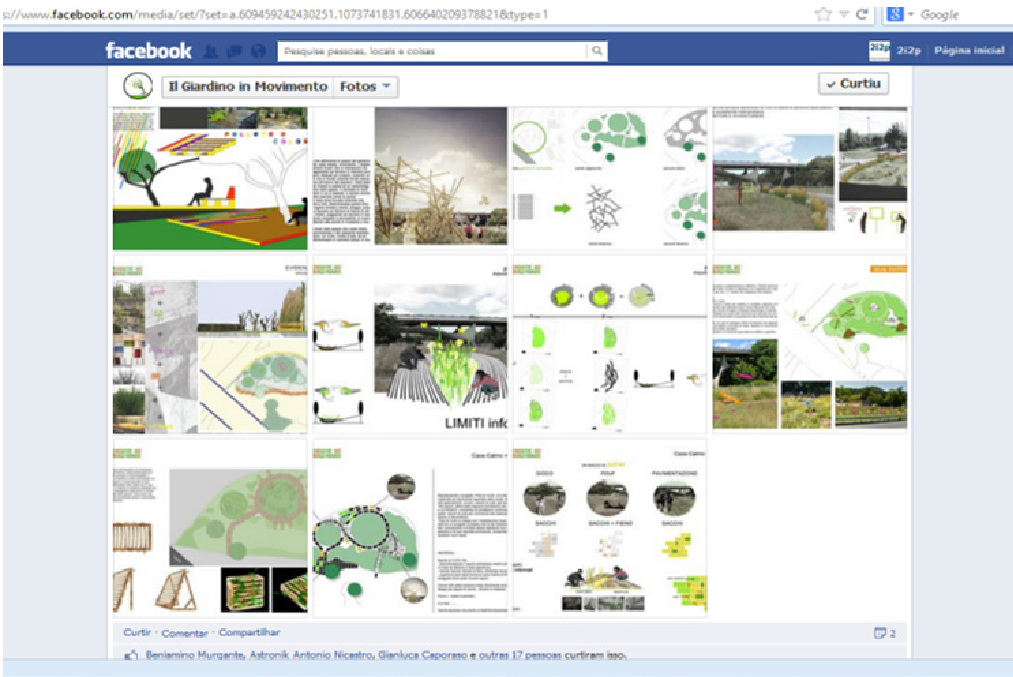 Figure: Word network where node size represents degree centrality.
Experiments & Results: The Rhetoric vs. Reality Gap
The study yielded several counter-intuitive findings:
1. The Paradox of Long-form Content
In the Brazilian case (Canteiros Coletivos), the word "movement" appeared with massive centrality. However, this was due to a single, incredibly long political post (1,114 words). Despite its semantic "importance" in the graph, it received zero likes or comments.
2. Visual Dominance
The highest engagement in both groups was consistently tied to photo albums of physical events. Interaction in the comments was often "private talk" between acquaintances rather than public deliberation on the "common good."
3. Geographic Context
In the Italian case, semantic clusters centered around external locations (e.g., "Roma," "Pompei") rather than the local city (Potenza), highlighting that digital groups often import external "best practices" or contexts to define their local identity.
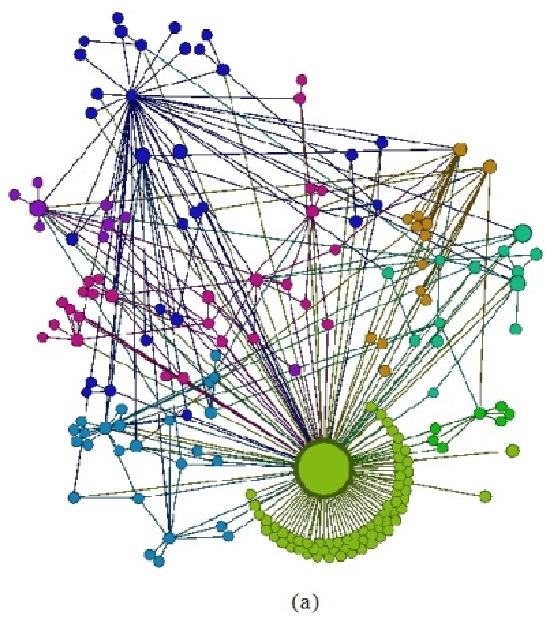 Figure: Social Network Analysis showing the concentration of interactions around key individuals.
Critical Analysis & Conclusion: Is the City really a Commons Online?
The study concludes that digital networks act as amplifiers of urban experience but not necessarily as deliberative chambers.
Takeaways:
- Degree Centrality can be misleading: High-frequency words in a network might simply reflect one long, ignored post rather than a community-wide consensus.
- Hyperlocalization: Place remains the symbolic anchor. Without geographical context, semantic analysis of urban movements loses its "physical" soul.
- Future Work: The authors suggest that complex network analysis should be used recursively to filter which "digital traces" are truly worth a deep qualitative dive.
Ultimately, the "City as Commons" is built more through shared images of collaborative gardening and art than through the textual manifestos that often dominate digital "subactivism."