
CityCare: A Holistic Human-Centered Framework for Smart City Management
CityCare: Crowdsourcing daily life issue reports in smart cities
CityCare and CityCareW are a dual-application ecosystem designed for smart cities to crowdsource urban issue reporting and management. The system introduces an end-to-end "report-to-resolution" lifecycle featuring gamification, duplicate detection, and supervisor-level prioritization.
TL;DR
CityCare is not just another "report-a-pothole" app; it is a comprehensive ecosystem that bridges the gap between civic participation and municipal operations. By introducing a dual-app architecture (CityCare for citizens and CityCareW for workers), the system addresses the "black hole" of reporting where citizens feel ignored and workers feel overwhelmed.
The "Black Hole" of Civic Participation
In many modern cities, reporting a broken street light feels like shouting into a void. Current SOTA applications like FixMyStreet or SeeClickFix focus heavily on the reporting side but fail to provide a structured workflow for the city staff. This leads to:
- Duplicate Fatigue: Ten people reporting the same pothole leads to administrative clutter.
- Lack of Urgency Control: Broken water mains are filed in the same queue as faded park benches.
- Waning Motivation: Without feedback or incentives, citizens stop using the app after their first report.
Methodology: Closing the Loop
The researchers utilized a Human-Centered Design (HCD) cycle to ensure the technology matches the messy reality of urban maintenance.
1. The Proximity Filtering Engine
To solve the duplication problem, CityCare performs a real-time spatial query. When a user begins a report, the system searches the Backend Database for existing pending reports within a 50-meter radius. If a match is found, the user is prompted to "Upvote" or add details to the existing report rather than creating a new one.
2. CityCareW: The Supervisor's Dashboard
The "W" stands for Workforce. This application splits users into Supervisors (who classify issues based on criticality) and Technicians (who receive GPS-tagged work orders). This architectural split ensures that field teams only see a prioritized list of tasks, maximizing operational efficiency.
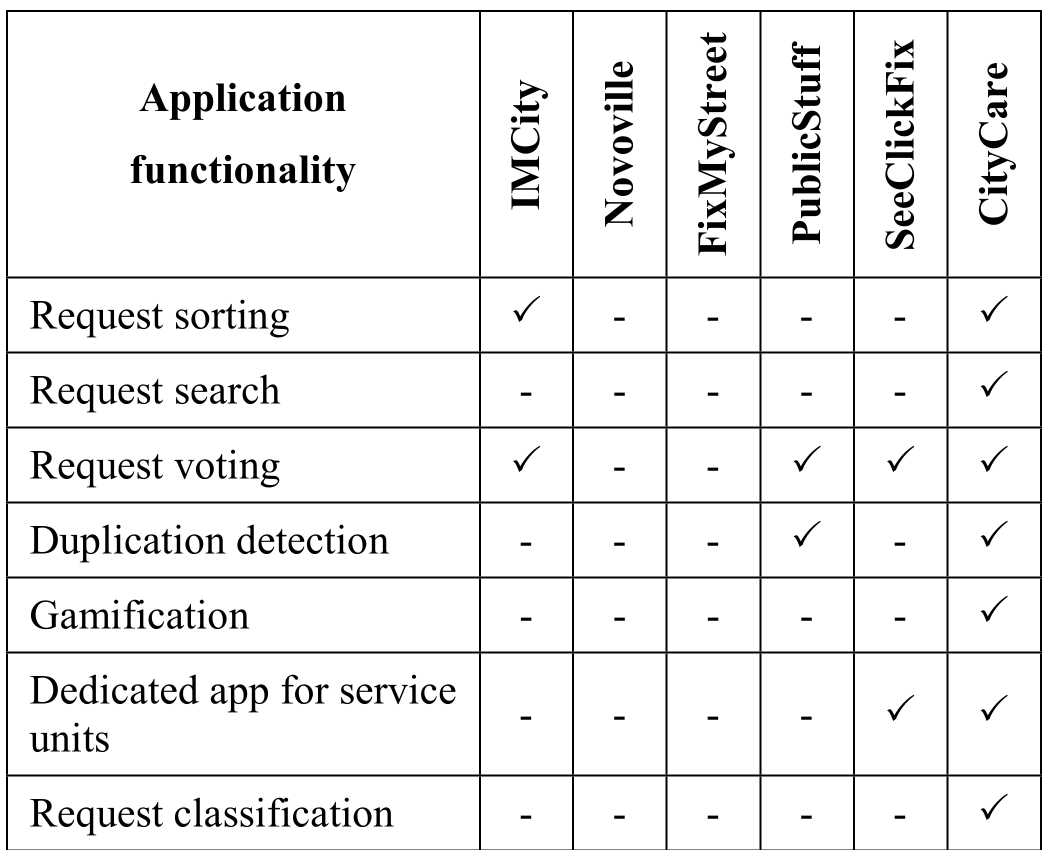 Table 1: Comparison showing CityCare's holistic feature set including duplicate detection and dedicated service apps.
3. Gamification as a Retention Tool
The study integrates a points-based system:
- Urgent Issues: 20 Points
- Very Important: 10 Points
- Important: 5 Points Points are only awarded after the technician confirms the issue was valid, creating a self-policing mechanism to prevent "fake" reports for point farming.
Experimental Insights
The evaluation focused on both the citizen experience and the municipal "back-end."
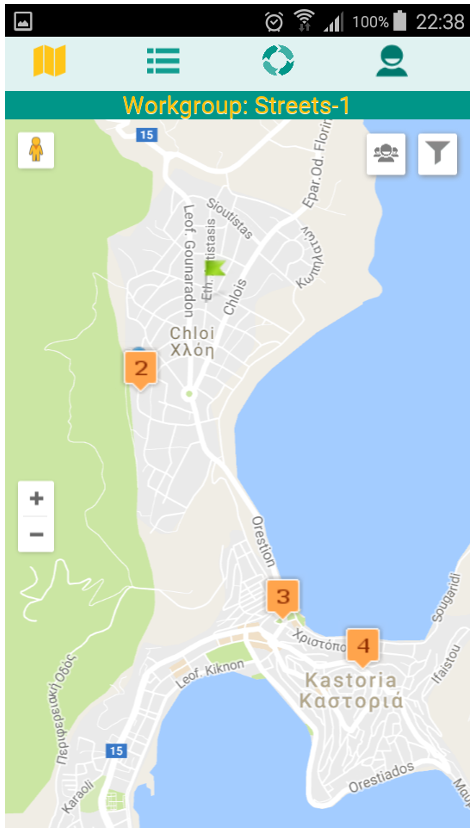 Figure 2: The workflow showing (a-c) citizen reporting, (d) supervisor assignment, and (f) the technician's prioritized map view.
- Usability: The app achieved a 4.7/5 average on the Likert scale for usability.
- Privacy: Interestingly, users reported very low anxiety regarding privacy (1.7/5), suggesting that for public civic issues, citizens are willing to share location data in exchange for service.
- Performance: The system maintained low latency even on resource-limited mobile devices by offloading heavy spatial queries to the backend.
Critical Analysis & Future Outlook
While CityCare excels in workflow management, its prioritization algorithm is currently "empirical" (based on manual weightings). A significant leap forward would be the integration of Autonomous Prioritization using AI to analyze the severity of a photo (e.g., distinguishing a minor crack from a sinkhole).
Furthermore, the paper notes that while gamification was well-received, users were skeptical about the "fun" aspect (S4 Average 3.5). This suggests that civic gamification should lean more towards tangible rewards (tax credits, municipal discounts) rather than purely digital badges.
In conclusion, CityCare proves that "Smart Cities" are built on smart workflows, not just smart sensors. By treating city employees as first-class citizens in the app ecosystem, the research provides a roadmap for sustainable urban crowdsourcing.