
Clarifying Trust in SIoT: From Static Scores to Cognitive Processes
Clarifying Trust in Social Internet of Things (Extended Abstract)
This paper proposes a comprehensive, dynamic trust model for the Social Internet of Things (SIoT), moving beyond static trustworthiness values. By integrating social-cognitive ingredients—trustor, trustee, goal, and context—into a relational framework, it achieves superior performance in malicious node detection and task delegation across real-world social network topologies (Facebook, Google+, Twitter).
TL;DR
Researchers have moved the needle on Social Internet of Things (SIoT) security by proposing a dynamic trust model that mirrors human-like social cognition. By treating trust as a mutual, context-dependent process—incorporating gain, damage, and environmental factors—the model significantly reduces resource abuse and improves task delegation success in unpredictable IoT environments.
Background: Why Social IoT Needs a New Trust Protocol
As the IoT transitions from simple connectivity to "social" autonomy, devices (agents) must interact without central oversight. Traditional trust models are often too "thin"—they provide a single score based on past success. However, in a complex SIoT ecosystem, a node might be trustworthy for GPS data but incompetent at image processing. Furthermore, existing models ignore the Trustee's perspective: why should a device accept a task if the requester is known for being resource-abusive?
The Problem & Motivation
The paper identifies five critical bottlenecks in current SIoT research:
- Unilateral Evaluation: Trustees are treated as passive slaves, not autonomous agents.
- Static Context: Trust is often lost when a task type changes slightly.
- Blind Transitivity: The "friend-of-a-friend" logic is often applied without considering the specific task domain.
- Outcome Misinterpretation: A failed task in a "hostile" environment (e.g., high interference) shouldn't penalize a node as much as a failure in a "perfect" environment.
Methodology: The Five Clarifications of Trust
The core of this work is the breakdown of trust into six ingredients: Trustor, Trustee, Goal, Evaluation, Decision/Action, and Context.
1. Mutual Evaluation
Instead of a one-way street, the model requires a "Reverse Evaluation." A trustee only accepts a task if the trustor's reputation exceeds a specific threshold, protecting the network from "Vicious Trustors" who exploit shared resources.
2. Characteristic-Based Inference (The "How")
Instead of seeing a task as an indivisible unit, the authors decompose it into characteristics.
- If Node A is trusted for "GPS Monitoring" and "Image Capture," it can be automatically trusted for "Real-time Traffic Monitoring" because the underlying characteristics overlap.
3. Context-Aware Transitivity
The paper proposes Conservative vs. Aggressive transitivity. The aggressive approach searches across multiple paths to "stitch together" trustworthiness for complex tasks with multiple requirements.
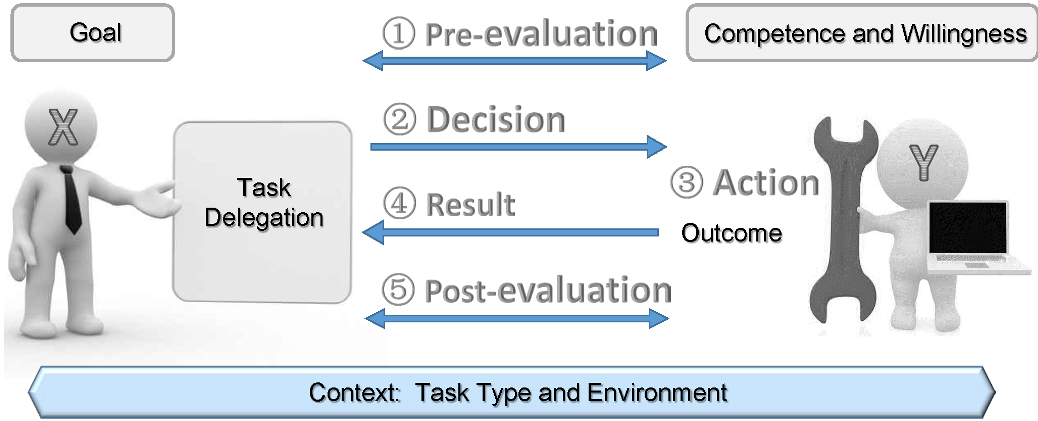 Fig 1: The dynamic process of trust, highlighting the interaction between goals, context, and results.
Experiments: Real-World Social Topologies
The authors didn't just test this in a vacuum; they used connectivity data from Facebook, Google+, and Twitter to simulate realistic SIoT clusters.
- Success Rates: The Aggressive Transitivity method showed a massive jump in task success (e.g., from 27% to 67% in Facebook subnetworks).
- Environmental Adaptation: Using a specific function to "remove" environmental influence, the system could distinguish between a malicious node and a node struggling in a "hostile" environment (e.g., low battery or high noise).
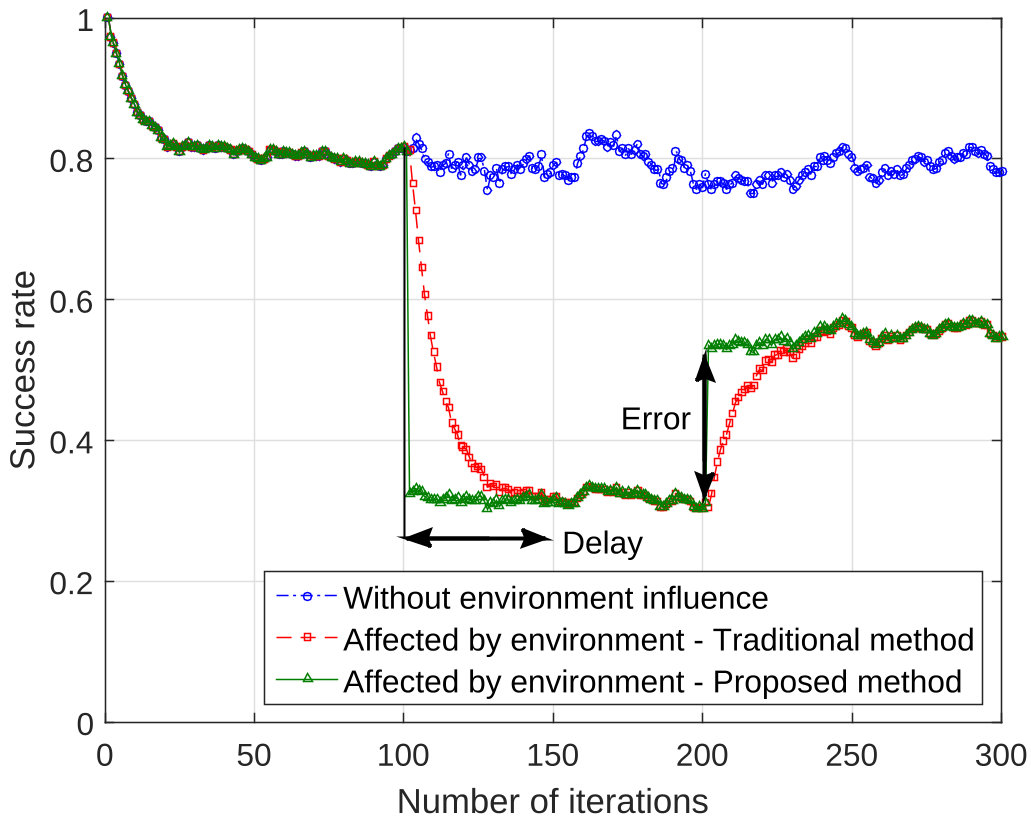 Fig 2: Comparison of success rates: The proposed model (green) tracks actual competence much faster than traditional methods (red) when the environment changes.
Critical Insight & Conclusion
The most profound takeaway from this work is the Environmental Decoupling. By using the "Wooden Bucket Theory" (Cannikin Law), the model identifies the "bottleneck" environment factor and normalizes node performance against it. This prevents the "bad luck" of a hostile environment from destroying a node's hard-earned social reputation.
Limitations
While robust, the Aggressive Transitivity method carries a high communication overhead. In massive, energy-constrained IoT networks, the number of "inquiry messages" sent between nodes could become a bottleneck itself.
Future Outlook
This characteristic-based approach paves the way for a more granular, "micro-service" style trust architecture in the IoT, where trust is not a general property of a device, but a specific property of its constituent capabilities.