
Clarifying Trust in Social IoT: Moving from Static Scores to Dynamic Processes
Clarifying Trust in Social Internet of Things (Extended Abstract)
This paper proposes a comprehensive, multi-dimensional trust model for the Social Internet of Things (SIoT). By redefining trust as a dynamic process rather than a static value, the authors introduce a socio-cognitive framework that incorporates mutuality, task-characteristic-based inference, and environmental awareness to manage autonomous agent interactions.
TL;DR
Trust is the glue of the Social Internet of Things (SIoT), yet traditional models are too simplistic—treating it as a one-way street or a static number. This paper redefines trust as a socio-cognitive process that accounts for mutual evaluation, shared task characteristics, and environmental flux. By breaking tasks into granular "characteristics," the system allows nodes to infer trust for new tasks based on past performance in similar areas, boosting success rates by over 40% in real-world network simulations.
Background: Why "Trust" is Broken in Current IoT
In a Social IoT ecosystem, smart objects act as autonomous agents. If Device A (Trustor) asks Device B (Trustee) to perform a task, it faces the "Uncertainty Gap." Prior works typically solve this with a simple reputation score. However, this fails in three critical areas:
- Lack of Trustee Protection: Why should a trustee accept a request if the trustor is known to be abusive?
- Task Isolation: If I trust you to provide GPS data, why can't I infer your reliability for "Traffic Monitoring," which relies on GPS?
- Environmental Blindness: A failure during a storm (hostile environment) shouldn't penalize a node's reputation as much as a failure in perfect conditions.
Methodology: The Six Pillars and Five Clarifications
The authors propose a model where trust is a relational construct.
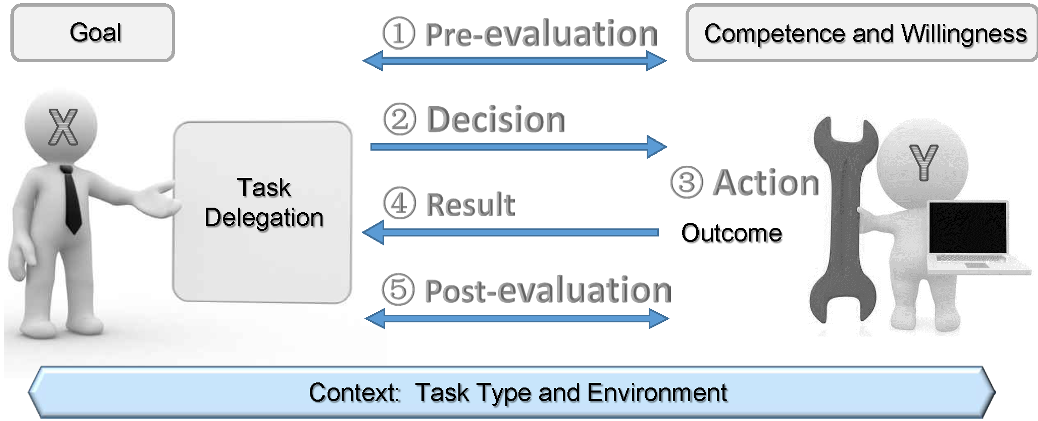
1. The Architecture of a Trust Decision
Trust isn't just a value; it's a sequence: Evaluation → Decision → Action → Result.
2. Characteristic-Based Inference
This is perhaps the most innovative "How" in the paper. Instead of treating "Task A" and "Task B" as black boxes, the authors decompose them into characteristics .
- The Intuition: If Task shares characteristics with previous tasks , we can calculate an inferred trustworthiness as a weighted sum of previous performances on those specific attributes. This solves the "Cold Start" problem for new service types.
3. Mutual Evaluation & Dynamic Environment
The model introduces Bilateral Trust. The Trustee evaluates the Trustor using a reverse evaluation threshold . If the trustor is "shady" (abuses resources), the trustee simply refuses the delegation.
Furthermore, to handle the Dynamic Environment, the authors introduce a "Cannikin Law" (Wooden Bucket Theory) function . This function "removes" the environment's influence. If a node succeeds in a "Hostile" environment (low value), it receives an extra reward in its trustworthiness update, accurately reflecting its resilience.
Experiments: Real-World Evidence
The authors didn't just stay in the theoretical realm. They tested the model using:
- Network Blueprints: Facebook, Google+, and Twitter sub-networks.
- Physical Hardware: A ZigBee network using TI CC2530 SoCs.
Performance Gains
The results confirm that "Aggressive Transitivity" (searching for nodes that share even partial characteristics of a task) yields the highest success rate.
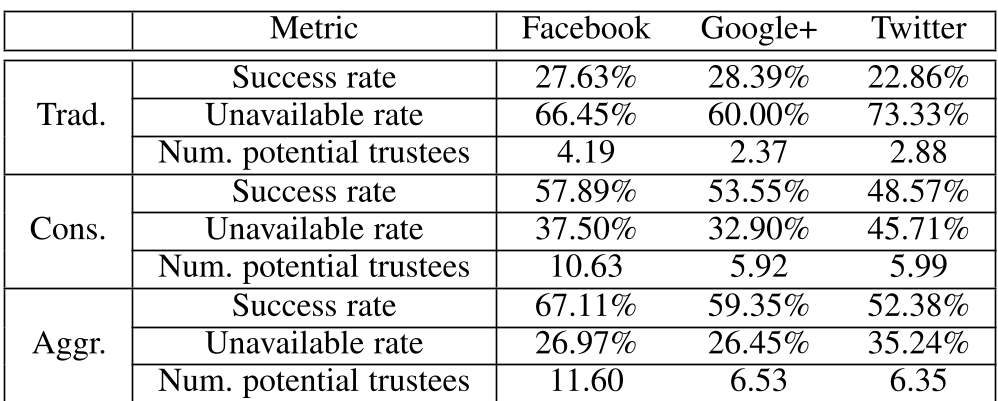
- Success Rate: Increased from 27.6% (traditional) to 67.1% (Proposed) in Facebook-based IoT topologies.
- Abuse Prevention: By implementing reverse thresholds, the "Abuse Rate" of resources plummeted as malicious trustors were blacklisted by autonomous trustees.
Critical Insight & Conclusion
The brilliance of this work lies in its granularity. By shifting from "Node-level trust" to "Node-Characteristic trust," the Social IoT becomes far more flexible.
Takeaway for the Industry: In future IoT deployments, we should stop asking "Is this node trustworthy?" and start asking "Is this node's performance on Characteristic X reliable given Environment Y?"
While the Aggressive Transitivity method introduces higher search overhead (more network pings), it is the only way to maximize service availability in a sparse, heterogeneous network. Future work might benefit from combining this logic with Federated Learning to decentralize the characteristic evaluation process further.