
CB-SBIT: Solving the Data Scarcity Problem in Botnet Classification through Balanced Instance Transfer
Class Balanced Similarity-Based Instance Transfer Learning for Botnet Family Classification
The paper introduces Class Balanced Similarity-Based Instance Transfer (CB-SBIT), an instance-based transfer learning framework designed to improve Botnet classification. By calculating multi-metric similarity between target and source instances and enforcing class balance post-transfer, it significantly enhances detection performance in data-scarce scenarios.
TL;DR
Researchers have developed CB-SBIT (Class Balanced Similarity-Based Instance Transfer), an algorithm designed to "borrow" relevant data from known botnet families to help identify new ones. Unlike previous methods, it forces the resulting training set to be class-balanced, preventing the model from becoming biased. It proves significantly more robust than SMOTE in extreme cases where only a single instance of a new botnet is available.
Context & Positioning
In the cat-and-mouse game of cybersecurity, new Botnet families emerge faster than we can label their data. Traditional Machine Learning (ML) models like Random Forest require substantial labeled training sets to be effective. When a new threat appears (the Target Task), we might only have a handful of captures.
CB-SBIT sits at the intersection of Transfer Learning and Data Imbalance mitigation. While feature-based transfer projects data into latent spaces (computationally expensive), CB-SBIT uses Instance Transfer, which is more efficient for real-time network traffic analysis.
The Core Problem: The Transfer Bias
The original SBIT algorithm had a "blind spot": it transferred any source instance that was sufficiently similar to the target data. If the source material was dominated by one class, the target dataset became heavily imbalanced, leading to high accuracy on paper but poor real-world recall (the model simply learns to predict the majority class).
Furthermore, classical oversampling like SMOTE creates "synthetic" data. In network security, synthetic data can sometimes lack the precise statistical nuances of real malicious packets.
Methodology: How CB-SBIT Works
The brilliance of CB-SBIT lies in its simplicity and efficiency. It operates via a single pass over the data:
- Similarity Multi-Filtering: It compares Source instances () to Target instances () using different similarity metrics (Tanimoto, Ellenberg, etc.).
- Thresholding: An instance is only "transferred" if it meets the threshold across all selected metrics.
- Class Balancing (The Secret Sauce): After the transfer, a
SubSamplefunction counts the classes. If the transfer introduced 100 malicious instances but only 10 benign ones, it trims the majority to ensure the model doesn't overfit.
 Fig 1: The general concept of knowledge transfer from Source to Target.
Evaluation & SOTA Comparison
The authors tested the algorithm against five botnets: Zeus, TBot, Sogou, RBot, and Smoke bot.
1. CB-SBIT vs. SBIT
In small data scenarios (2 to 10 initial instances), CB-SBIT outperformed the original version in 64% of cases. By enforcing balance, the Random Forest base learner was able to find better decision boundaries.
2. CB-SBIT vs. SMOTE
The most striking result appeared in the "1x1" dataset (where only one benign and one malicious instance exist).
- SMOTE Outcomes: Failed to run (requires instances to interpolate).
- CB-SBIT Outcomes: Successfully augmented the data, providing a working model for "Patient Zero" scenarios.
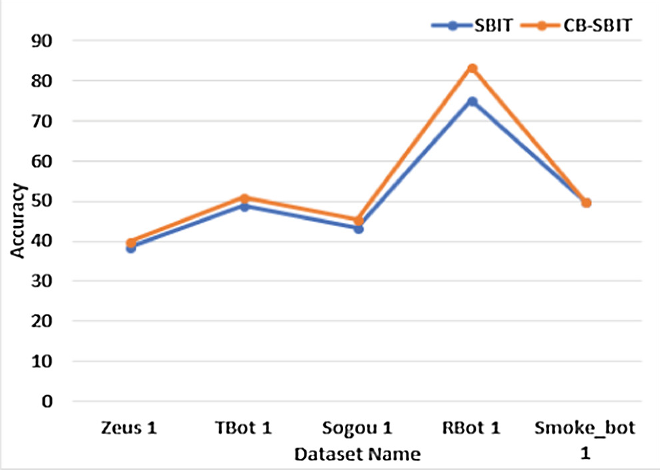 Fig 2: Comparison of accuracy across varying dataset sizes (Zeus botnet example).
3. The Failure in Text Data
Interestingly, when tested on the "20 News Groups" text dataset, TransferBoost outperformed CB-SBIT. The authors discovered that document similarity in text is much "sparser" than in network traffic. In network logs, features like Source Port or Protocol provide a rigid backbone for similarity; in text, the high-dimensional TF-IDF space makes finding similar instances much harder.
Critical Analysis & Takeaways
- Domain Specificity: This research highlights that Instance Transfer is not a silver bullet. Its success is highly dependent on the "overlap" between source and target domains.
- Efficiency: Unlike iterative boosting methods, CB-SBIT's single-pass approach makes it highly suitable for high-speed network environments.
- Limitation: The reliance on predefined thresholds for similarity means the algorithm still requires some manual "tuning" per domain.
Final Thought: For security practitioners, CB-SBIT offers a powerful tool for cold-start botnet detection, turning the massive logs of old attacks into a fuel source for detecting the new.