
Investigating Class Imbalance: The Silent Killer of Automated Health Claim Audits
Investigating the effects of class imbalance in learning the claim authorization process in the Brazilian health care market
This paper investigates the impact of class imbalance on machine learning models used for health insurance claim authorization in Brazil. By evaluating five classifiers (C4.5, RIPPER, Random Forest, SVM, Naive Bayes) across various class distributions, it identifies the performance degredation caused by the scarcity of unauthorized claims and examines the efficacy of mitigation techniques like SMOTE, MetaCost, and Random Oversampling.
TL;DR
In the Brazilian healthcare market, fraud and abuse drain up to 10% of revenue. While Machine Learning (ML) can automate claim audits, the extreme rarity of "unauthorized" claims—the Class Imbalance Problem—cripples standard algorithms. This study benchmarks how much performance is lost to this imbalance and reveals a surprising winner: simple Random Oversampling often outperforms more complex synthetic methods like SMOTE in this domain.
The Financial Bleeding: Why Imbalance Matters
Health insurance companies in Brazil face a grim financial reality: assistantial costs often exceed revenues. Fraud and abuse are the primary culprits. While automating the "Claim Authorization Process" seems like the logical solution, the data is inherently lopsided. In the datasets studied, 98% of claims are authorized, leaving the ML model with very few examples of what a "fraudulent" or "denied" claim looks like.
The result? A model that achieves 98% accuracy by simply saying "Yes" to everything—a disaster for fraud detection.
Methodology: The Stress Test
The researchers didn't just train a model; they performed a "stress test" on five popular algorithms:
- C4.5 (Decision Tree)
- RIPPER (Rule-based)
- Random Forest (Ensemble)
- SVM (Support Vector Machine)
- Naive Bayes (Probabilistic)
They artificially varied the class distribution from 1% to 50% (balanced) to 99% to measure the Performance Loss (PL) and subsequently tested three "remedies": Random Oversampling, SMOTE, and MetaCost.
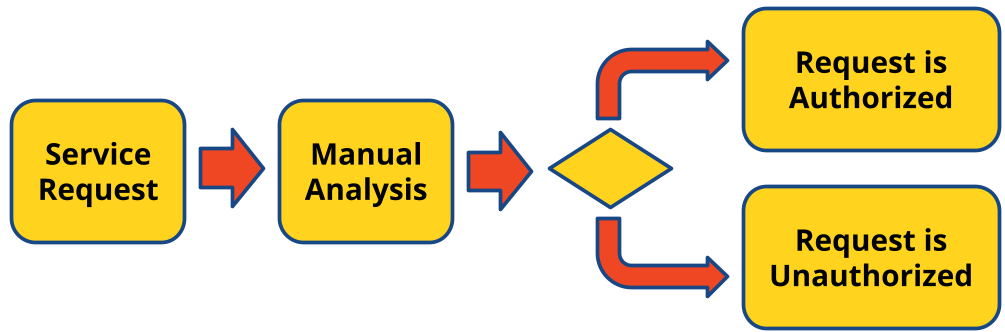 Figure 1: The standard workflow of claim authorization in the Brazilian market.
Key Findings: The Susceptibility of Algorithms
The study’s results highlight a clear divide in how algorithms handle scarcity:
- The Robust: Random Forest and Naive Bayes showed remarkable stability. Their Area Under the ROC Curve (AUC) remained relatively flat even as imbalance grew.
- The Fragile: SVM, C4.5, and RIPPER were highly sensitive. These models saw significant performance degradation when the minority class dropped below 20%.
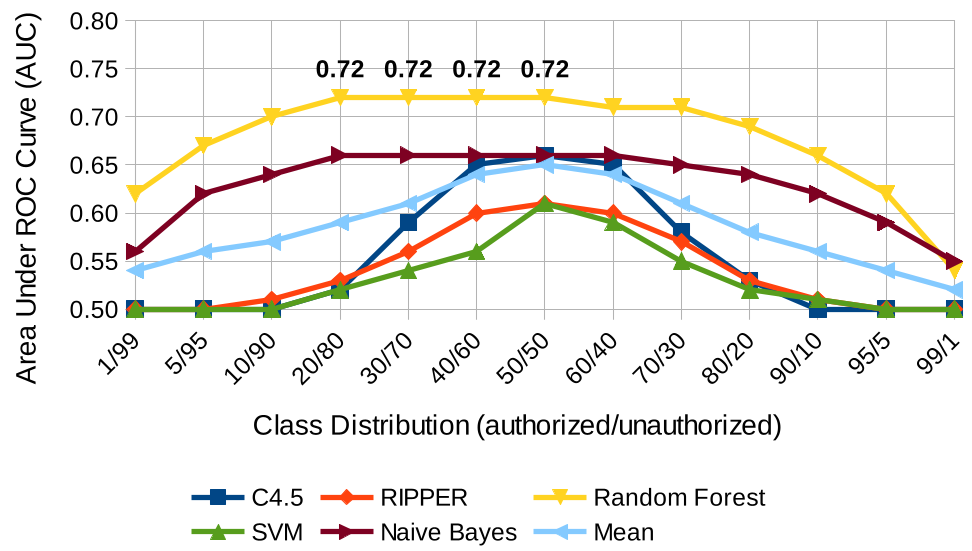 Figure 2: AUC performance across varying class distributions (50/50 is the balanced reference).
The Treatment Paradox: Is SMOTE Always Better?
Usually, researchers recommend SMOTE (Synthetic Minority Over-sampling Technique) because it creates new data points rather than just duplicating old ones. However, this study found:
- Random Oversampling was the MVP: It provided the most consistent performance recovery for C4.5 and SVM, especially when authorized claims were the majority.
- The SMOTE Failure: In several scenarios, SMOTE actually increased performance loss. The authors hypothesize that in medical data, SMOTE might be amplifying "noise" or creating overlaps between fraudulent and legitimate clusters, confusing the classifier.
- MetaCost benefited C4.5 and RIPPER but struggled with Naive Bayes, likely due to poor probability estimations in the cost-minimization phase.
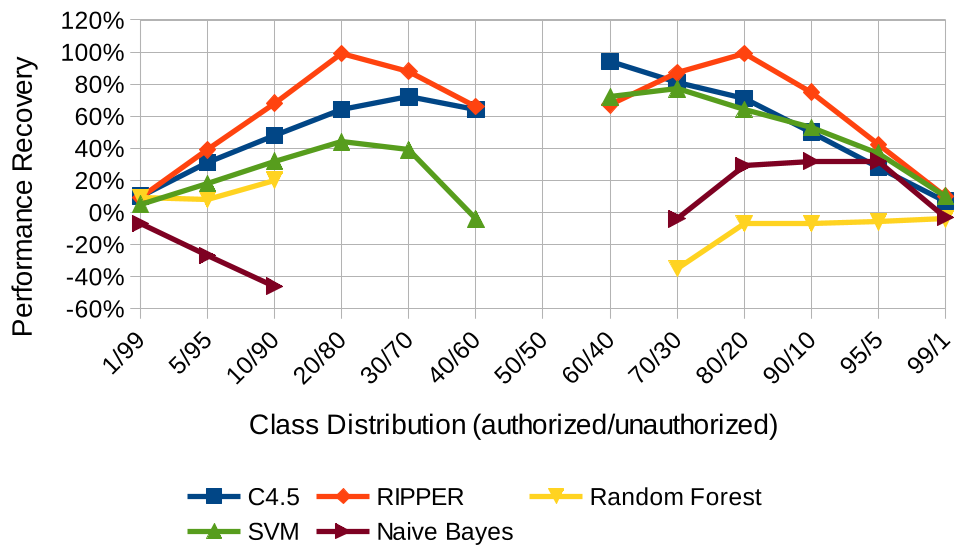 Figure 3: Recovery rates using Random Oversampling—showing significant gains for SVM and C4.5.
Critical Insight & Conclusion
The study proves that there is no "one-size-fits-all" solution for class imbalance in health insurance.
- Algorithm Selection > Preprocessing: If you can afford the computation, use Random Forest—it inherently resists imbalance.
- Simplicity Wins: For sensitive models like SVM or C4.5, start with Random Oversampling. It is computationally cheaper and, in this specific domain, more effective than synthetic generation.
- The AUC Limit: Even with the best treatments, as the imbalance becomes extreme (e.g., 1/99), the "recovery" plateaus. There is a physical limit to how much information can be extracted from a handful of minority samples.
Future Outlook: The next frontier for this research involves moving beyond sampling to Anomaly Detection (treating unauthorized claims as outliers) and exploring deep learning architectures that can better handle high-dimensional, noisy medical records.