
The Ghost in the Script: Why AI Can’t Solve the Cartesian Problem of Meaning
Classical AI linguistic understanding and the insoluble Cartesian problem
This paper explores the "insoluble Cartesian problem" in Classical AI, arguing that linguistic understanding involves internal knowledge and awareness of meaning—a first-person cognitive process irreducible to algorithms. It critiques the Turing Test and Schank & Abelson’s Script Applier Mechanism (SAM) by asserting that machine intelligence remains an "as-if" simulation lacking genuine semantics.
TL;DR
Is a chatbot truly "intelligent" just because it talks like us? Rodrigo González argues no. By revisiting René Descartes’ 17th-century skepticism and pitting it against Turing’s Functionalism, this paper asserts that linguistic understanding requires a first-person awareness that algorithms simply cannot replicate.
Positioning: This is a philosophical post-mortem of Classical AI (Symbolic AI) that remains hauntingly relevant to today’s Large Language Models (LLMs).
The Core Conflict: Flexible Reason vs. Rigid Mechanisms
The paper begins with a paradox: Classical AI researchers often use Descartes' own criteria for intelligence (linguistic flexibility) to try and prove him wrong.
Descartes famously argued that:
- Machines are physical: Therefore, they are "finite and inflexible."
- Reason is a universal instrument: Humans can produce infinite, relevant sign arrangements.
- Conclusion: Since machines only act via the "disposition of their organs" (or code), they cannot think.
Turing’s Gamble: The Imitation Game
Alan Turing attempted to dissolve this problem by moving the goalposts. Instead of asking "Can a machine think?", he asked "Can a machine act so well it deceives us?".
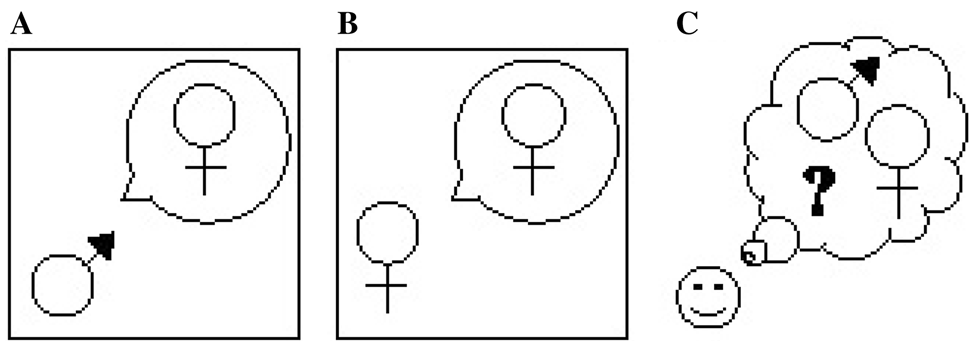 Figure 1: The progression of the Turing Test, from gender-guessing to the standard machine vs. human setup.
Turing embraced a Functionalist view—the idea that intelligence is a computable function independent of the hardware (brain or silicon). However, González points out that this only solves the third-person problem. It doesn't prove the machine knows what it is saying.
SAM and the "Script" of Understanding
In the 1970s, Schank and Abelson developed SAM (Script Applier Mechanism). SAM used "scripts"—standardized sequences of events (like what happens in a [PUB] or at a [SUPERMARKET])—to answer questions about stories.
| Script [PUB] Example | SAM's Process |
|---|---|
| "Flor went to the pub..." | 1. Fetch [PUB] script |
| "...she paid and left." | 2. Match intent to "paying bill" |
| Question: Did Flor drink? | Answer: Yes (Inference based on script) |
While SAM seemed to understand, González (echoing John Searle's Chinese Room) argues this is mere syntax. Running an algorithm—no matter how complex—produces no "what-it-is-like-to-be" experience.
The Insoluble Problem: The First-Person Viewpoint
The author’s "Insoluble Cartesian Problem" can be summarized through a devastating syllogism:
- Linguistic Understanding = Knowledge + Awareness of meaning.
- Awareness = Only occurs from a first-person viewpoint.
- Machines = Have no first-person viewpoint.
- Ergo: Machines cannot understand language.
To illustrate this, González points to Euclid’s Algorithm. A person can find the greatest common divisor of two numbers by following set steps without understanding a single thing about number theory.
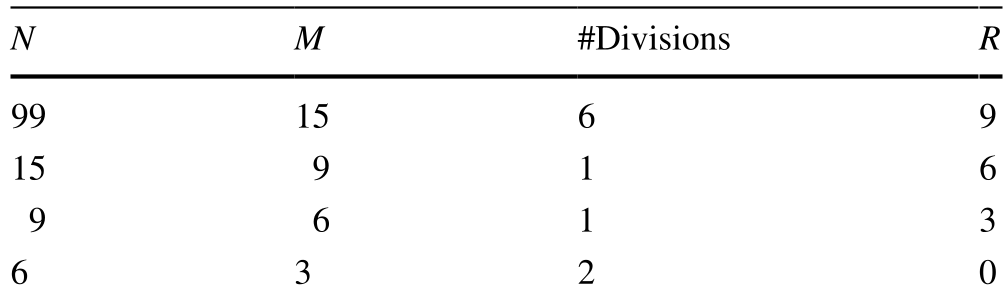 Figure 2: Algorithmic steps for finding a divisor. It is "mechanically" successful but "psychologically" empty.
Critical Insight & Conclusion
The paper concludes that AI researchers have been seduced by a "third-person bias." We see a chatbot outputting coherent text and project our own first-person awareness onto it.
The Takeaway: As we move deeper into the era of LLMs, the Cartesian problem remains: we have created machines with incredible "as-if" intelligence, but they remain "extended things" devoid of the "thinking substance" (awareness) that defines human reason.
Limitations: The paper relies heavily on the Searlean intuition that syntax doesn't produce semantics—a point contested by "System Reply" advocates who argue the entire system understands, even if the parts do not.