
Beyond the Adjacency Matrix: Leveraging Semantic Web for Social Link Prediction
Classification Analysis in Complex Online Social Networks Using Semantic Web Technologies
This paper evaluates the use of Semantic Web technologies for link prediction in complex Online Social Networks (OSNs). By utilizing RDF-based graph representations and a three-dimensional semantic similarity measure (Taxonomy, Relational, and Attribute similarity), the authors demonstrate that ontology-based metadata can achieve classification accuracy comparable to or exceeding traditional feature-vector and graph-based SOTA methods.
TL;DR
Predicting connections in social networks is usually a numbers game—how many friends do we have in common? This paper argues that semantics matter. By using Semantic Web technologies (RDF and Ontologies), the researchers developed a similarity measure that treats "interests" and "profiles" as a rich, structured graph rather than flat data, achieving up to 96% accuracy in link prediction.
The "Flat File" Problem in Social Networks
Most machine learning algorithms are "flat-file" oriented; they expect a matrix of rows and columns. However, social reality is multidimensional. If User A likes "Death Metal" and User B likes "Hard Rock," a traditional system might see two different strings and conclude there is zero similarity. In reality, these genres are taxonomically close.
The authors argue that current Social Network Analysis (SNA) suffers from a loss of background knowledge because it cannot handle the rich-typed graphs intrinsic to Web 2.0 without a "costly transformation process."
Methodology: The Three Pillars of Semantic Similarity
The core of the paper is the evaluation of a semantic similarity metric calculated directly from an RDF representation. It breaks similarity down into three distinct dimensions:
- Taxonomy Similarity (TS): Evaluates where concepts sit in a hierarchy. (e.g., Is "Volleyball" a "Team Sport"?)
- Relational Similarity (RS): The most powerful predictor. It looks at shared relations to third-party objects (groups, events, or other people) recursively.
- Attribute Similarity (AS): Compares literal values like names or ages using distance metrics like Levenshtein edit distance.
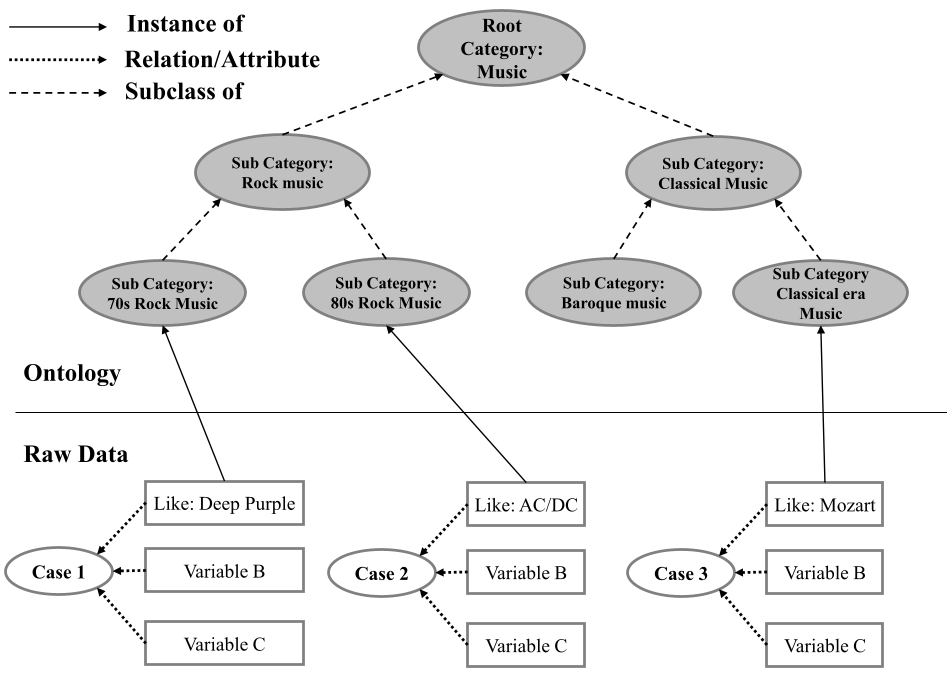
The authors extended existing ontologies like FOAF (Friend of a Friend) and WSG 84 to model two specific communities: a Beach-Volleyball league and a Facebook student community.
Experiments and Superior Results
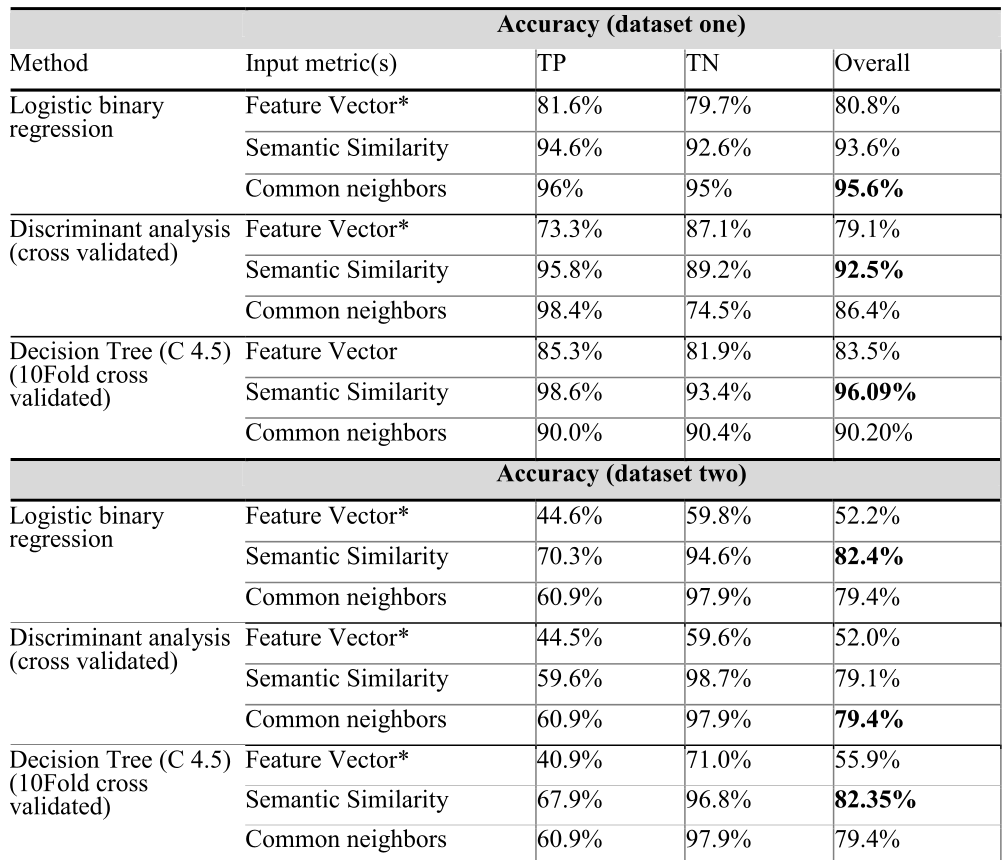
The researchers tested three input types across Logistic Regression, Discriminant Analysis, and C4.5 Decision Trees:
- Feature Vectors: Traditional profile data.
- Common Neighbors: The standard "SOTA" network baseline.
- Semantic Similarity: The proposed ontology-based approach.
Key Findings:
- Accuracy Boost: In the Volleyball dataset, the Semantic Similarity approach using a Decision Tree hit 96.09% accuracy, outperforming the common neighbors' 90.2%.
- Relational Dominance: The "Relational Similarity" (RS) dimension was the strongest predictor, proving that who and what you interact with is more telling than your static profile attributes.
- Discriminative Power: Statistical analysis (ANOVA) confirmed that semantic measures have high "Cohen’s d" effect sizes, indicating they are robust at separating "Linked" vs "Not Linked" pairs.
Deep Insight: Why This Matters
The brilliance of this work lies in Inference. Traditional databases store what is. Semantic Web technologies allow us to derive what could be. By merging a user's hobby (e.g., specific music) with a music ontology, a system can understand that two people are compatible even if they have never attended the same event.
Limitations
- Interpretability: While accurate, it is hard to pinpoint exactly which RDF triple caused a "similarity match," making "Black Box" explanations difficult.
- Complexity: Calculating recursive relational similarity is more computationally expensive than counting common neighbors.
Conclusion
This paper serves as a bridge between the "Web 2.0" social world and the "Web 3.0/Semantic Web" logic. It proves that by treating social data as a meaningful graph rather than a spreadsheet, we can build significantly more accurate recommendation systems. For future developers, the takeaway is clear: don't just track connections; track the meaning behind them.