
Classification and Regression: Why Money Still Grows on Trees
Classification and regression: money *can* grow on trees
This paper provides a comprehensive survey and comparative analysis of predictor trees for classification and regression, introducing optimized algorithms like QUEST and GUIDE. It benchmarks 33 different classifiers and presents scalable data access frameworks such as SPRINT and RainForest for handling massive datasets beyond main memory limits.
TL;DR
This landmark tutorial from KDD 1999 dives deep into the evolution of decision trees—from their statistical origins (CART) to high-performance, scalable implementations for "very large databases." It introduces unbiased selection methods like QUEST and GUIDE and architecture frameworks like RainForest that allow models to learn from data that doesn't fit in your RAM.
Background Positioning: This work serves as a foundational bridge between classical statistical learning and the modern Era of Big Data, formalizing the trade-offs between interpretability, bias, and scalability.
The Hidden Trap: Why Traditional Trees are Biased
Most early decision tree algorithms (including standard CART) use Exhaustive Search to find the best split. While intuitive, this creates a massive Inductive Bias:
- Categorical Favoritism: Variables with more categories (e.g., "Zip Code") have many more potential split points than binary ones (e.g., "Gender"), making them statistically more likely to be chosen even if they are noise.
- Missing Value Distortion: Methods often favor variables with high missingness because they can artificially reduce impurity measures.
The authors argue for a shift toward Statistical Testing (F-tests and Chi-square) to decouple variable selection from split-point optimization, ensuring that the "importance" of a variable is judged fairly.
Methodology: The Core Algorithms
1. QUEST & GUIDE: Precision Statistical Splitting
Unlike CART, which searches every possible value, QUEST (Quick, Unbiased, Efficient, Statistical Tree) uses:
- ANOVA for numerical predictors.
- Chi-square tests for categorical predictors.
- QDA (Quadratic Discriminant Analysis) to find the exact split point once a variable is chosen.
GUIDE extends this to regression, allowing for piecewise-linear models that can detect interactions between variables—something traditional "constant-fit" trees miss entirely.
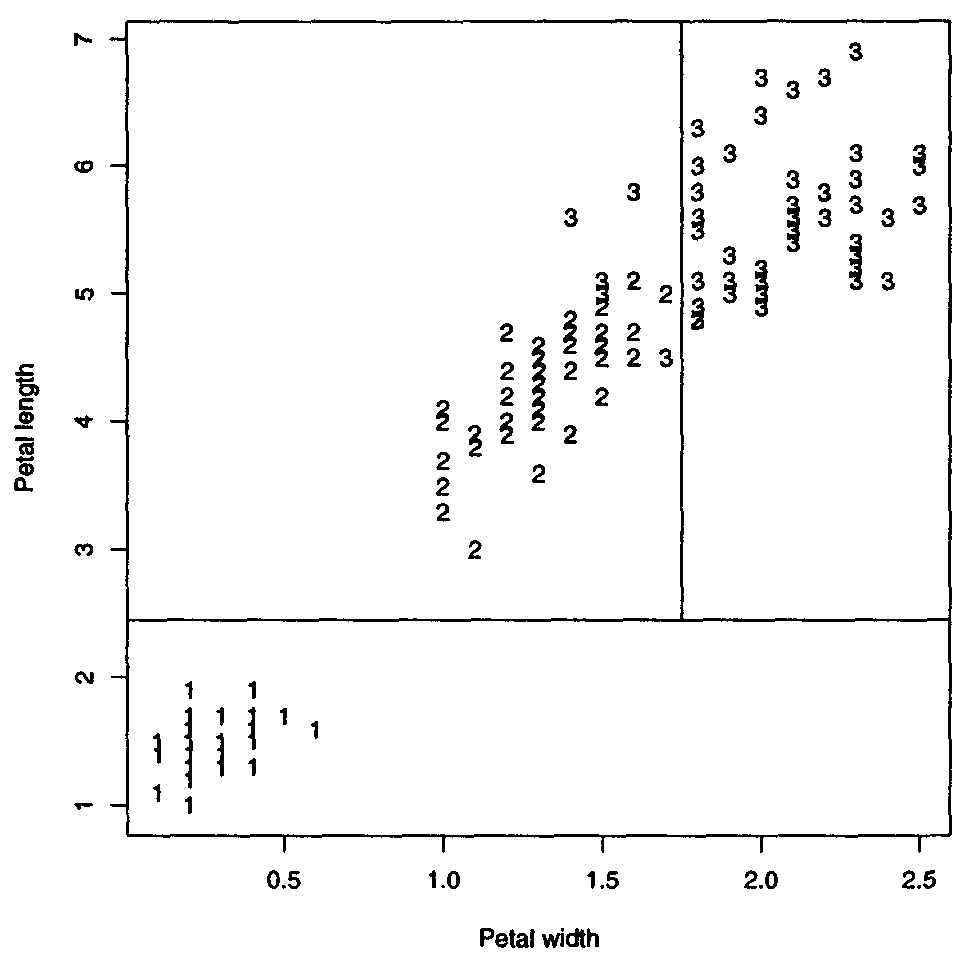 Figure: QUEST variable selection logic using p-values to prevent selection bias.
2. Scalability: SPRINT and RainForest
The "Large Database" problem was the final frontier in 1999. Since disk access is roughly 200,000x slower than RAM, the authors detailed:
- SPRINT: Uses Attribute Lists (Rid, Value, Label) that are pre-sorted, allowing for a single sequential scan during splits.
- RainForest: Introduces AVC-sets (Attribute-Value, Class), a compact summary of the data distribution at each node. This allows the algorithm to build trees by reading the database only a few times.
 Table: Example of data layout used in scalable tree construction.
Battle of the Algorithms: The 33-Model Benchmark
In one of the most comprehensive benchmarks of the era, the authors compared 33 classifiers (Trees, Neural Nets, Statistical) across 32 datasets.
Key Findings:
- Accuracy: Methods like QUEST (Linear) and Logistic Regression were among the most consistent performers. Surprisingly, complex Neural Networks (RBF) sometimes underperformed due to tuning difficulties.
- Speed: C4.5 and FACT were the "sprinters" of the group, with training times in seconds, while "black-box" models like POLYCLASS took hours.
- Interpretation: Univariate trees remained the gold standard for human-readable logic, whereas "Mixed" or "Linear" trees offered better accuracy at the cost of simplicity.
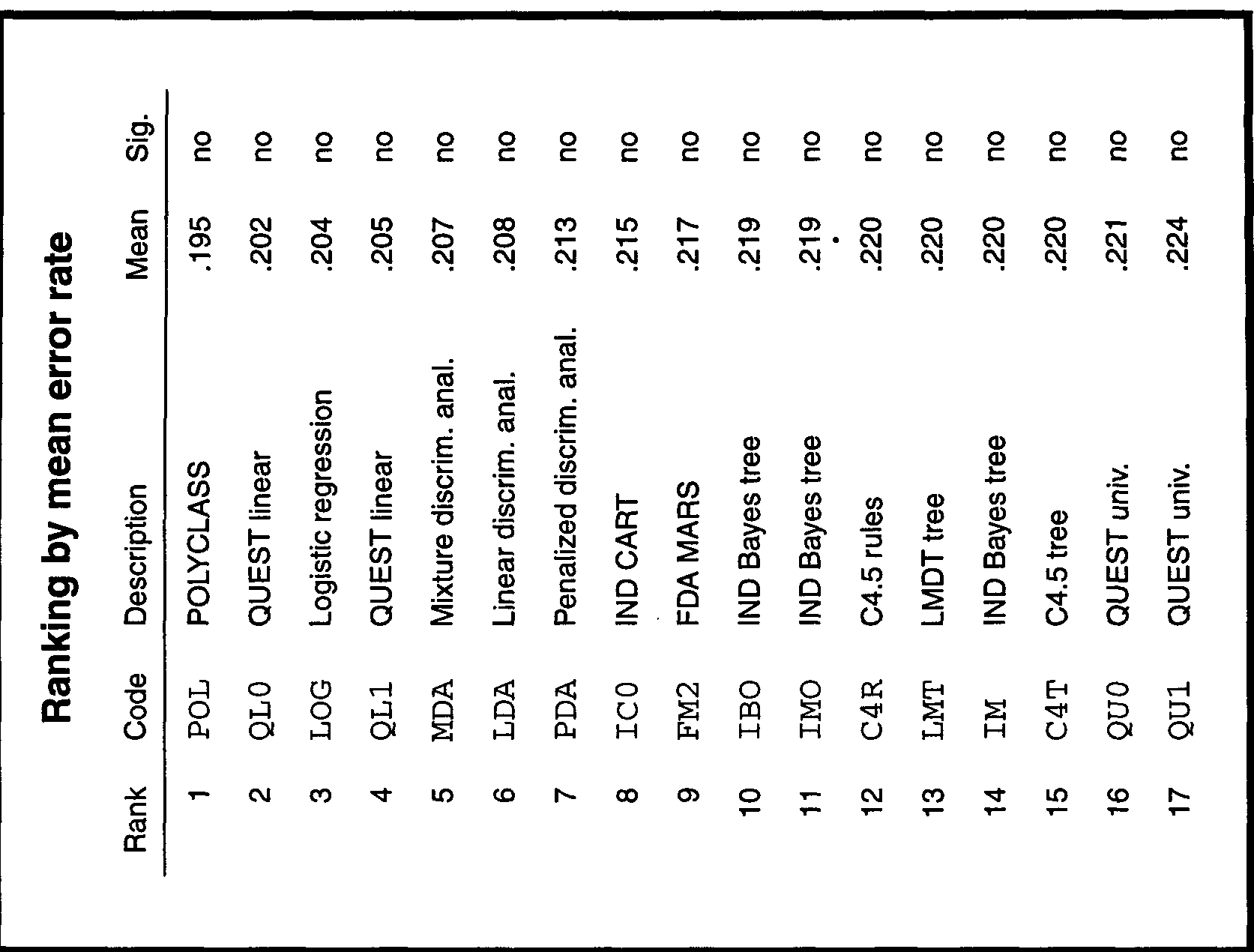 Figure: Comprehensive ranking of classifiers by mean error rate.
Critical Insight & Conclusion
Takeaway
The paper proves that decision trees are not just simple "if-then" loops; they are sophisticated statistical tools. The RainForest framework and QUEST algorithm successfully moved tree induction from "toy" datasets to industrial-scale data mining.
Limitations
- Greedy Nature: Even with statistical corrections, these algorithms remain "greedy"—they make local decisions that might not lead to a global optimum.
- The Rashomon Effect: The paper notes that many different trees can produce similar accuracy (The Rashomon Effect), meaning the "interpretation" we see might just be one of many equally valid "truths" in the data.
Future Outlook
This work paved the way for modern Ensemble Methods (Random Forests, XGBoost). While single trees are powerful, the future (now our present) involves combining these unbiased "weak learners" into powerful ensembles.