
Beyond Class Labels: Solving Ranking and Sorting through Binary Classification
Classification Approach towards Ranking and Sorting Problems
This paper proposes a unified framework to address ranking and sorting problems by reducing them to binary classification. Using a novel "Embedded Space Approach," the methodology enables standard algorithms like SVM, Perceptron, and Winnow to capture the inherent ordinal structure of data without the computational explosion typical of pairwise comparisons.
TL;DR
Researchers from UIUC, IBM, and Siemens have demonstrated that ranking and sorting—tasks usually deemed far more complex than classification—can be efficiently solved by reducing them to a standard binary classification problem. By mapping data into a specific "Embedded Space," they achieve SOTA performance on ranking tasks while keeping the training complexity linear () rather than quadratic.
Background Positioning: This work sits at the intersection of Ordinal Regression and Statistical Learning Theory, effectively bridging the gap between simple classification and complex preference learning.
The Core Insight: Rank vs. Class
In standard Multiclass Classification, the labels (e.g., Apple, Orange, Banana) have no inherent order. In Ranking, however, the labels carry a "degree of interest" (Avoid < Poor < Good < Excellent).
The authors argue that treating these as independent categories loses the "structure" of the data. Conversely, treating them as numbers for Regression is too restrictive because the absolute value of the rank doesn't matter—only the relative order does. Their breakthrough is the proof that the Rank-Dimension of a linear functional is identical to its VC-Dimension, implying that the complexity of learning a ranker is theoretically the same as learning a classifier.
Methodology: The Embedded Space Approach
The major contribution is the move away from the "Difference Space" (where you compare every pair of items, leading to complexity) to an Embedded Space.
1. The Mapping Mechanism
Instead of just learning a weight vector , the model learns plus a set of thresholds . To make this work within a standard binary classifier:
- Each data point is expanded into two augmented vectors.
- These vectors include indicator dimensions that represent the thresholds.
- If a point has rank , it must stay "above" threshold and "below" .
2. Architecture Diagram
 The figure illustrates how the distance from the hyperplane is mapped to a one-dimensional space containing the rank thresholds.
Handling Non-linearity with Kernels
For complex data (like images), a linear ranker isn't enough. The authors extend their approach to Kernel-SVMs. They define a composite kernel: This allows the model to learn non-linear decision boundaries for ranking while still treating the thresholds as linear offsets in the augmented space.
Experimental Results
Synthetic Sorting
The authors tested Perceptron, Winnow, and SVM. In non-linear scenarios, the Kernel-SVM showed a massive advantage:
| Algorithm | Ave. No. of Transpositions (Lower is Better) |
|---|---|
| Perceptron | 62771 |
| Winnow | 62840 |
| Kernel-SVM | 1456.4 |
Real-World Application: Automatic Image Focusing
The model was tasked with selecting the "best focused" image from a set of scenes. Even when trained mostly on synthetic blurred data, it identified the correct image in 35 out of 37 real scenes captured by a web camera.
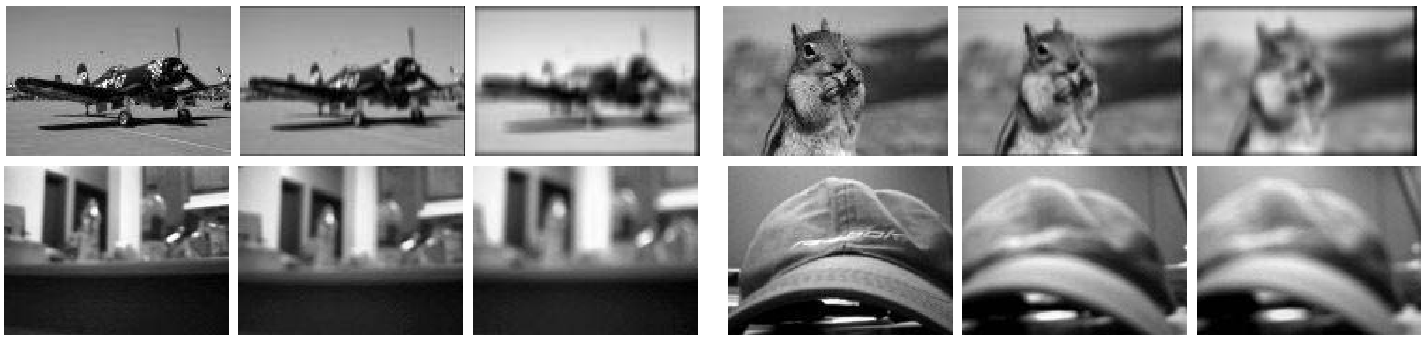 Examples of the system correctly ranking images by their focus level.
Critical Analysis & Conclusion
Takeaway
The "Classification Approach to Ranking" is a powerful paradigm shift. It proves that by carefully designing the input space (embedding thresholds into the feature vector), we can use highly optimized binary classifiers (like SVM) to solve complex preference problems.
Limitations
The approach assumes a fixed number of ranks for the "Ranking" problem. In "Sorting" scenarios where , the method still relies on a single projection axis, which might not capture multi-dimensional preferences (e.g., I like this movie for its action, but that one for its acting).
Future Outlook
This work lays the groundwork for modern "Learning to Rank" systems used in search engines and recommendation systems. The idea of augmenting feature vectors with structural information is a precursor to how modern neural networks use positional or structural embeddings.