
Decoding Employability: A Data Mining Approach to Graduate Success
A Classification-Based Graduates Employability Model for Tracer Study by MOHE
This paper presents a systematic data mining approach to construct a Graduates Employability Model using classification techniques. Focused on the Malaysian Ministry of Higher Education (MOHE) Tracer Study data, the authors benchmarked Bayes-based and tree-based algorithms, identifying J48Graft as the SOTA classifier with 92.3% accuracy for predicting post-graduation employment status.
TL;DR
Higher education institutions produce thousands of graduates annually, but predicting their market readiness remains a complex challenge. This paper leverages the Malaysian MOHE Tracer Study (12,830 instances) to build a predictive model for employability. By comparing Bayes and Tree-based algorithms, the research finds that the J48Graft algorithm achieves a superior 92.3% accuracy, identifying industry sectors and job status as more critical than traditional academic metrics.
The "Why": Moving Beyond Qualitative Surveys
For years, employability research has been the domain of social scientists using manual interviews and small-scale surveys. However, as the volume of graduates grows, these methods fail to capture the "hidden patterns" within national databases. The authors identify a critical gap: despite having access to the massive MOHE Tracer Study database, the industry lacked a robust, automated classification model to predict whether a graduate would end up employed, unemployed, or in an "undetermined" state.
Methodology: Bayes vs. Trees
The study treats employability as a supervised classification task. The researchers performed rigorous preprocessing, including:
- Data Discretization: Converting continuous values like CGPA and Age into categorical intervals to optimize classifier performance.
- Feature Engineering: Using Information Gain to rank 20 different attributes.
The Battle of Algorithms
The core of the paper lies in the head-to-head comparison between two distinct mathematical philosophies:
- Bayesian Methods: Statistical models (like Naïve Bayes and AODE) that estimate prior and posterior distributions to assign class probabilities.
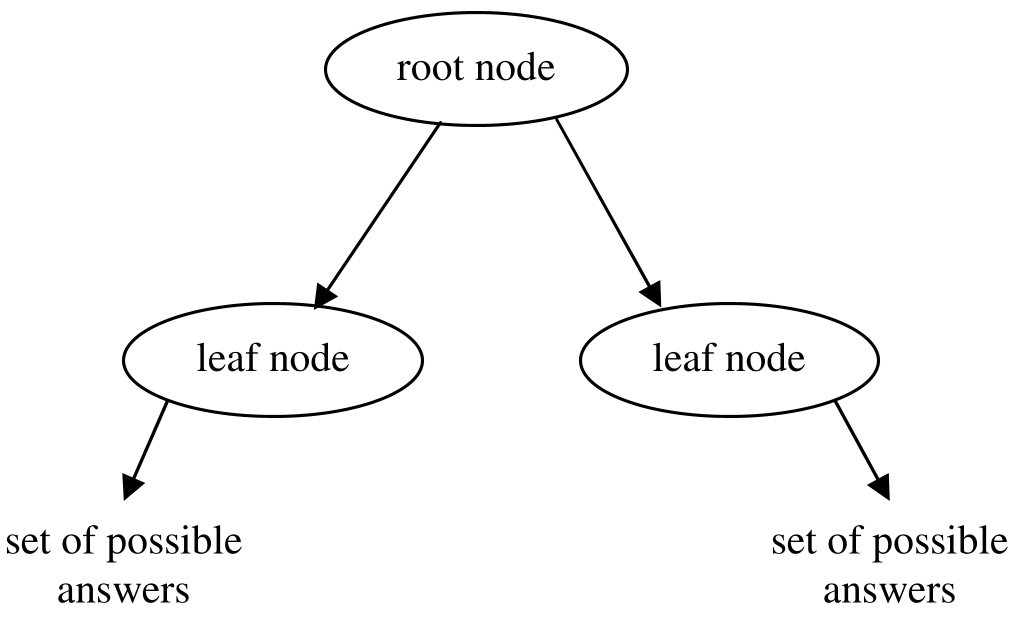
- Tree-based Methods: Logic-driven models (like J48 and REPTree) that sort instances down branches based on attribute tests.
Insights from Information Gain
One of the most striking findings is the ranking of influencing factors. While students often obsess over CGPA, the Information Gain analysis showed that the Job Sector and Job Status are the most powerful discriminators for classification.
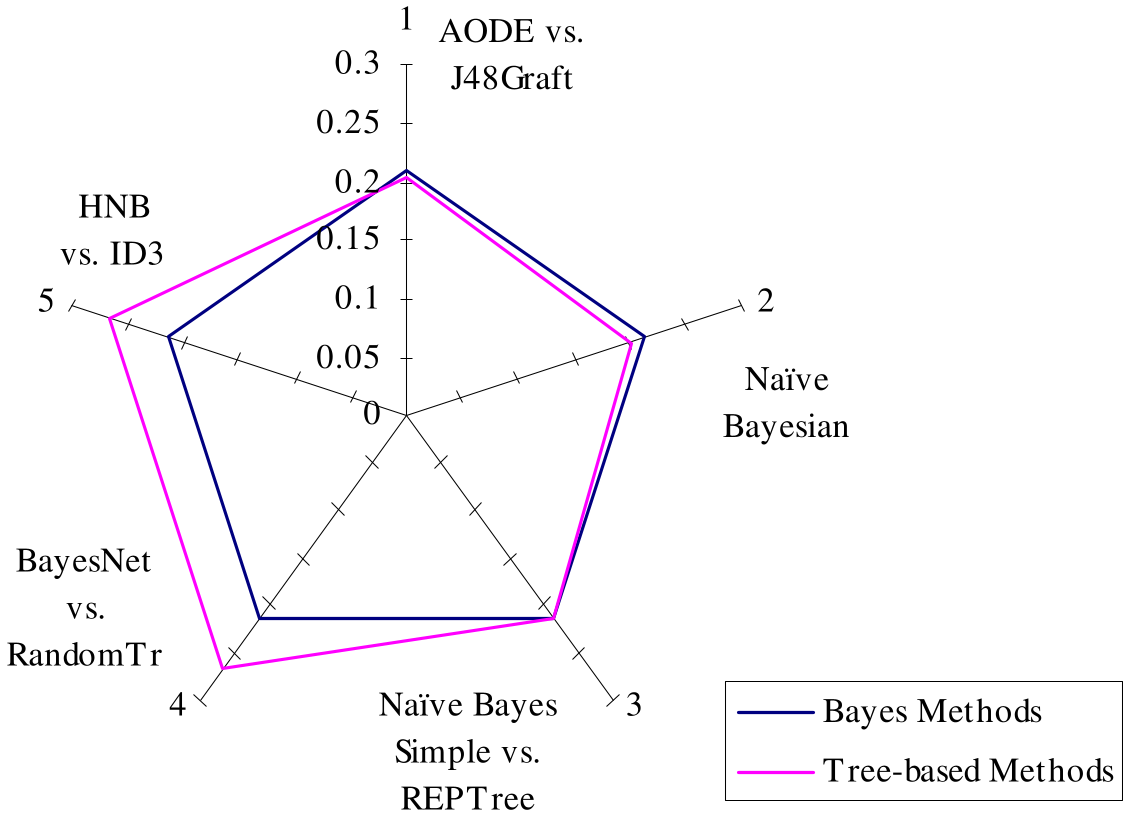 Fig 1: A radial display showing the Root Mean Squared Error (RMSE) across algorithms. Tree-based methods (lower RMSE) generally provided better forecasts than Bayes counterparts.
Experimental Results & SOTA Performance
The researchers found that J48Graft (a variant of the C4.5 tree) achieved the highest accuracy. The secret to its success is Grafting: unlike standard pruning which removes branches to simplify the tree, grafting adds nodes using non-local information to identify predictive patterns in regions of the data that are sparsely populated.
| Algorithm | Accuracy (%) | Kappa Statistic |
|---|---|---|
| J48Graft | 92.3 | 0.849 |
| J48 | 92.2 | 0.848 |
| AODE (Best Bayes) | 91.1 | 0.827 |
| Naïve Bayesian | 90.9 | 0.825 |
Critical Analysis & Conclusion
Takeaway
The study proves that tree-based classifiers are more "knowledge-friendly" for educational datasets. They don't just provide a prediction; they provide a readable logic path (the tree structure) that policymakers can use to understand why certain graduates are struggling.
Limitations & Future Work
While the accuracy is high, the authors acknowledge a "confidentiality gap"—10% of attributes were unavailable due to sensitivity issues. Furthermore, the model is a snapshot of the first six months post-graduation.
The next frontier for this research involves Clustering-based Preprocessing and the integration of Alumni Data to create a longitudinal view of employability that evolves as a career progresses.
Professional Perspective
This work represents a solid transition from descriptive statistics to predictive analytics in educational administration. By identifying J48Graft as the optimal classifier, it sets a technical benchmark for future Intelligent Student Information Systems (ISIS) in the ASEAN region.