
Decoding the Sound of Feelings: Mapping Emotions to Japanese Onomatopoeia
Classification of Emotional Onomatopoeias Based on Questionnaire Surveys
This paper presents a quantitative study on the emotional classification of 324 Japanese onomatopoeias using Plutchik’s eight basic emotions. The authors achieve a moderate inter-rater agreement (Kappa = 0.600) and demonstrate that providing dictionary definitions significantly improves classification consistency.
TL;DR
Researchers from Aoyama Gakuin and Hokkaido University investigated whether Japanese onomatopoeia—words like uki-uki (cheerful) or gira-gira (glaring)—can reliably serve as emotional markers for AI. By testing 324 words against Plutchik’s eight basic emotions, they found that while native speakers share a general intuition, "dictionary grounding" is essential to resolve semantic ambiguity and improve inter-rater agreement for complex affective states.
The "Sensory-Emotion" Gap
Japanese is famously rich in onomatopoeia (mimesis), used not just for sounds (giongo) but for physical states and internal feelings (gitaigo). For Natural Language Processing (NLP) to truly understand human sentiment, it must decode these "shortcut" expressions. However, the problem lies in subjectivity. Does jiri-jiri mean the sound of a bell (neutral), the scorching sun (discomfort), or someone running out of patience (anger)? Without a unified baseline, human-labeled data—the fuel for AI—remains noisy and inconsistent.
Methodology: From Intuition to Definition
The authors hypothesized that native speakers could intuitively detect emotions, but initial tests showed significant variance. To bridge this gap, they employed a two-stage experimental design:
- Preliminary Blind Test: 10 raters categorized 324 onomatopoeias based on Plutchik’s basic emotions (Joy, Anger, Sadness, etc.).
- Definition-Guided Refinement: For the most contentious 122 words, raters were provided with explicit dictionary definitions to anchor their judgments.
The Taxonomy of Japanese Mimetic Sounds
The study utilized a comprehensive list of onomatopoeias categorized by their dictionary-defined functions:
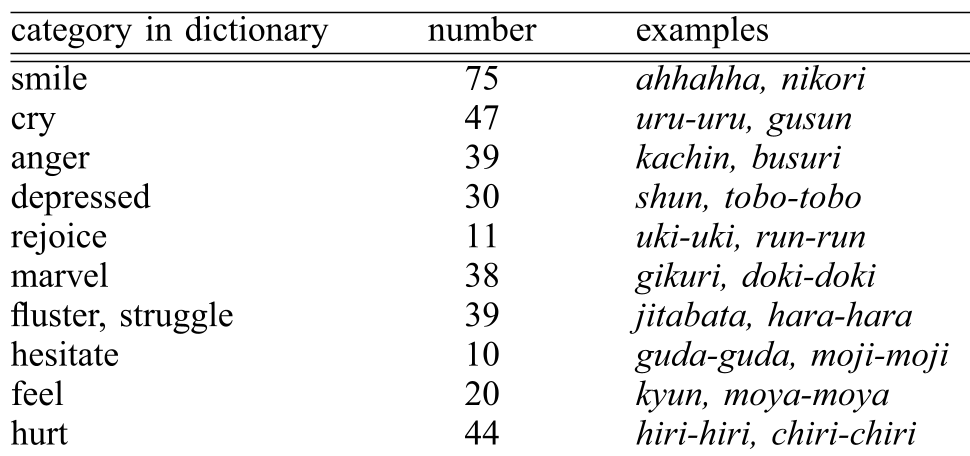 The categories range from "Smile" (ahhhha) to "Hurt" (hiri-hiri), illustrating the broad spectrum of emotional and sensory coverage.
Metrics of Agreement: Cohen’s Kappa
To measure reliability, the authors used the Kappa Coefficient, which adjust for "chance agreement." In the preliminary experiment, the scores were respectable (Average 0.600, indicating "substantial agreement"), but specific pairs of raters dipped into the "fair" range (0.338).
The discrepancy was often caused by "Meaning Collision." For word like jiri-jiri, some raters looked at the sensory meaning (the sun) while others looked at the psychological meaning (impatience).
Key Results: Improving Consistency
When the researchers introduced definition sentences, the consistency for the most difficult words saw a measurable leap:
- Agreement Rate: Increased from 20.6% to 31.5%.
- Kappa Coefficient: Increased from 0.293 to 0.359.
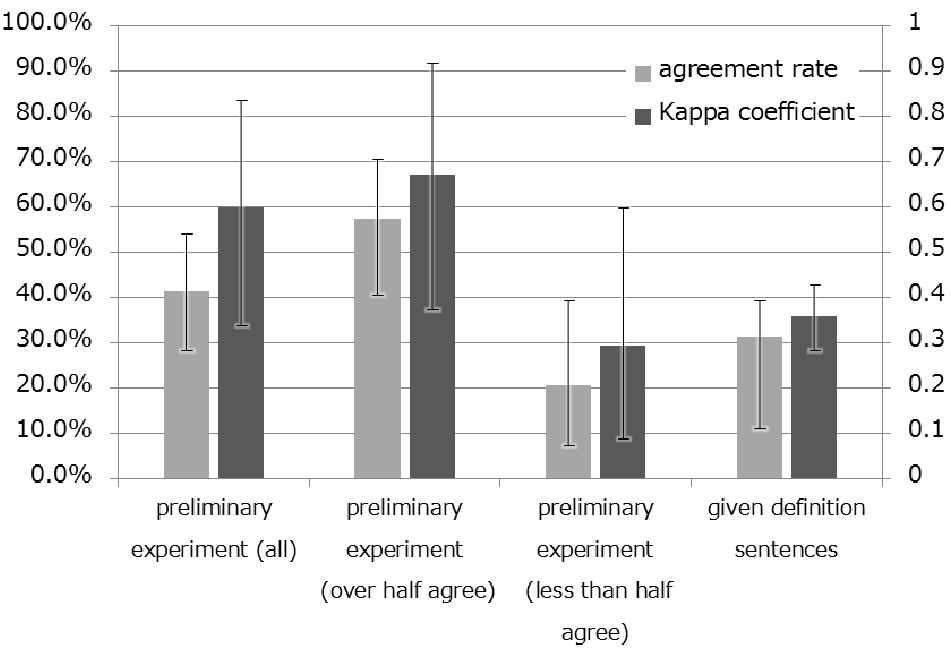 The visual evidence shows that while "Grounding" (definitions) helps, some words remain inherently polysemous or non-emotional.
Critical Analysis: The Limit of Basic Emotions
One of the paper’s most interesting findings is the existence of 34 "unclassifiable" onomatopoeias. Words like atafuta (falling into a flutter) incorporate Joy, Surprise, and Fear simultaneously. The authors conclude that these words are either unfit for Plutchik’s discrete categories or represent sensory movements devoid of static emotion.
Takeaway for Future AI
For developers building sentiment analysis tools for Japanese or other onomatopoeia-heavy languages:
- Context is King: Modeling onomatopoeia as isolated tokens is insufficient; sentence-level context is required to disambiguate sensory vs. emotional usage.
- Beyond Basic Emotions: Future research should leverage "Complex Emotion" models (secondary and tertiary emotions) to capture the nuances of words like dogimagi.
Conclusion
This work provides a critical foundation for using Japanese onomatopoeia as a "landmark" for human-computer interaction. By quantifying the difficulty of emotional labeling, it paves the way for more robust, context-aware affective computing.