
Leveraging the Unlabeled: Enhancing Bio-Physiological Emotion Recognition via Unsupervised Pre-training
Classification of Emotional States in a Woz Scenario Exploiting Labeled and Unlabeled Bio-physiological Data
The paper introduces a partially supervised learning framework for recognizing emotional states in Human-Computer Interaction (HCI) using bio-physiological signals. By integrating unsupervised clustering (k-means, Neural Gas, GMM) as a preprocessing step, the method effectively leverages both session-specific labeled data and unrelated unlabeled data to improve classification robustly.
TL;DR
This research tackles the chronic shortage of labeled data in affective computing. By using unsupervised techniques like Neural Gas and Gaussian Mixture Models (GMM) to create a new representation space before classification, the authors show that "irrelevant" or unlabeled bio-physiological data can actually help a model identify emotional states like pleasure and arousal more accurately than using labeled data alone.
The Data Scarcity Bottleneck
In the world of Human-Computer Interaction (HCI), teaching a machine to "feel" what a user feels is notoriously difficult. The primary hurdles are:
- Expensive Labeling: Expert annotation of physiological signals (Heart rate, Skin conductance) is time-consuming.
- Subject Variability: Your "stressed" heart rate looks very different from mine, making universal models weak.
- Temporal Bias: Bio-signals are time-dependent; if you train on samples adjacent to your test set, the model "cheats" by remembering the signal's drift rather than the emotion.
The authors argue that current supervised models fail because they don't have enough data to grasp the complex manifold of human physiology.
Methodology: The "Activation" Insight
Instead of feeding raw features directly into a Support Vector Machine (SVM), the authors propose a two-step "Partially Supervised" pipeline:
- Structural Discovery (Unsupervised): They take all available data—even data from sequences where the emotion labels aren't the ones being tested—and run it through clustering algorithms (k-means, Neural Gas) or density estimators (GMM).
- Feature Transformation: Each data point is redefined by its relationship to these clusters. For example, a sample is no longer just a "heart rate of 80"; it becomes an "activation vector" representing how close it is to 15 different physiological prototypes.
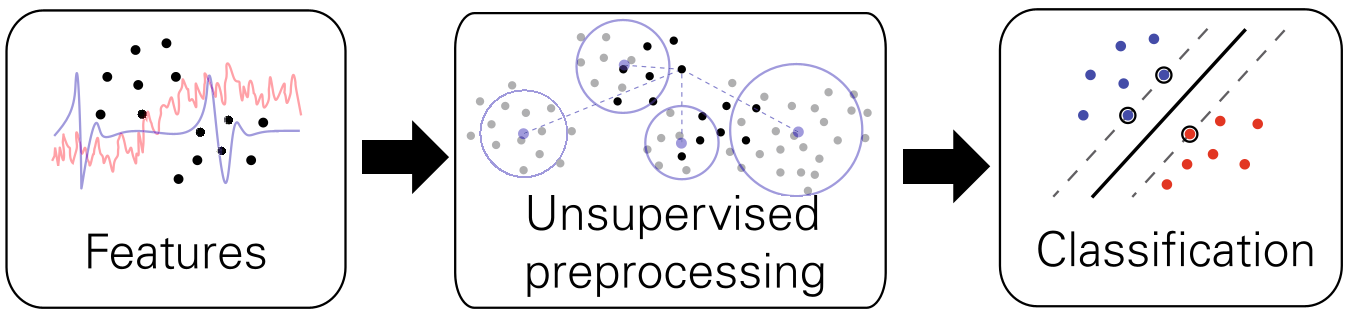 Algorithm 1: The transformation of labeled data into a new prototype-based representation space.
This approach treats the unsupervised step as an "initialization" of a hidden layer, similar to how Radial Basis Function (RBF) networks operate.
Experimental Setup: The Wizard-of-Oz Scenario
The data was collected using a Wizard-of-Oz (WoZ) design where 20 participants interacted with a voice-controlled interface. To induce emotions, the "computer" (actually controlled by a researcher) acted out either "positive" (praising the user) or "negative" (wrongly executing commands, dispraising) behaviors.
The study focused on distinguishing between:
- ES-2: High Pleasure / Low Arousal / High Dominance (Positive)
- ES-5: Low Pleasure / High Arousal / Low Dominance (Negative)
Results and Performance
The results prove that "more data is better," even if that data isn't labeled for the specific task at hand.
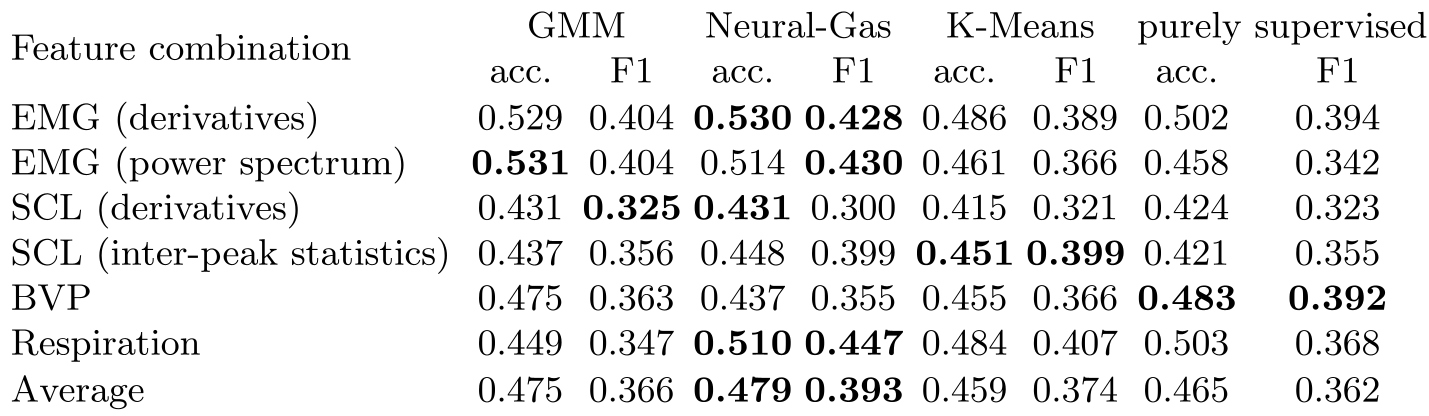 Table 1: Comparison of Accuracy and F1-scores across different feature combinations and learning strategies.
Key Findings:
- EMG is King: Electromyography (muscle activity) features yielded the highest accuracy (~53%), followed closely by Respiration.
- GMM Dominance: Using Gaussian Mixture Models to estimate the data density was the most effective strategy, outperforming purely supervised SVMs in the majority of individual subject trials (32.4% win rate).
- Robustness: The partially supervised methods provided more stable results, helping the classifier avoid simply guessing the majority class.
Critical Analysis & Conclusion
While an accuracy of ~53% might seem low compared to Computer Vision benchmarks, in the noisy, high-variance realm of bio-physiological emotion recognition, these gains are significant.
Takeaway for the Industry: The core lesson here is that domain-specific structure matters. When building HCI systems, don't throw away "unlabeled" sessions. Use them to map the "physiological landscape" of your user. This pre-training step ensures that when the labeled data finally arrives, the model already understands the language of the sensors.
Future Directions: The paper suggests that the next frontier is Multimodal Fusion—combining the 6 individual classifiers (EMG, SCL, BVP, etc.) into a committee of experts—and integrating temporal segmenting to better handle the flow of emotions over time.