
GSAM: Bridging Genetic Evolution and Wavelet Precision for Healthcare Diagnostics
Classification of healthcare data using genetic fuzzy logic system and wavelets
The paper introduces GSAM, an integrated healthcare data classification system that combines a Fuzzy Standard Additive Model (SAM) with Genetic Algorithms (GA) and Wavelet Transformation (WT). Achieving up to 97.40% accuracy on breast cancer datasets, it establishes a new SOTA for interpretable medical decision support.
TL;DR
Diagnosis in medicine is a battle against noise and complexity. The paper "Classification of healthcare data using genetic fuzzy logic system and wavelets" introduces GSAM, a hybrid model that fuses Fuzzy Logic, Genetic Algorithms (GA), and Wavelet Transforms. By intelligently pruning fuzzy rules and extracting non-obvious features, GSAM achieves superior accuracy on breast cancer (97.4%) and heart disease (78.8%) benchmarks compared to traditional SVMs and Neural Networks.
The Pain Point: High Dimensions and Medical Uncertainty
In the medical field, data is rarely "clean." Whether it's cell thickness in tumors or cholesterol levels in heart patients, the variables are often high-dimensional and riddled with uncertainty.
- The Technical Trap: Traditional fuzzy systems suffer from rule explosion. As you add more inputs, the number of "If-Then" rules grows exponentially (), leading to a massive computational burden and falling into local minima during training.
- The Feature Flaw: Standard dimension reduction like PCA often misses subtle, discriminative signals because it focuses purely on variance rather than class separation.
The Methodology: The Three Pillars of GSAM
1. Feature Extraction via Wavelets (WT)
Instead of using raw clinical data, the authors use Haar Wavelets. To decide which wavelet coefficients to keep, they utilize the Kolmogorov–Smirnov (KS) test. Unlike PCA, which looks for variance, the KS test identifies features that deviate most from a normal distribution—often where the most "interesting" medical markers hide.
2. Genetic Algorithm (GA) Optimization
GSAM doesn't just use all initialized rules. It treats rules as "genes" in a chromosome. Through selection, crossover, and mutation, the GA finds the "fittest" set of rules that minimize both prediction error and the total number of rules. This ensures a lean, efficient model.
3. The Hybrid Learning Pipeline
The system follows a sophisticated learning path:
- AVQ Clustering: Unsupervised initialization of fuzzy patches.
- GA Phase: Evolutionary pruning.
- Gradient Descent: Final supervised fine-tuning.
 Figure 1: The integrative learning process of GSAM, combining evolutionary and gradient-based methods.
Experimental Results: SOTA Performance
The authors compared GSAM against Probabilistic Neural Networks (PNN), SVMs, and ANFIS.
Key Findings:
- Breast Cancer: GSAM + Wavelets reached 97.40% accuracy, outperforming every other benchmark.
- Heart Disease: This noisier dataset saw the biggest benefit from Wavelets, with accuracy jumping from 63.17% (Original) to 78.78% (Wavelet).
- Efficiency: Using 3 wavelet features instead of 9 original features reduced processing time for SAM systems by nearly 75%.
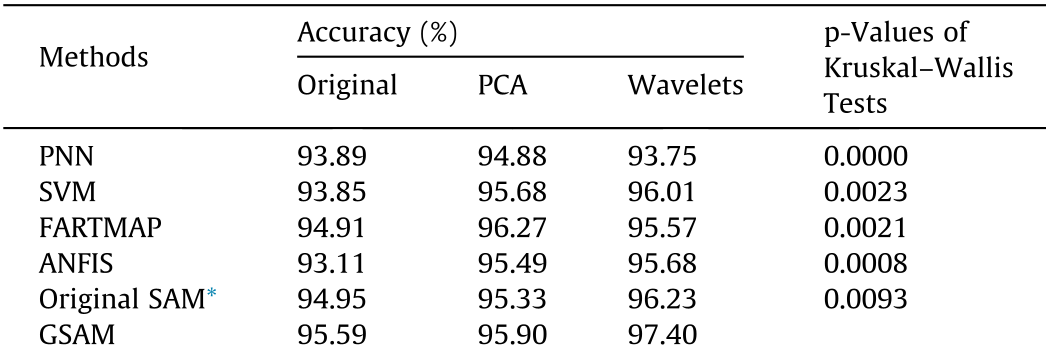 Table 1: Accuracy comparison across different feature extraction methods. GSAM consistently dominates.
Visual Evidence: Why Wavelets?
The paper provides compelling 3D projections of the feature space. Note how the Wavelet-transformed features (Fig. 12/20) provide a much clearer separation between "Healthy" and "Diseased" clusters compared to raw data or PCA.
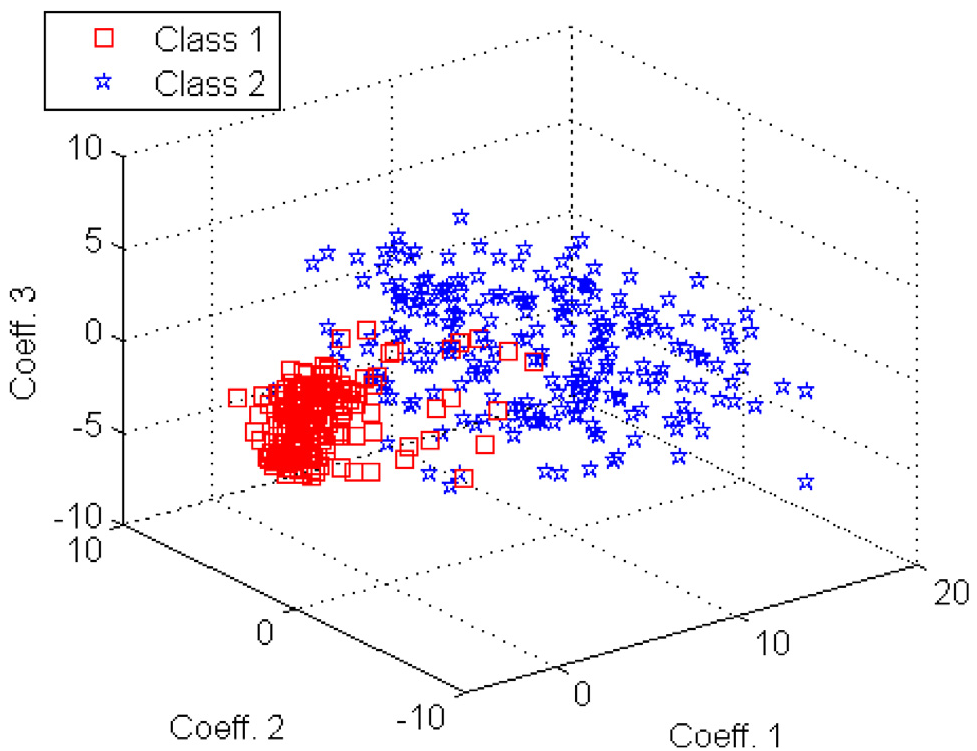 Figure 2: 3D Projection of features. Wavelet Transformation creates significantly more "linearly separable" clusters.
Critical Insight & Future Outlook
Takeaway: The real magic of GSAM is not just the fuzzy logic, but the pre-processing strategy. By using Wavelets with a KS test, the authors effectively "denoised" the medical data before the AI ever saw it.
Limitations: While accurate, GSAM is slower than PNN or SVM due to the evolutionary GA cycle. The authors suggest that future iterations could replace the gradient descent part with Extreme Learning Machines (ELM) to achieve near-instant training times.
Conclusion: GSAM proves that in the medical domain, "less is more." By using fewer, but more mathematically salient features, we can build diagnostic tools that are both more accurate and more interpretable for clinicians.