
Beyond Spambots: Decoding Automated Agents on Twitter via Popularity-Based Classification
12014_Classification of Twitter Accounts into Automated Agents and Human Users.
This paper presents a systematic methodology for classifying Twitter accounts into "automated agents" and "human users." It introduces a popularity-based partitioning approach and a Random Forests classifier trained on a large-scale human-annotated dataset, achieving accuracy levels comparable to human inter-annotator agreement.
TL;DR
Researchers from the University of Cambridge have developed a sophisticated framework to distinguish between human users and automated agents (bots) on Twitter. By abandoning the "one-size-fits-all" detection model in favor of popularity-based partitioning and focusing on source metadata, their Random Forests classifier achieved an accuracy of 86.44%, effectively matching human-level intuition and doubling the performance of existing benchmarks.
Problem & Motivation: The Identity Crisis of OSNs
Twitter's open API has been a double-edged sword. While it facilitates innovation, it has also led to an explosion of automated agents—ranging from benevolent news aggregators to malevolent political infiltrators.
The authors argue that previous work suffered from two fatal flaws:
- Spam Paradox: Most researchers conflate "bot" with "spam." In reality, many bots are helpful (e.g., emergency alerts), and many spammers are human.
- Heterogeneity Ignorance: A celebrity account with 10 million followers behaves fundamentally differently than an average user with 1,000 followers. Treating them as a single distribution leads to massive false positives.
The "Aha!" moment for this research was realizing that the source of the tweet (Is it coming from a mobile app or a Python script?) is a far more robust indicator of automation than the content itself.
Methodology: Divide and Conquer
The core innovation lies in partitioning the 60-million tweet dataset into four Popularity Bands:
- Band 10M: Global celebrities and major news entities.
- Band 1M: Highly popular niche influencers.
- Band 100K: Mid-tier active accounts.
- Band 1K: The "Bulk of Twitter"—ordinary users.
Feature Engineering
The study utilizes 21 features, but the breakthrough comes from the Activity Source Identity. The authors categorized thousands of Twitter API "source" strings into seven types:
- S1/S2: Browser and Mobile (Human-centric).
- S4/S5/S6: Scheduling tools, Marketing platforms, and News services (Agent-centric).
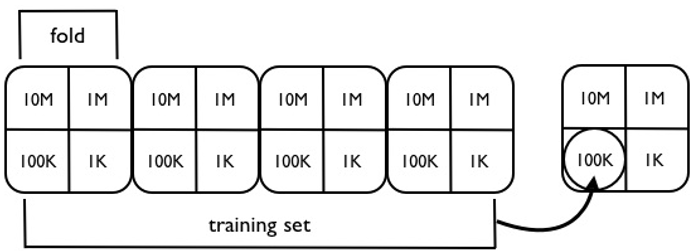 Fig 1. The experimental design for 5-fold cross-validation across segregated popularity bands.
Experiments & Results: Crushing the Baseline
The researchers compared their Random Forests model against BotOrNot (a leading academic tool at the time). The results were stark: while human annotators agreed with each other 89% of the time, they only agreed with BotOrNot 48% of the time. This suggests that existing tools were essentially "flipping a coin" on many account types.
Key Findings:
- Accuracy: The proposed model reached 100% accuracy for Band 10M and 88% for the common Band 1K users.
- Cross-Band Generalization: Training on one popularity band and testing on another proved that features like "Tweet Frequency" and "Source Identity" are universal hallmarks of automation.
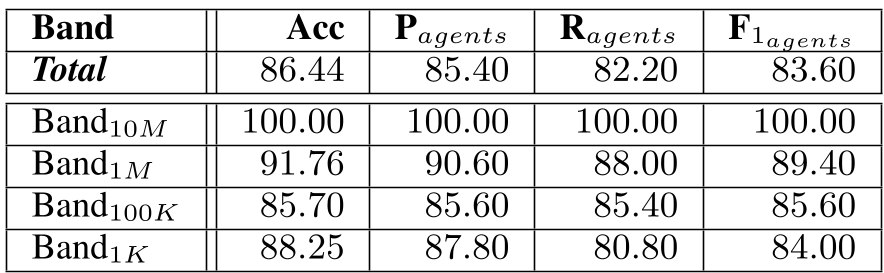 Fig 2. Classification performance (Precision, Recall, F1) showing high stability across different user tiers.
Critical Analysis & Takeaways
Why it works
The success of this method stems from recognizing the Infrastructural Footprint of bots. A bot can mimic human text, but it rarely uses a mobile phone interface to post. By prioritizing the "How" (source endpoint) over the "What" (content), the model becomes resilient to evolving Natural Language Generation.
Limitations
The study notes a "grey area" in Band 100K, where human agreement was lowest. These are often "cyborg" accounts—human-managed profiles that use automation for high-volume posting. Distinguishing between a very active human and a very "human-like" bot remains the frontier of this field.
Future Outlook
As LLMs (like GPT-4) make bot content indistinguishable from human prose, the metadata-driven approach pioneered here will likely become the primary line of defense for platform integrity. Future iterations will need to incorporate temporal patterns (inter-arrival times of tweets) to catch more sophisticated, throttled automated agents.
Final Takeaway: To find a bot, don't just read what it says; look at the tools it uses to say it.