
Decoding the Gender Factor in Quality Control: A Machine Learning Perspective
Classifier-based analysis of visual inspection: Gender differences in decision-making
This paper investigates gender differences in visual quality inspection decision-making using a machine learning approach. By modeling the decisions of 100 subjects (50 male, 50 female) with rule-based classifiers, the study identifies that while overall accuracy is similar, women demonstrate significantly higher detection rates (lower miss rates) by adopting more conservative decision criteria.
TL;DR
Is the industry intuition that "women are better at inspection" actually true? This study moves beyond anecdotal evidence by using Machine Learning classifiers to "clone" the decision-making logic of 100 human subjects. The results show that while both genders are equally "accurate," women are significantly better at catching defects (lower miss rates) because they apply stricter internal thresholds, especially when judging physical defects like scratches.
The "Intuition" vs. Evidence Gap
In many factories, visual inspection lines are dominated by female workers. The management's logic is usually rooted in the belief that women possess higher endurance and better consistency. However, from a scientific standpoint, "consistent" doesn't necessarily mean "different." While ergonomics has studied visual search (how eyes move), the actual logic of the decision (accept vs. reject) remained a black box.
The authors of this paper argue that to understand these differences, we shouldn't just look at the final score (Accuracy), but rather at the Decision Boundary—the invisible line in a person's mind that separates a "pass" from a "fail."
Methodology: Training Classifiers as Human Surrogates
The core innovation of this work is the use of ML classifiers to model human behavior. Instead of using a classifier to replace a human, they use it to represent the human.
1. The Tube of Interest (ToI)
If you show an inspector a glaringly obvious defect, everyone agrees it's a "reject." This provides zero data on their unique decision logic. The researchers focused on the "Tube of Interest"—images that sit right on the edge of the official inspection standard where human disagreement is highest.
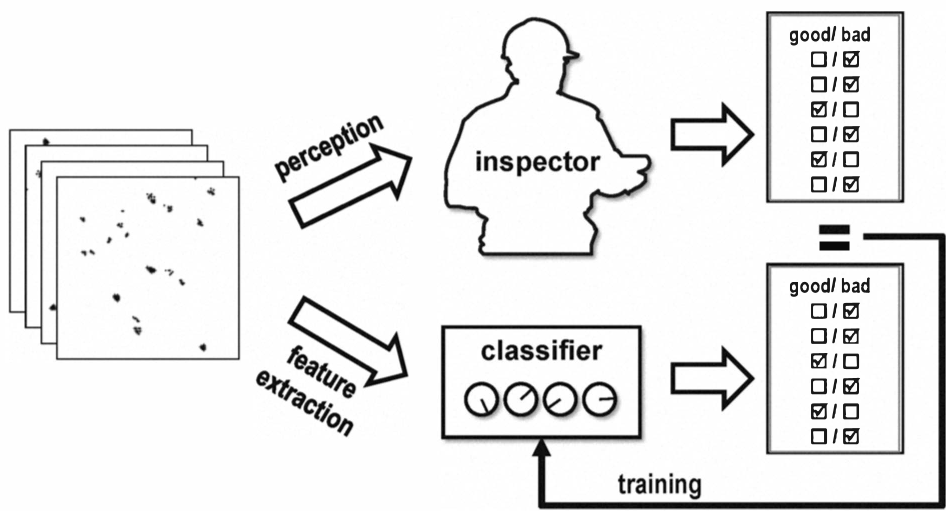 Fig 1: Classifiers are tuned (like knobs) to match the unique decision pattern of each human subject.
2. Rule-Based Modeling
The team utilized a version of the Disjunctive Normal Form (DNF) to translate inspection standards (e.g., "Reject if scratch > 5mm AND in critical zone") into a mathematical framework. By comparing how a human's "subjective thresholds" deviated from the "official thresholds," they could quantify gender-specific biases.
Key Findings: Risk-Takers vs. Gatekeepers
The experiment involved 600 images containing scratches, cavities, and dirt spots.
The "Miss" Gap
The most striking finding was in the Miss Rate (Type II Error). Men missed significantly more defects than women (d = 0.649, p = 0.002). In Signal Detection Theory terms, men adopted a "risky" criterion—preferring to let a borderline part pass rather than risk a false alarm. Women, conversely, were more conservative "gatekeepers."
Where the Difference Lives: Scratches
Using the classifier parameters, the researchers found that these differences weren't uniform. The "Gender Gap" was most extreme when judging the length of scratches.
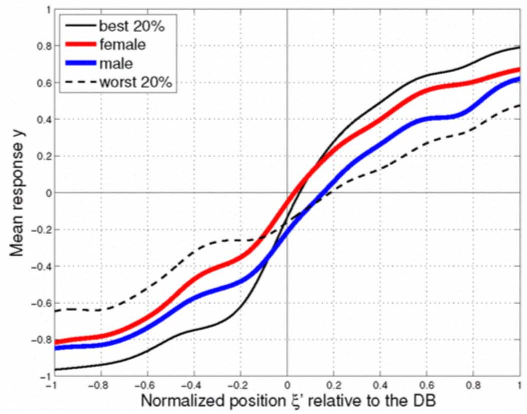 Fig 2: Response curves showing how male and female subjects diverge as stimulus values move toward the decision boundary.
Detailed Results Analysis
Looking at the quantitative data (Table V), we see that women applied lower thresholds for scratch sizes. In a real-world factory setting, this means a woman is more likely to reject a part with a borderline scratch that a man might let slip through.
| Metric | Female Mean | Male Mean | Effect Size |
|---|---|---|---|
| Miss Rate | 14.0% | 17.3% | 0.649 (High) |
| False Alarm Rate | 11.3% | 9.1% | -0.414 (Med) |
| Scratch Size Threshold | 0.286 | 0.546 | 0.575 (Med) |
Critical Insight: Why Does This Matter?
The study proves that gender differences in inspection aren't about "better eyes"—they are about Different Risk Profiles.
- For Industry: If the cost of a "miss" (a defective part reaching a customer) is high, female inspectors provide an objective statistical advantage due to their conservative bias.
- For AI Research: This paper highlights that "Ground Truth" is often subjective. If we train an AI on data labeled solely by one gender or one group, the AI will inherit that group's specific risk-aversion profile.
Conclusion & Future Work
The authors successfully demonstrated that classifier-based modeling is a powerful tool for psychometric analysis. While the current model explains about 85% of human responses, future work aims to use more complex, non-linear models to capture the "logic" that simple rule-based systems might miss. The takeaway is clear: when it comes to the "final line of defense" in manufacturing, the female conservative bias is a measurable, valuable asset.