
Beyond Sentiment: Automated Emotion Mapping in Crisis Tweets
Learning to classify emotional content in crisis-related tweets
This paper presents a supervised machine learning approach for "Affect Analysis" in social media during crises, specifically classifying tweets into four categories: Positive, Anger, Fear, and Other. Using 2.3 million tweets from Hurricane Sandy, the authors built a Support Vector Machine (SVM) classifier that achieves 60% accuracy on the multi-class problem, significantly outperforming rule-based baselines.
TL;DR
Researchers from the Swedish Defence Research Agency (FOI) have developed a method to move beyond simple "Positive/Negative" sentiment analysis toward multinomial affect analysis (Fear, Anger, Joy) in crisis situations. By training an SVM on tweets from Hurricane Sandy, they achieved a ~60% accuracy rate across four categories, providing a blueprint for how emergency responders can monitor public psyche in real-time.
The Problem: Information Overload vs. Emotional Nuance
During a disaster, social media is a double-edged sword: it offers unprecedented "tactical situational awareness," but the sheer volume of data makes manual human monitoring impossible.
Most previous work (e.g., Alert4All project) focused on binary sentiment. However, for a responder, the distinction between Fear (potential panic) and Anger (dissatisfaction with response efforts) is critical. The authors argue that multinomial classification—identifying specific emotional states—is the key to making social media actionable for command and control.
Methodology: Engineering a Balanced Dataset
One of the greatest challenges in crisis data is the imbalance. Most tweets are neutral or irrelevant ("Other"). To solve this, the authors used a biased sampling method:
- Keyword Seeding: Using seeds like "scared," "furious," and "happy" (and their WordNet synonyms) to find 1000 candidate tweets for each emotion.
- Strict Annotation: Three independent annotators labeled the tweets. They used a "Majority Agreement" rule to ensure data quality.
- Threshold-based Logic: Because the "Other" class is too varied to learn directly, the model learns the three specific emotions. If a new tweet doesn't strongly reflect any of them (based on a probability threshold ), it is relegated to "Other."
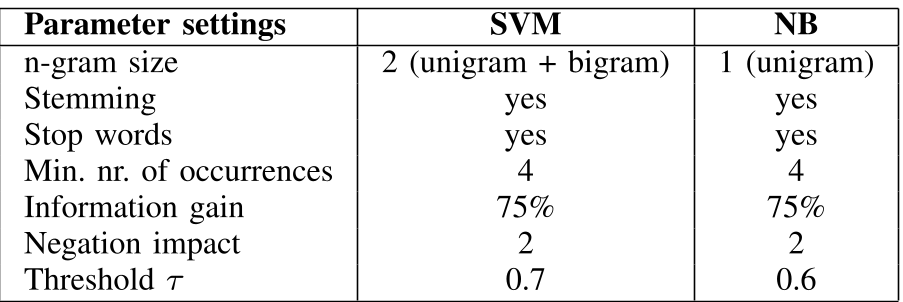 Table 1: Optimal parameter settings for SVM and Naive Bayes classifiers.
Experiments and Results
The authors tested Support Vector Machines (SVM) and Naive Bayes (NB) against two baselines: a random choice and a rule-based system.
Key Insights:
- SVM Dominance: The SVM outperformed all other methods, hitting 59.7% accuracy on the 4-class problem.
- Emotional Precision: When the task was simplified to just choosing between the three emotions (Fear, Anger, Positive), the SVM accuracy jumped to 75.3%.
- Feature Engineering: Stemming, stop-word removal, and Information Gain (IG) selection were crucial. Keeping only the top 75% most informative features yielded the best results.
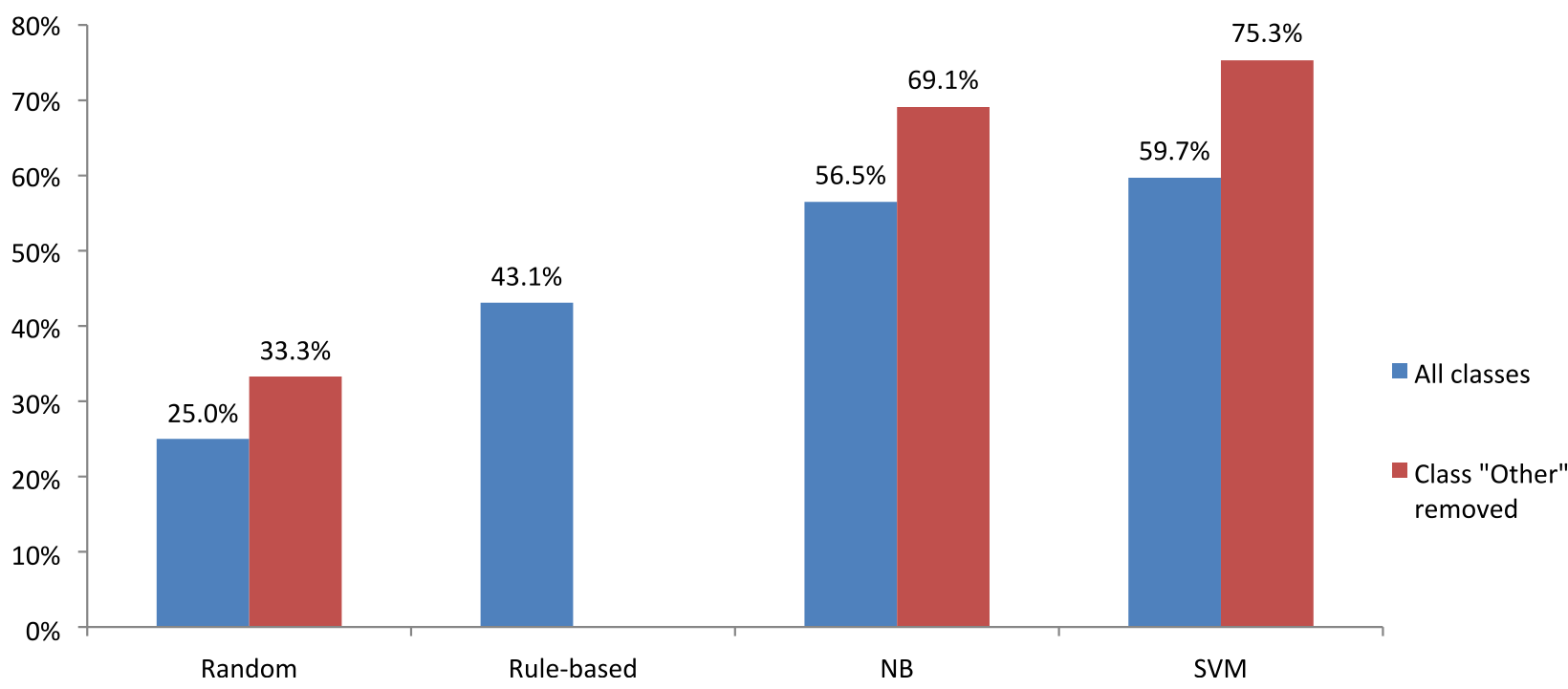 Figure 1: Comparison of classifier accuracy. Blue indicates the full dataset (including "Other"), while red shows performance on emotional classes only.
Critical Analysis: Is it Ready for the Field?
The authors are refreshingly objective: at ~60% accuracy, this tool should not be used to judge individual tweets. However, it is highly effective for aggregate monitoring. If a 10% spike in "Fear" is detected across a city after an official alert, authorities can immediately recognize that their messaging needs adjustment.
Limitations:
- Sarcasm: Sarcasm remains a major hurdle for bag-of-words models.
- Spatio-Temporal Awareness: The current model struggles to distinguish between "I am scared now" (current state) and "I was scared yesterday" (historical state).
Conclusion
This work represents a vital step toward a more psychologically-aware crisis response system. By moving from simple sentiment to specific emotions, emergency organizations can better understand the "pulse" of the population during their most vulnerable moments. Future iterations combining this domain-specific training with large affective lexicons promise even higher precision.