
Not Every Friend is a Friend: Decoding Social Media Imposters with Decision Trees
Not every friend on a social network can be trusted: Classifying imposters using decision trees
Identifying fake accounts or "imposters" on Online Social Networks (OSNs) like Facebook using a feature-based decision tree classification approach. The study achieves a peak accuracy of 92.1% by analyzing profile attributes rather than message content or complex social graphs.
TL;DR
With over 83 million fake accounts estimated on Facebook, the threat of identity theft and scams is at an all-time high. This paper explores a prophylactic approach to security by using Decision Tree algorithms to classify imposters. By shifting the focus from "what is said" (text mining) to "who they claim to be" (profile attributes), the researchers achieved an impressive 92.1% detection accuracy.
Background Positioning
In the landscape of social network security, most tools are either reactive (waiting for a report) or computationally heavy (building massive social graphs). This work positions itself as a preventive, feature-based alternative that is human-interpretable and efficient enough to run on mobile devices.
Problem & Motivation: The "Honey-Pot" Effect
Existing methods often assume fake users have few connections. However, the authors debunk this: fake accounts often use attractive avatars to lure in users, creating a "honey-pot" effect where they accumulate hundreds of mutual friends quickly.
The core problem is the lack of initial verification. Once an imposter is in your "friends" circle, they gain a "coat" of legitimacy, making them harder to detect via traditional social graph metrics like Trust-rank.
Methodology: The 13 Dimensions of an Imposter
The researchers identified 13 key attributes to train their models. The most innovative among these is the use of Avatar Authenticity. By using reverse image search (Google Photo Search), they can verify if a user's photo is a "stolen" identity from a celebrity or a model.
Key Attributes Include:
- Profile Completeness: Imposters often leave specific fields blank or use arbitrary data.
- Friend Increase Rate: A localized person gaining 30+ friends a day is a major red flag.
- Avatar Origin: Is the photo original, or does it exist elsewhere as a known public figure?
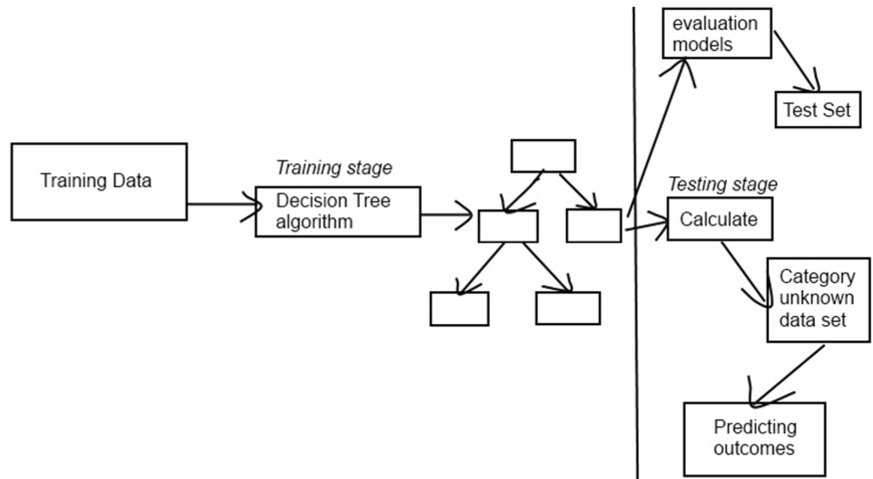 Figure 1: The typical train-and-test process for the proposed Decision Tree model.
Experiment & Results: Which Tree Wins?
The study compared five different algorithms: J48, REPTree, RandomTree, ADTree, and FT.
- Functional Trees (FT): The champion in accuracy (92.1%), but the slowest to train.
- J48 & ADTree: These emerged as the most "balanced" candidates, offering high accuracy (~90%) with much smaller memory footprints (compactness).
The researchers also visualized the social connections of a tested Facebook account with 915 friends. The resulting graph clearly shows how fake accounts, commercial spammers, and real friends form distinct clusters.
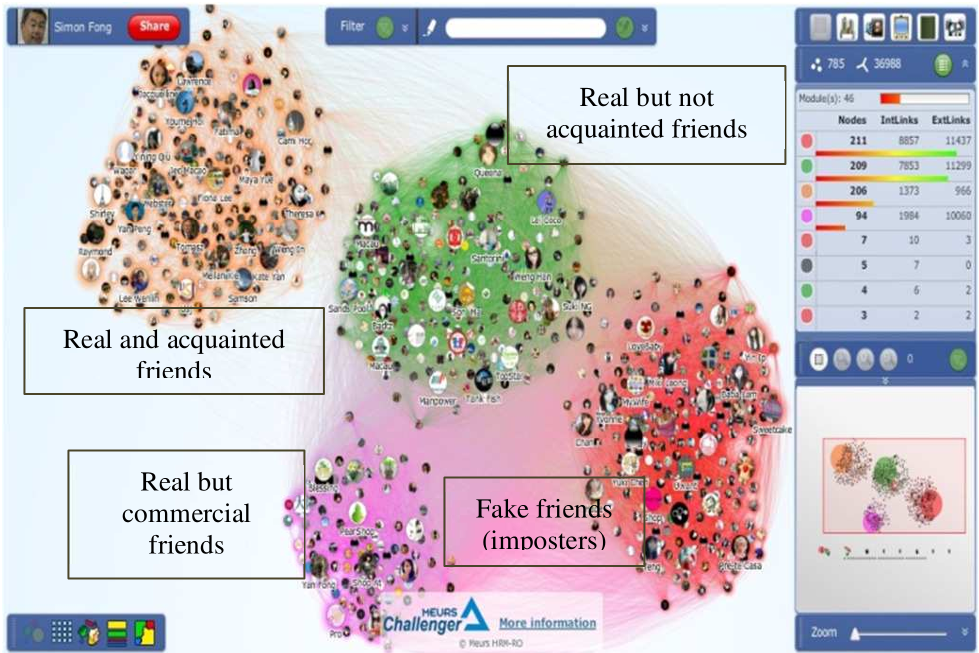 Figure 2: Social graph showing distinct clustering of authentic users vs. fake imposters and commercial accounts.
Performance Metrics
| Classifier | Accuracy | Training Speed | Tree Compactness |
|---|---|---|---|
| FT | 92.1% | Very Low | High |
| ADTree | 90.3% | Medium | High |
| J48 | 87.9% | High | Very High |
Critical Analysis & Conclusion
Takeaway
The study proves that we don't need complex "black-box" AI to identify scammers. Simple IF-THEN-ELSE rules derived from decision trees are sufficient to flag potential imposters with over 90% certainty.
Limitations
The data was collected via a specific "30-mutual-friend" rule, which might introduce some sampling bias. Furthermore, as imposters become aware of these detection attributes (e.g., they start using AI-generated faces that don't appear in reverse image searches), the "Avatar Photo" attribute might lose its effectiveness.
Future Outlook
This approach is highly suitable for Edge Computing—specifically for mobile app integrations that can warn users before they accept a suspicious friend request, rather than cleaning up the damage after the fact.