
Socializing Multimedia: A Metadata-Driven Framework for the Web 2.0 Era
Classifying Multimedia Resources Using Social Relationships
The paper introduces a software framework for multimedia authoring that leverages social relationships and rich metadata to manage heterogeneous user-generated content. By integrating explicit social ties and implicit interest-based clustering, it achieves sophisticated content classification and personalized retrieval through its "Online Community Life" (OCL) blogging portal.
TL;DR
This research tackles the chaos of user-generated content by proposing a framework that unifies Social Networking and Multimedia Authoring. By utilizing social relationships as a primary classification axis and implementing an ingenious metadata inheritance system, the authors demonstrate how to turn unstructured media into a personalized, context-aware ecosystem.
The "Info-Swamp" Problem
The transition to Web 2.0 turned consumers into creators, but it created an "information swamp." Prior works often relied on rigid ontologies (difficult to maintain) or isolated silos (video-only or text-only). The authors identify two critical gaps:
- Lack of Context: Most media is detached from the user's social state or physical location.
- Interaction Complexity: Manually tagging and managing privacy for thousands of uploads is a burden that kills user participation.
Methodology: The Core Engine
The framework’s brilliance lies in its three-pillar architecture designed to bridge the gap between people and data.
1. The Resource Hierarchy & Metadata Inheritance
Instead of treating every photo or blog post as an isolated object, the system organizes them into a hierarchical tree.
- Atomic Resources: Single files (e.g., a video clip).
- Composite Resources: Collections (e.g., a travel diary).
To solve the "cold start" tagging problem, the authors introduced Metadata Inheritance:
- Upward Flow: Tags and context from a photo automatically propagate to the parent Weblog.
- Downward Flow: User ratings on a Weblog influence the perceived quality of the individual items within it.
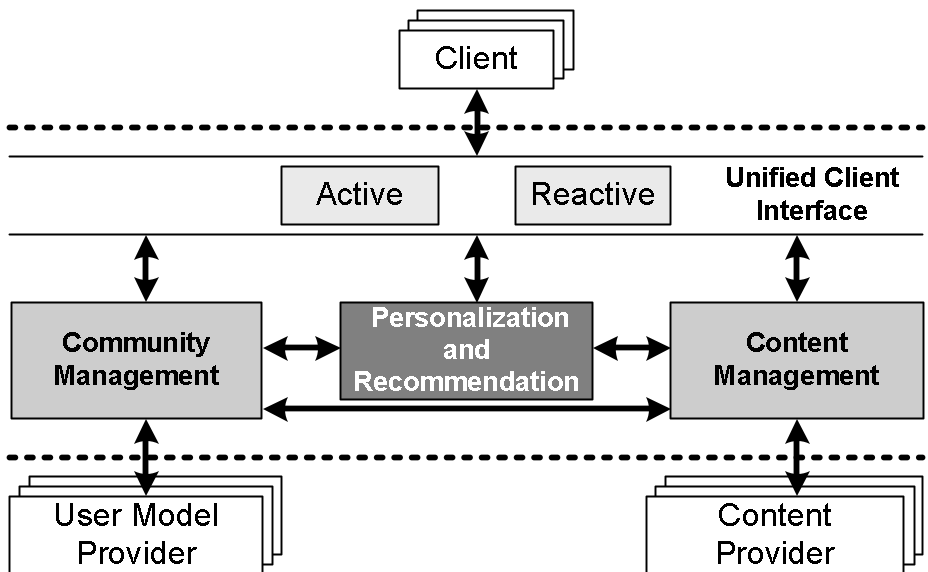 Figure 1: The Online Community Life (OCL) components showing the interplay between Community and Content management.
2. Social-Driven Recommendation (PerRec)
The system doesn't just look at what you liked; it looks at who you are. By using Collaborative Filtering, it creates "Autonomously-managed communities"—groups formed not by manual invites, but by shared behavioral patterns.
Showcase: Online Community Life (OCL)
The OCL portal serves as the ultimate "stress test" for the framework. It integrates context-aware features like:
- Geospatial Snapshots: Mapping blog entries to GPS coordinates.
- Cross-Service Mashups: Using Flickr for storage while using the framework for recommendation.
- Pervasive Access: Including the "Call-A-Blog" feature where a simple phone call (SIP/GSM) creates a multimedia entry.
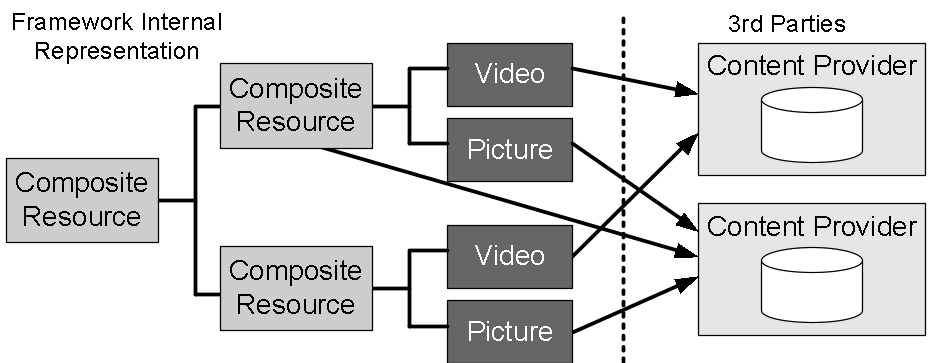 Figure 2: The hierarchical organization of multimedia resources and their link to third-party content providers.
Experimental Insights & Results
The paper demonstrates that by utilizing IMS (IP Multimedia Subsystem), the framework achieves network independence. Whether a user is on a high-speed WiFi connection or a legacy GSM network, the "Reactive Communication" (Push/SMS) ensures the social network remains "live." The qualitative success of the OCL portal proves that metadata-heavy classification is more flexible than traditional folder-based systems.
Critical Analysis & Conclusion
Takeaway
The core contribution of this work is the realization that social relationships are metadata. By treating a "friendship" or an "interest group" as a data attribute, the system simplifies the complexity of content retrieval for the end-user.
Limitations & Future Work
The reliance on 3rd-party services (Flickr, Blogger) introduces a dependency on external APIs, which can change or break. Furthermore, while the metadata inheritance model is elegant, it remains to be seen how it handles "semantic drift"—where a parent resource's meaning changes as new, diverse sub-resources are added.
Future iterations of this research would likely move toward Automated Semantic Labeling (using AI to generate the tags that users are too lazy to provide) while maintaining the robust social-graph-based filtering established here.