
Beyond Black Boxes: Optimizing Disability Classification with Bayesian Networks and Numeric Re-encoding
Classifying Self-Care Activities of Children and Youths with Disabilities
This paper presents a machine learning-based approach to classify self-care activities of children with disabilities using the ICF-CY (International Classification of Functioning, Disability, and Health in Children and Youth) framework. The author introduces a numeric re-encoding of the SCADI dataset and demonstrates that a Bayesian Network classifier significantly outperforms prior neural network-based methods in both accuracy and computational efficiency.
TL;DR
Diagnosis of motor disabilities in children is a resource-intensive task for occupational therapists. This paper revolutionizes the use of the SCADI dataset by moving away from sparse Boolean models toward a Numeric Model paired with Bayesian Networks. The result? Higher accuracy, faster inference, and most importantly, an interpretable model that clinicians can actually trust.
Context: The Bottleneck in Pediatric Care
The ICF-CY framework is the gold standard for describing how a child functions within their environment. However, the path from "observing a child washing or eating" to "assigning a diagnostic treatment group" is slow and prone to human burnout. While previous attempts used Artificial Neural Networks (ANNs), they often treated the data as a massive, sparse matrix of 1s and 0s, ignoring the structured nature of medical impairment levels.
The "Numeric" Insight: Why Less is More
The author identifies a significant flaw in prior work: the Boolean Data Model. In the original SCADI dataset, an impairment level of 0 to 4 was spread across multiple columns.
The author proposes the Numeric Model, which reverts these back to single integer attributes. This achieves two things:
- Dimensionality Reduction: The input layer for a Neural Network drops from 205 nodes to just 31.
- Relationship Preservation: It allows algorithms to perceive the "distance" between a "Mild" and "Complete" impairment.
Methodology: The Power of Probabilistic Graphical Models
While the paper explores MLPs and Rule-based learners (JRip), the Bayesian Network (BayesNet) emerges as the hero. Unlike a Neural Network, a BayesNet maps out the conditional dependencies between activities.
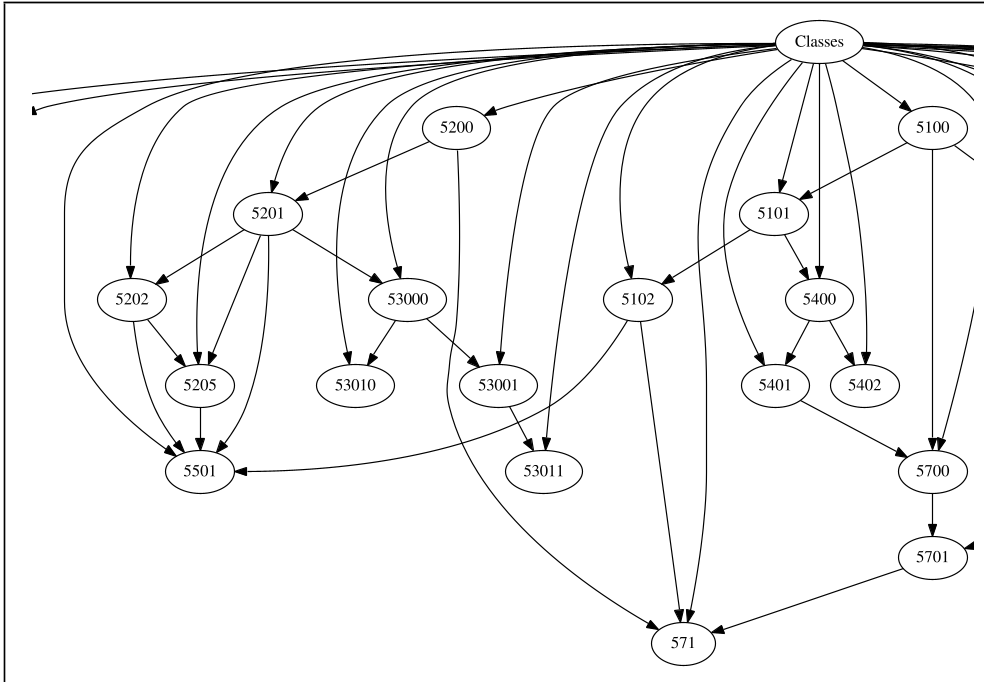 Fig 1. Portions of the inferred BayesNet showing logical dependencies between caring for teeth (5201) and general skin care (5200).
By limiting the number of "parents" (influencing factors) for each node (), the author finds that even simple structures () yield superior results on the numeric data.
Experimental Showdown
The results are clear: the Numeric Model + BayesNet combination dominates across all metrics—Percent Correct, F-measure, and ROC area.
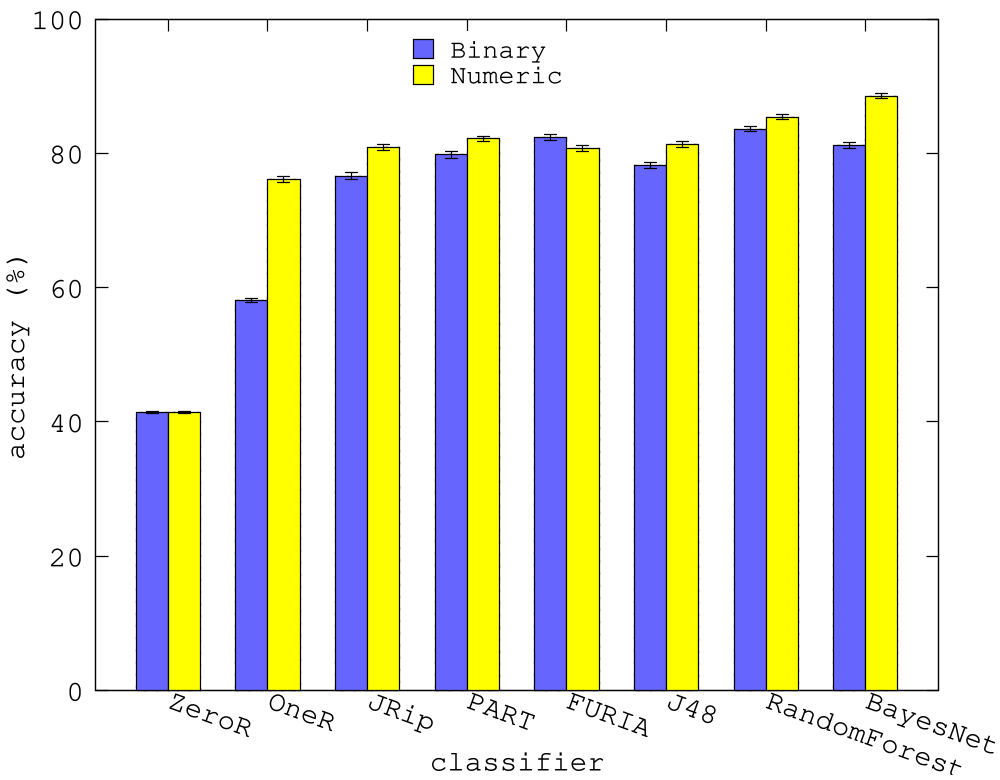 Fig 2. Accuracy comparison across various classifiers. The "BayesNet-Numeric" strategy consistently tops the charts.
Key Findings:
- Speed: Training and testing times were significantly lower for numeric models. In the case of MLPs, the model size shrunk linearly with the reduced input dimensions.
- Interpretability: The JRip rule-based classifier provided a human-readable "logic tree" (e.g., If washing body is completely impaired AND eating is moderate, then Group 5). This is vital for medical settings where "The AI said so" is not an acceptable diagnosis.
Critical Analysis & Conclusion
This paper serves as a reminder that SOTA (State-of-the-Art) is not always about bigger models. In clinical informatics, the "Inductive Bias" we build into our data representation (Numeric vs. Boolean) often matters more than the number of layers in a perceptron.
Takeaways for the Industry
- Data Representation Matters: Before throwing a Transformer at a problem, ask if your encoding matches the physical reality of the data.
- Interpretability > Raw Power: In healthcare, a 1% gain in accuracy is rarely worth the loss of model transparency.
- Small Data Challenges: With only 70 instances in the SCADI set, high-variance models like deep ANNs are prone to overfitting. Bayesian methods provide a much-needed "regularization" through their probabilistic structure.
Future Outlook: The next step is scaling this to real-time IoT feeds, where sensors on a child's wearable device could automatically populate these ICF-CY codes, allowing therapists to focus on intervention rather than clerical observation.