
Adaptive Ontology: Elevating Web Page Classification with Information Theory
Classifying Web pages using adaptive ontology
The paper presents an automated Web page classifier that utilizes an adaptive ontology combined with a hybrid feature selection mechanism (TF-DF and Information Gain). By integrating packet capturing with machine learning algorithms like C4.5 and CN2, the system achieves a SOTA-level average classification accuracy of 95.2% across diverse domains.
TL;DR
This paper introduces an automated Web page classification system designed for network traffic monitoring. By leveraging Adaptive Ontology and a unique hybrid feature selection method—merging TF-DF weights with Information Gain—the authors successfully reduced high-dimensional text data into a handful of potent classification rules. The result? A lean, fast system boasting an average accuracy of 95.2%.
Background Positioning
In the landscape of 2000s Web mining, this work stands as a bridge between static keyword filtering and the more dynamic, semantic-aware systems we use today. It transitions away from rigid taxonomies toward a model where the "description of objects" (the ontology) evolves alongside the data, specifically targeting the operational overhead of enterprise network management.
The Motivation: Why Static Systems Fail
The authors identify a critical gap in existing Web filters: Lack of Adaptability.
- The Dimension Curse: Web pages contain thousands of terms, most of which are noise.
- Static Weakness: Traditional methods like the Dewey Decimal Classification (DDC) don't adapt when a user's need for "sophisticated classification" grows.
- The Frequency Trap: Simply looking at Document Frequency (DF) might select terms common to a class that don't actually help separate it from others.
The "Insight" here is that a classifier must not only find frequent terms but must find terms that maximize Information Gain within a specific ontological hierarchy.
Methodology: The Physics of Information
The system architecture is a three-tier pipeline: Packet Capturing Protocol Analysis Contents Classification.
1. Feature Extraction (TF-DF)
The first filter uses an intuitive logic: a representative term must occur frequently in a page and appear across many pages of the same class. This formula ensures that the "representativeness" of a term outweighs the noise.
2. Information-Theoretic Refinement
Once terms are weighted, the system applies Shannon Entropy to measure the "uncertainty" of a term. Using Information Gain (Gain factor), the system selects only features that provide the most predictive power.
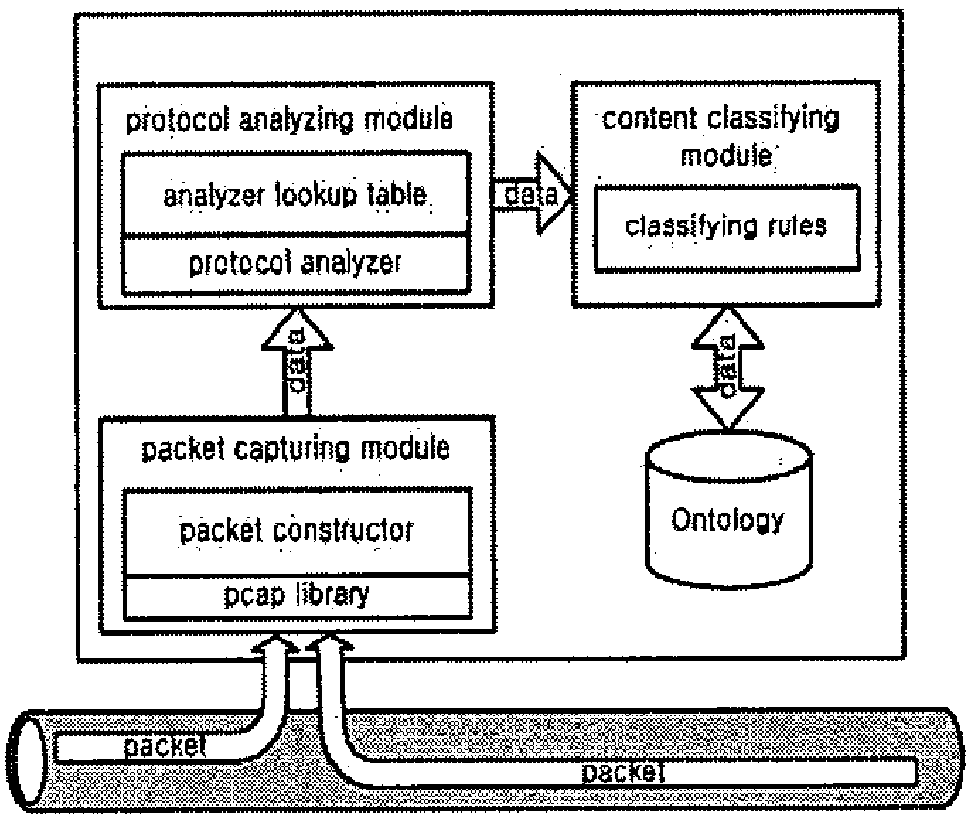 Figure 1: The three-module architecture for capturing and classifying network streams.
3. Rule Compilation
The refined features (reduced from 1,700 down to roughly 11-45 terms) are fed into machine learning algorithms (C4.5, Naive Bayes, CN2) to generate a "rule-set" that can be applied in real-time.
Experimental Results: High Precision with Low Data
The authors tested the framework across four themes: Banking, Programming, Science, and Sport.
| Theme | Key Representative Term | Weight |
|---|---|---|
| Banking | bank | 0.8681 |
| Programming | java | 0.9397 |
| Science | observv (sic) | 0.7472 |
| Sport | football | 0.7293 |
The efficiency of this approach is remarkable. By setting a threshold (), the system identified just 45 terms out of 6,800 to represent the entire four-theme domain.
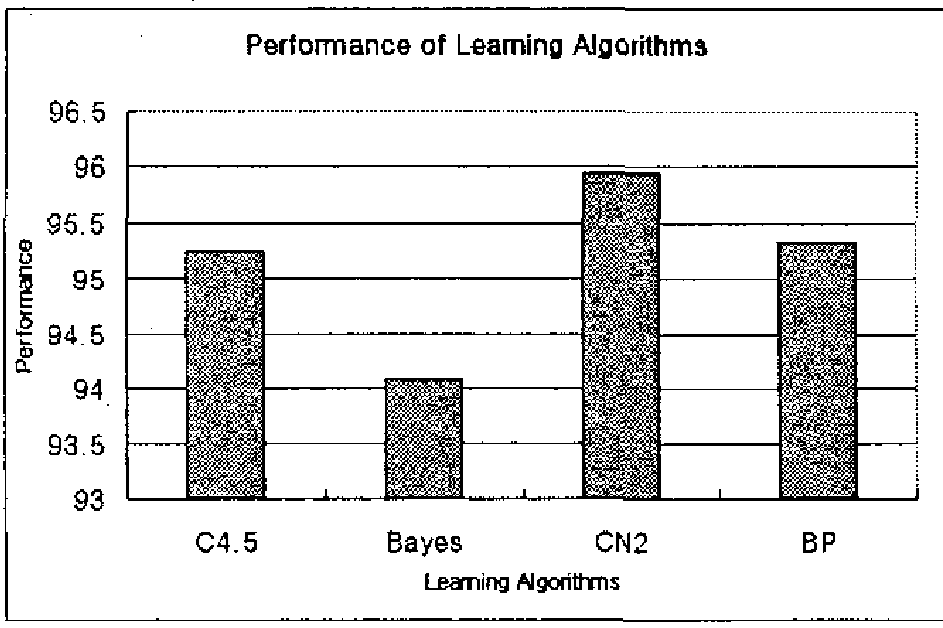 Figure 3: Comparing ML algorithms. CN2 achieved the highest accuracy at 95.94%.
Results Summary:
- Average Accuracy: 95.2%
- Best Performer: CN2 Algorithm (95.94%)
- Efficiency: Dimension reduction from ~1,700 terms/page to ~11 terms/page.
Critical Analysis & Future Outlook
Takeaway
The synergy between Domain Ontologies and Entropy-based feature selection proved that classification doesn't need "Big Data" in the modern sense; it needs "Significant Data."
Limitations
While the 95.2% accuracy is impressive, the paper relies on a relatively narrow set of four themes. In a real-world scenario (the authors mention a 30,000 harmful site dataset), the "Adaptive" nature of the ontology would be pushed to its limits by adversarial tactics (e.g., keyword stuffing by malicious sites).
The Future
This work lays the groundwork for modern Dynamic Content Analysis. The jump from 1,700 terms to 11 terms suggests that most Web content is redundant for the purpose of classification—a lesson that remains relevant even in the age of LLMs and vector embeddings.