
Classroom Salon: Leveraging Collective Intelligence for CS Education
Classroom salon: A tool for social collaboration
Classroom Salon is a social collaboration platform designed to bridge the gap between Social Networking Sites (SNS) and Course Management Systems (CMS) through document-centric interactions. It facilitates collective intelligence in Computer Science education via collaborative annotation, content analysis, and built-in learning analytics.
TL;DR
Classroom Salon is a specialized social networking tool that transforms static educational documents into dynamic centers of collaboration. By allowing students to annotate code and text in a shared "Salon" environment, it utilizes social habits to enhance learning performance. Unlike general social media, it provides instructors with a high-fidelity "Dashboard" to analyze student engagement and interaction patterns through visual data.
Context: When Social Media Meets the Classroom
The rise of Web 2.0 has made social connectivity the "fabric of student culture." However, academia has struggled to harness this. General SNS (Social Networking Sites) are often too disorganized for pedagogical management, while standard Course Management Systems are often viewed as "clunky" and lack the viral engagement of social apps.
Classroom Salon was born from the insight that context is everything. By forcing conversations to happen on the document (via highlights and annotations) rather than in a separate, disconnected forum, the authors aimed to reduce cognitive load and thread redundancy.
Methodology: The "Salon" Architecture
The platform is built on three core pillars: Salons, Documents, and the Dashboard.
- Salons: Private or public online spaces where instructors can curate specific social circles.
- Document-Centric Interaction: Every conversation is anchored to a specific part of a document—be it a logic error in a C++ snippet or a complex paragraph in a CS theory textbook.
- The Dashboard: This is the data-science layer. It provides instructors with pie charts and histograms of student contributions, tag usage (e.g., marking a comment as "helpful"), and "Hotspots" where most student confusion or interest is concentrated.
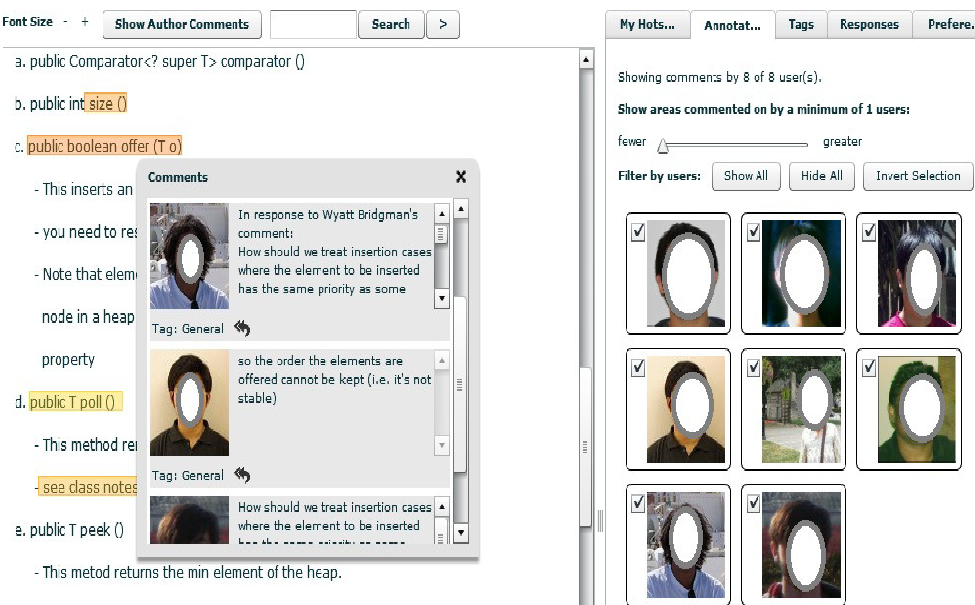 Figure 1: The UI allows for seamless switching between viewing, participating, and analyzing student interactions.
Key Techniques: Learning by Debugging
One of the most innovative applications discussed is collaborative debugging. Instead of students struggling alone with a buggy program, the "Salon" approach sets up a social environment where:
- One student highlights a potential bug.
- Others comment to extend the explanation or dispute it.
- The group "converges" on the correct fix in a social context.
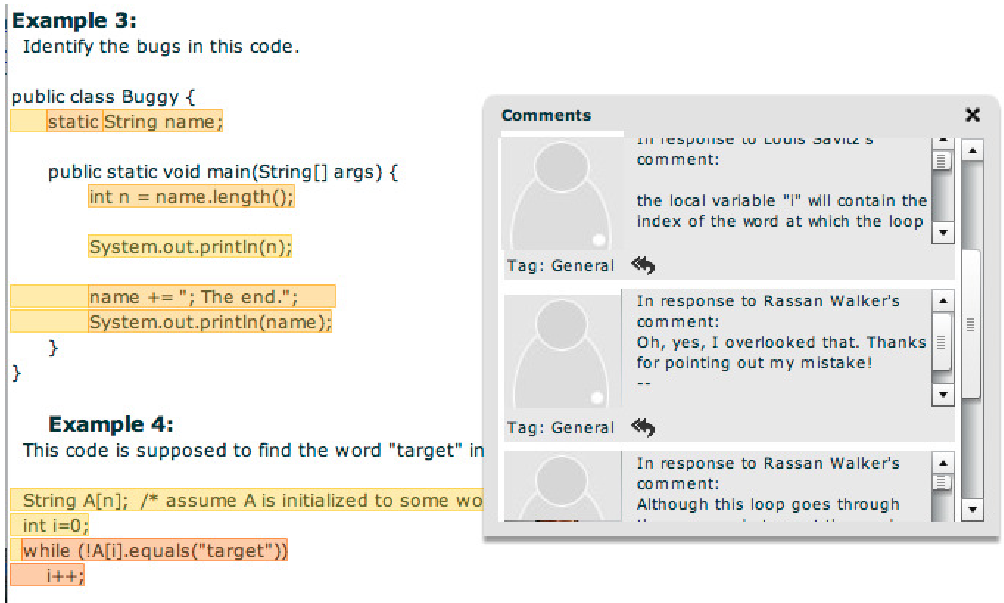 Figure 2: Code analysis in Classroom Salon, where social annotations identify programming errors.
Experiments and Results
In a trial with CS2 students at CMU (Carnegie Mellon University), the authors observed a significant reduction in noise. Traditional discussion forums often result in "hundreds of redundant threads" for the same problem. In Classroom Salon, because the question is tied to the exact line of code, the first few comments usually resolve the issue for everyone, effectively achieving zero redundancy.
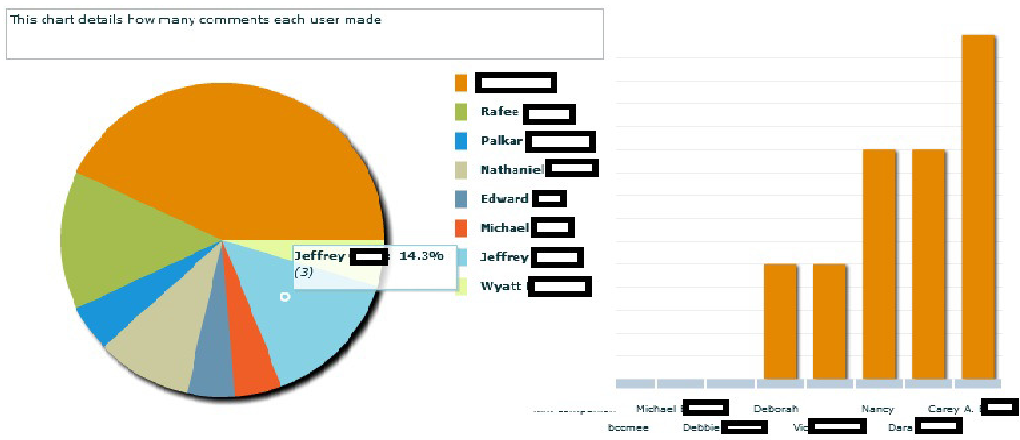 Figure 3: Graphical view of student contribution metrics and "helpful" tag distribution.
Critical Insight & Future Outlook
The true value of Classroom Salon isn't just "chatting about school"; it's the quantification of social contribution. The "Dashboard" allows an instructor to see at a glance who the "helpful" students are (via crowdsourced tags) and where the "hotspots" of difficulty lie.
Limitations: While the preliminary results are promising, the effectiveness of the tool relies heavily on students' willingness to participate "publicly" within their class Salon. There is a risk that quieter students might feel intimidated by the activity of high-performing peers.
Conclusion: Classroom Salon makes a compelling case for the "Document-as-a-Platform" model. As education becomes increasingly digital and remote, tools that can simulate the "collective intelligence" of an 18th-century French Salon through modern data analytics will be vital for maintaining student engagement in complex technical disciplines.