
CCI: Taming Uncertainty in Graphs with Noisy Human Wisdom
Cleaning uncertain graphs via noisy crowdsourcing
The paper introduces NECP (Noisy Edge Cleaning Problem), a framework to improve query result quality in uncertain graphs via crowdsourcing. It proposes the CCI (Cleaning with Crowdsourcing Noise) algorithm, which selects optimal edges to resolve reachability query ambiguity while accounting for inevitable worker errors (noise).
TL;DR
Uncertain graphs are ubiquitous, from social networks to biological PPI networks. However, query results on these graphs are often "ambiguous" (e.g., a 51% reachability probability). This paper introduces CCI, a method to clean these graphs using Noisy Crowdsourcing. It proves the problem is #P-hard and offers a practical solution that picks the best edges to "ask humans about," even when humans make mistakes.
The "Uninformative" Result Problem
Imagine asking a GPS, "Is there a road between City A and City B?" and it answers, "Maybe, 51% chance." This is useless for decision-making.
In uncertain graphs, edges have existential probabilities. To make these graphs more "certain," we can use crowdsourcing to verify if an edge truly exists. But there is a catch: Crowdsourcing workers are not perfect. Most workers have an accuracy of around 75%. If we don't account for this noise, our efforts to "clean" the graph might actually introduce more confusion.
Methodology: The Core Logic
The authors define the NECP (Noisy Edge Cleaning Problem). The goal is to maximize the Quality Improvement (), where Quality is measured using Shannon Entropy.
1. Modeling the Noisy Crowd
The authors introduce (Crowd Accuracy). They derive a formula to update edge probabilities based on "Yes/No" answers from a noisy crowd. This allows the system to predict how much a query's entropy will drop before actually paying for the crowdsourcing task.
2. Searching for the "Optimal Edge" (OE)
Finding the best edges is computationally expensive. The paper introduces several clever optimizations:
- Effective Edge Selection: Only focus on edges that actually lie on paths between the source and target.
- Skyline Pruning: Not all edges are equal. If Edge A appears in more paths (Higher Edge Occurrence) and has a lower initial probability than Edge B, Edge A is mathematically "better" to clean. The authors use a Skyline Algorithm to prune inferior candidate edges.
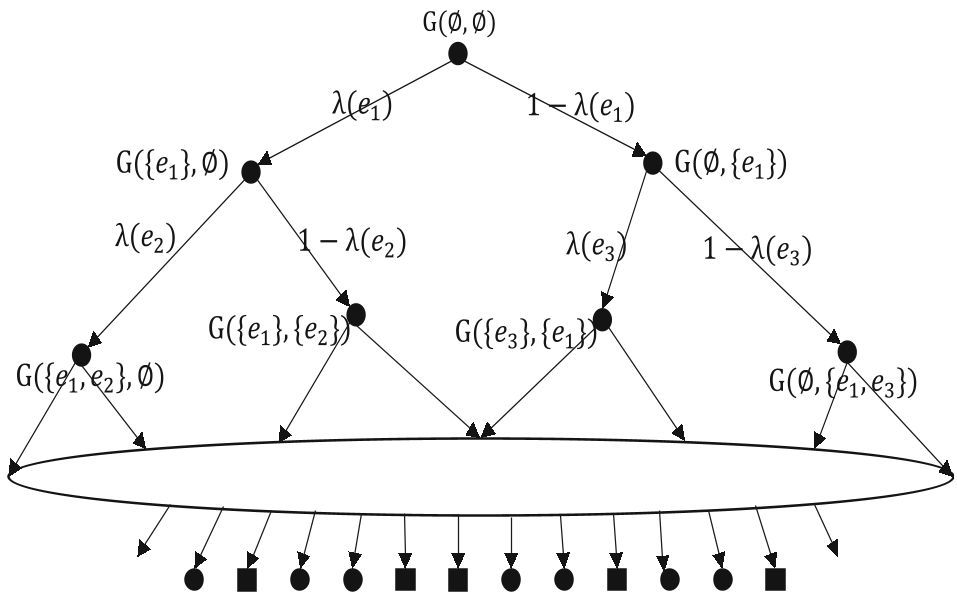 Figure: The optimized DC-tree approach for reachability calculation.
Experiments: Performance & Scalability
The authors tested CCI against several baselines:
- RS: Random Selection (Baseline).
- AE: Ambiguous Edges (Cleaning edges closest to 0.5 probability).
- ME: Major Edges (Cleaning edges that appear most frequently).
Key Findings:
- Effectiveness: CCI consistently achieves the highest uncertainty reduction, approaching the performance of exhaustive search (CEE) but at a fraction of the cost.
- Efficiency: Thanks to Skyline pruning, CCI's elapsed time remains stable even as the graph grows to 500,000 vertices.
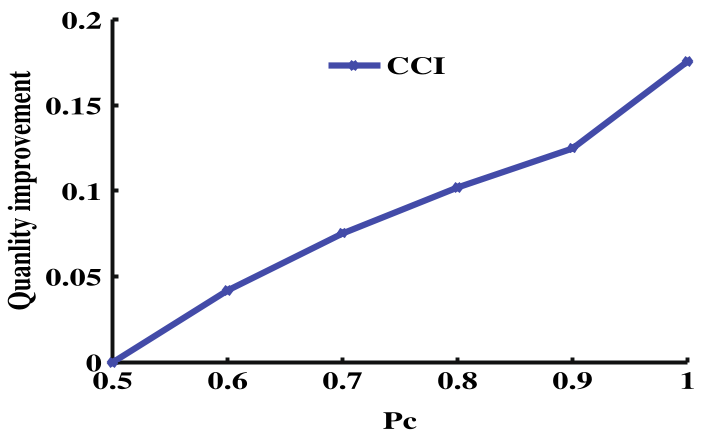 Figure: Performance comparison showing CCI's stability as edge density increases.
Critical Insights
The true beauty of this work lies in Theorem 3, which proves that the expected quality improvement is monotonic with respect to an "Edge Correlator" factor (). This mathematical foundation allows the algorithm to rank edges without simulating thousands of possible "what-if" scenarios.
Limitations & Future Work
- Homogeneous Noise: The model assumes a fixed for the whole crowd. In reality, some workers are better than others.
- Budgeting: While the paper discusses a budget , it doesn't deeply explore the trade-off between asking more people about one edge vs. asking one person about many edges.
Conclusion
This paper provides a robust bridge between graph theory and probabilistic crowdsourcing. By acknowledging that human data is messy, it provides a realistic framework for maintaining high-quality knowledge graphs in an uncertain world.