
Clearing the FOG: Why Fuzzy Overlapping Groups are the Key to Social Dynamics
Clearing the FOG: Fuzzy, overlapping groups for social networks
This paper introduces the FOG (Fuzzy Overlapping Grouper) framework, a stochastic generative model and a maximum-likelihood algorithm (H-FOG) designed to detect cohesive groups in social networks. Unlike traditional partitioning methods, FOG allows entities to hold multiple memberships with varying "fuzzy" affiliation strengths, reaching SOTA-level alignment with ethnographic "ground truth" observations.
Executive Summary
TL;DR: The "FOG" (Fuzzy Overlapping Grouper) framework moves beyond binary "in-or-out" community detection by allowing individuals to belong to multiple groups with varying degrees of affiliation. Using a stochastic generative model, it identifies not just who is in a group, but who leads it, who is weakly attached, and who acts as a bridge between competing factions.
Background Positioning: This paper is a seminal contribution to Link Analysis and Social Network Analysis (SNA). It serves as a bridge between graph-theoretic structural analysis and modern machine learning-based generative modeling, specifically targeting the limitations of strict partitioning in complex human organizations.
The Problem: The "Strict Partitioning" Trap
In traditional social network research, we often try to cut a graph into neat, non-overlapping slices. We call these "cliques" or "clusters." However, reality is far messier. A person can be a member of a project team, a lunch group, and a professional society simultaneously—and their commitment to each varies.
Prior work (like k-clique or Girvan-Newman) either forces a single membership or treats multiple memberships as equal. The authors argue that this loses critical "signal": the intensity of membership is often more informative than the fact of membership itself.
Methodology: The FOG Generative Model
The genius of FOG lies in its "bottom-up" stochastic approach. Instead of looking at a static graph, it views social interactions as a stream of emitted links.
1. The Stochastic Core
The model assumes that hidden group entities generate observable events (links). The probability of a link being produced by group is defined as:
otin l} 1 - g_e\right)$$ Where $g_e$ is the **membership strength** of entity $e$ in group $g$. This allows the model to handle "fuzzy" memberships formally. ### 2. Turning Networks into "Rich" Links Since much of SNA data is pairwise (A knows B), the authors use a **Random Tree** algorithm to simulate social contexts. By "walking" the graph, they generate events involving multiple people, which provides the "fuel" for the H-FOG algorithm to cluster similar interactions. 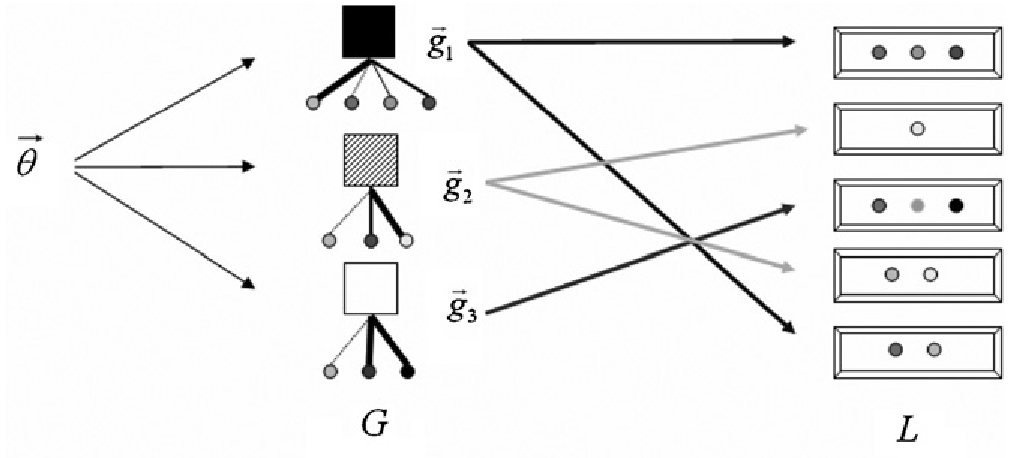 *Figure: The hierarchy showing how groups relate to entities through probabilistic emission.* ## Experiments: Predicting the "Monk Exodus" The authors tested FOG on the classic **Sampson Monastery** dataset. During Sampson's study, a group of liberal monks (the "Young Turks") left the abbey after a conflict with the "Loyal Opposition." **Key Findings:** - **Leadership Detection**: FOG identified Gregory as the leader not just because he was in the group, but because he had the highest affiliation strength ($g_e$) across multiple contexts. - **Predictive Power**: Remarkably, the **rank of affiliation strength** was a near-perfect predictor of the *order* in which monks resigned or were expelled. - **Interstitial Roles**: The algorithm successfully identified "waverers"—monks who were caught between groups—by showing their split membership across different clusters. 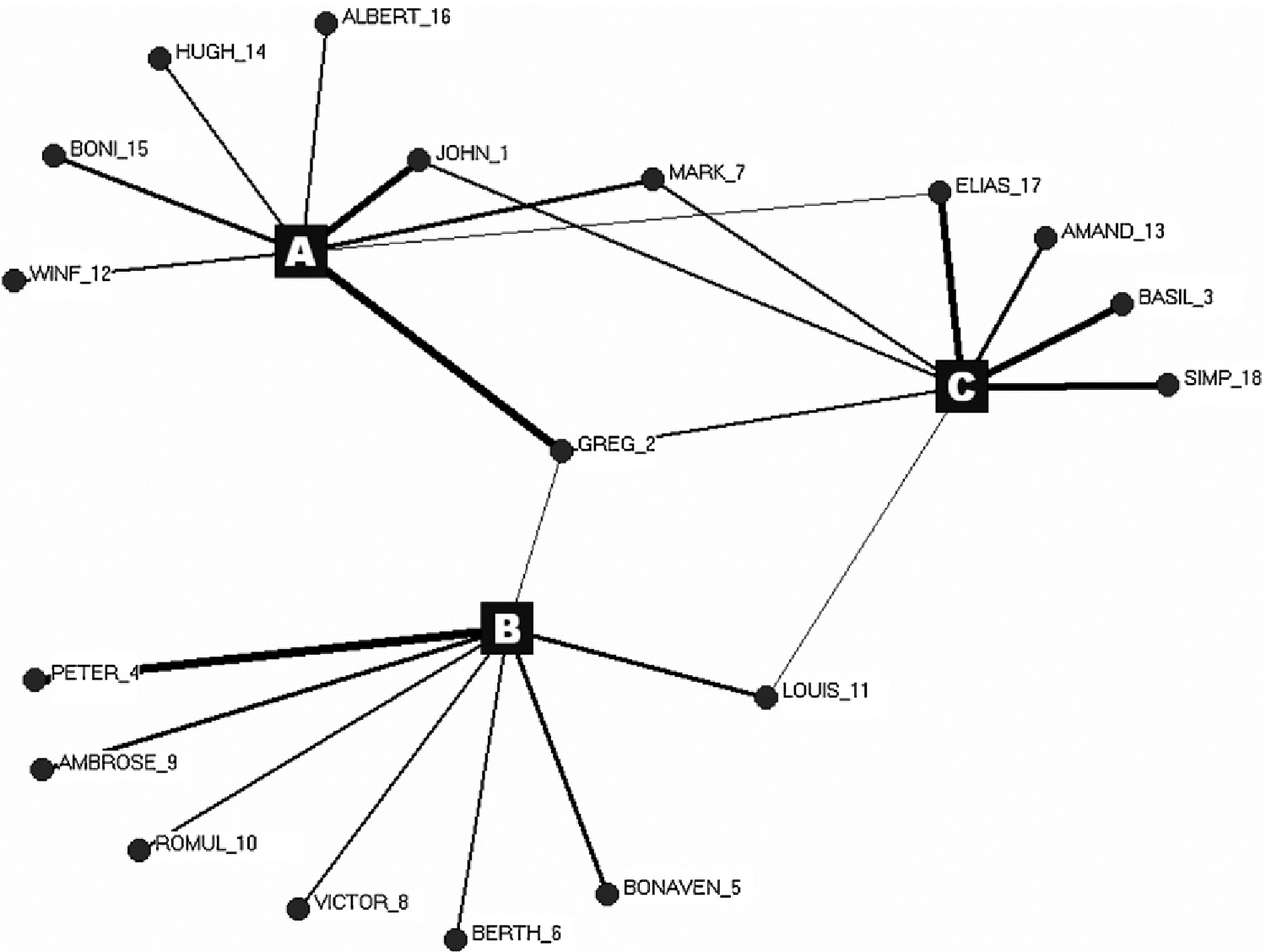 *Figure: FOG's two-mode network visualization of the Sampson Monastery, highlighting membership weights.* ## Deep Insights: The Core-Periphery Structure In the analysis of the **Southern Women** dataset, the authors utilized a "spectrographic" visualization. They discovered that group leaders often show a surprising propensity to appear in events associated with *other* groups. This suggests two types of leadership: 1. **Embedded Leaders**: Solidly within their clique, providing internal stability. 2. **Boundary-Spanning Leaders**: High-profile individuals who define the group to the outside world but face the most "structural stress" due to their diverse ties. 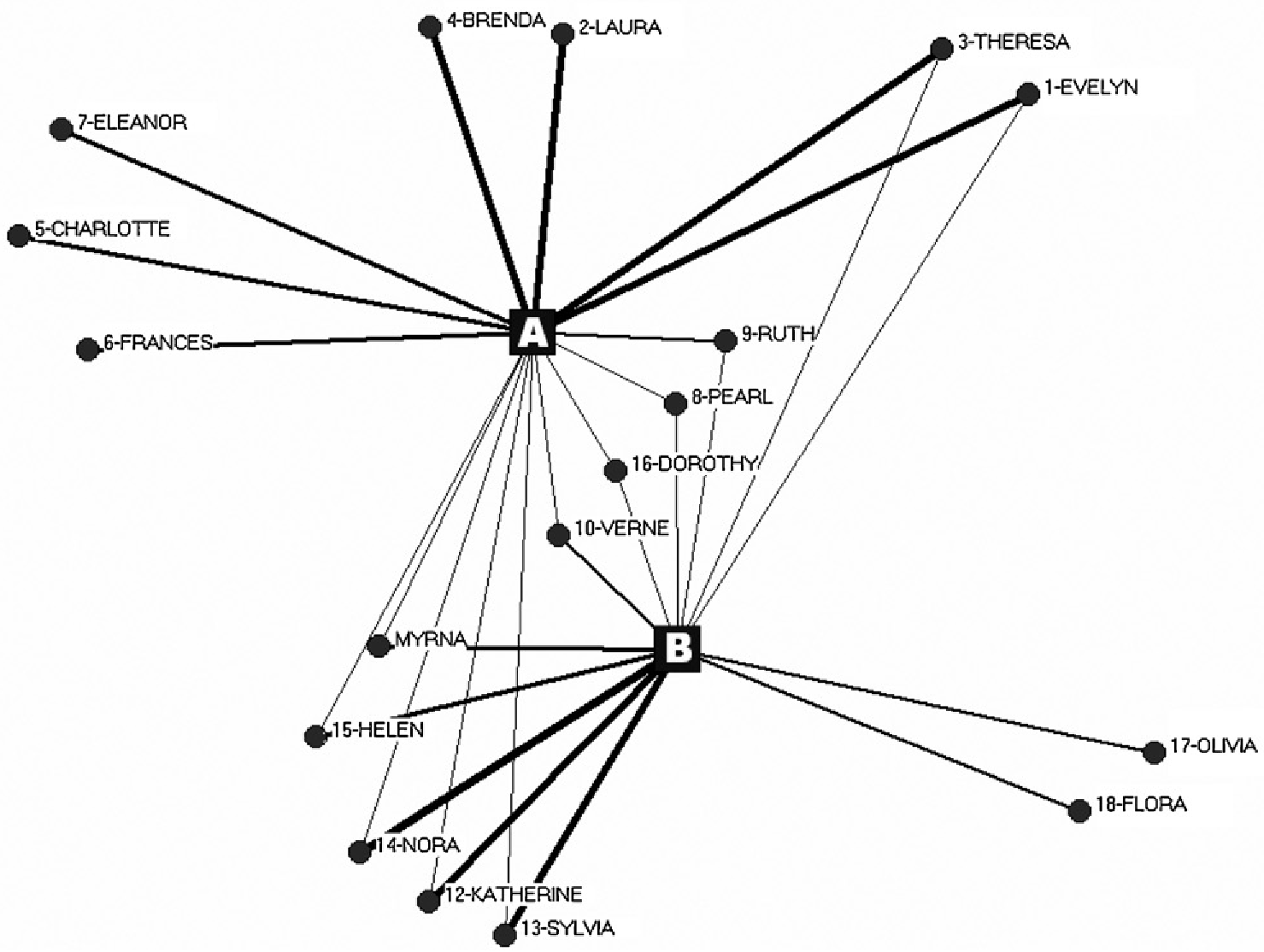 *Figure: Spectrographic view of affiliation strengths among the Southern Women, revealing overlapping core-periphery tiers.* ## Conclusion & Future Look **Takeaway**: FOG proves that "fuzziness" is a feature, not a bug. By measuring the *degree* of overlap, we can predict which groups will split and which individuals will emerge as leaders. **Limitations**: The H-FOG algorithm is computationally expensive ($O(L^3)$), making it difficult to scale to massive networks like Facebook or Twitter without the EM-based "k-FOG" or Dirichlet-based "$\alpha$-FOG" variants mentioned by the authors. **Future Work**: The future of this research lies in applying these fuzzy models to **multi-mode networks** (e.g., people, locations, and topics simultaneously) to see how physical space and social affiliation co-evolve.