
MC2 CLEF 2017: Decoding Cultural Impact Through Massive Multilingual Microblog Mining
CLEF 2017 Microblog Cultural Contextualization Lab Overview
The CLEF 2017 Microblog Cultural Contextualization (MC2) lab presents a comprehensive framework for analyzing how cultural contexts influence the social impact of microblogs. It utilizes a massive dataset of 70 million microblogs focused on global festivals to benchmark tasks including multilingual content analysis, microblog search, and timeline illustration, achieving high-performance baselines through deep learning and advanced IR techniques.
TL;DR
The CLEF 2017 Microblog Cultural Contextualization (MC2) Lab tackles the challenge of making sense of the chaotic, multilingual world of Twitter by providing cultural context. Using a curated dataset of over 70 million microblogs related to global festivals, the lab establishes a benchmark for tasks like automatic summarization, event localization, and timeline reconstruction. It moves beyond simple keyword search to "contextual search," helping users understand the who, what, and why behind a short post.
Contextualization: Why Keywords Are Not Enough
In the world of microblogging, brevity is the enemy of clarity. A tweet about a music festival often contains implicit information—local slang, niche artist names, or references to specific venues—that an "outsider" might not understand.
The authors argue that existing Information Retrieval (IR) systems treat tweets as isolated strings. The MC2 Lab's core insight is that cultural events (like festivals) provide a unique longitudinal anchor. By linking tweets to Wikipedia and expanded URLs, we can transform a cryptic 140-character post into a rich, educational summary.
Methodology: The Three Pillars of Cultural Analysis
The lab is structured around three distinct but interconnected tasks designed to test the limits of modern NLP:
1. Content Analysis & Summarization
This is the "Understanding" phase. Given a stream of microblogs, systems must identify the language (challenging for tweets mixing dialects), recognize entities, and link them to Wikipedia.
- The Innovation: Using Deep Learning for multilingual multidocument summarization to generate context in four target languages regardless of the source tweet's language.
2. Multilingual Microblog Search
Searching for cultural traces across 18 months of data.
- The Challenge: Queries are often "well-formed" (from newspapers or reviews), while the targets are "noisy" (tweets). Systems had to bridge this gap using Language Models and Latent Dirichlet Allocation (LDA) for query expansion.
3. Timeline Illustration (The "Total Recall" Challenge)
For a specific festival show (e.g., Klangstof at Transmusicales), systems must retrieve every relevant tweet.
- Architecture Insight: The evaluation revealed that retweets are often more valuable than original tweets because they represent the "insider" audience's reaction rather than just official marketing.
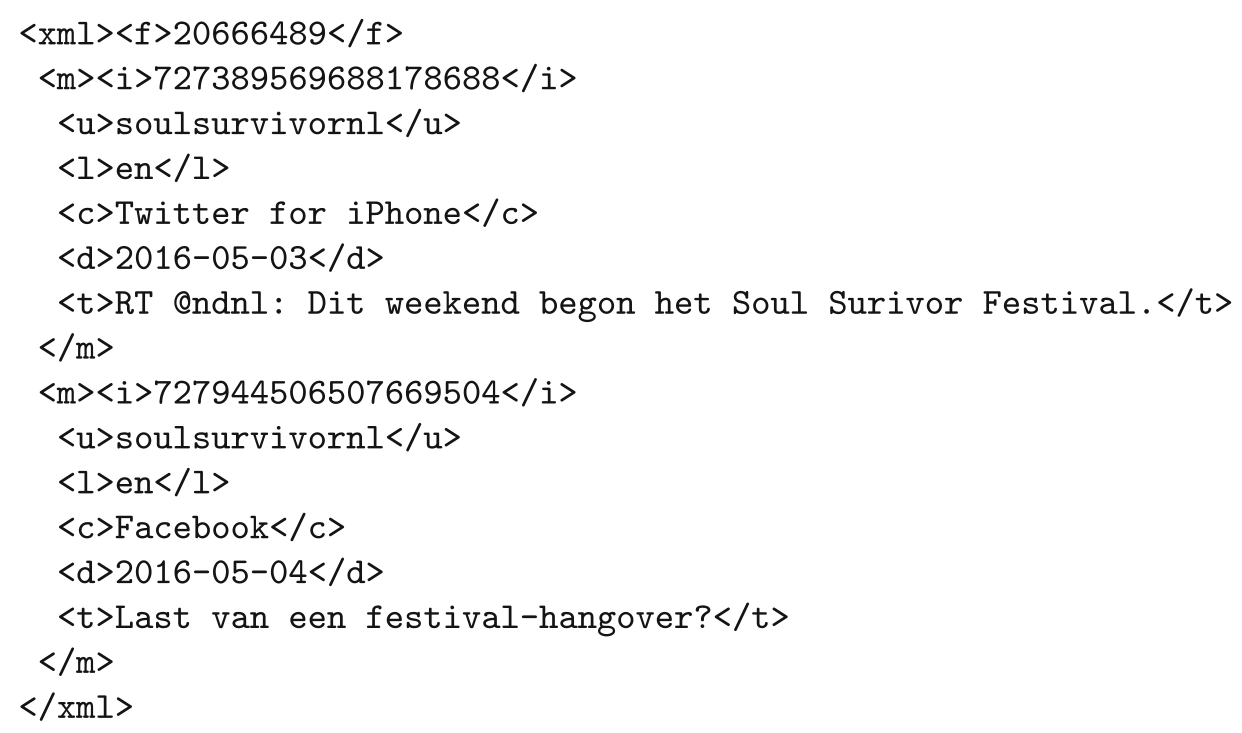 Caption: Figure 1. Example of the structured XML data used to store microblog metadata, facilitating complex queries.
Notable Results and SOTA Baselines
The lab saw participation from 12 global teams. The results highlighted several technical breakthroughs:
- Robust Language ID: Essential for Latin languages where English festival names often mask the underlying local dialect.
- Deep Learning vs. Traditional IR: While BM25 remained a strong baseline for retrieval, Deep Learning was superior for the generative task of "contextualization" (summarization).
- Performance Metrics: The IITH team outperformed others in timeline illustration by using a combination of BM25 and Divergence from Randomness (DRF) models, incorporating artist names and top hashtags as features.
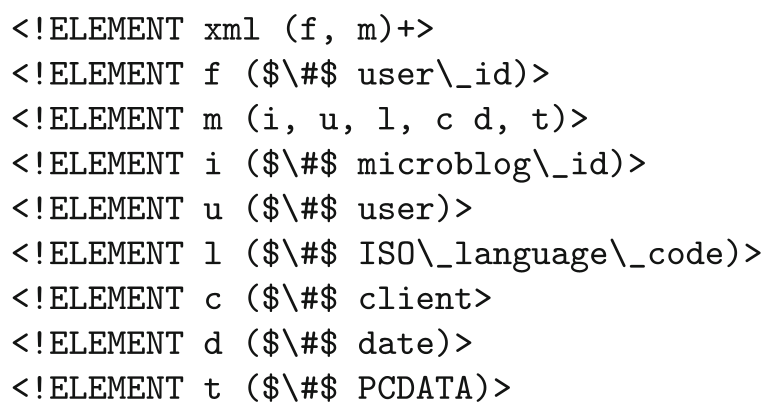 Caption: Figure 2. An example of a complex Indri query used to filter specific locations and locales within the massive dataset.
Critical Insight: The "Attendee" Perspective
One of the most profound takeaways from the MC2 lab is the shift in value from "Official Feeds" to "Cultural Attendees." Official festival accounts provide "what is happening," but the lab's evaluation proved that informal microblogs and reposts provide the "social impact"—the genuine cultural sentiment that makes a festival an event.
Conclusion & Future Outlook
The CLEF 2017 MC2 Lab successfully demonstrated that massive, noisy data can be tamed through cross-lingual entity linking and contextual expansion. However, the limits of linguistic resources for Arabic and Spanish dialects remain a hurdle.
The future of this field lies in Zero-shot Cross-lingual Transfer, where models trained on high-resource languages (like English Wikipedia) can automatically contextualize cultural events in any local dialect. For researchers, this lab offers a goldmine of 70 million data points to continue pushing the boundaries of social media mining.
Disclaimer: Data access is available for academic purposes through the ANR GAFES project.