
AQ21 Meets UMLS: Infusing Medical Semantics into Rule-Based Machine Learning
Clinical data analysis using ontology-guided rule learning
This paper introduces an ontology-guided extension to the AQ21 rule learning system, specifically designed for clinical data analysis. By integrating the Unified Medical Language System (UMLS), the method enables machine learning algorithms to "understand" medical semantics and reason across multiple hierarchical attributes to induce more accurate and interpretable clinical rules.
TL;DR
Clinical data is more than just numbers; it is a complex web of semantic relationships. This paper presents an ontology-guided extension to the AQ21 rule learning system, which utilizes the Unified Medical Language System (UMLS) as background knowledge. This allows the system to perform "Natural Induction," creating rules that don't just fit the data but actually respect the hierarchical structure of medical science.
Context: This work positions itself at the intersection of Symbolic AI and Healthcare Informatics, moving beyond purely statistical learning to "knowledge-aware" pattern discovery.
The Problem: Data Rich, Knowledge Poor
Most machine learning (ML) models in healthcare operate in a semantic vacuum. They treat a diagnosis code for "Breast Carcinoma" the same way they treat a "Customer ID"—as a discrete, isolated token.
The authors identify two critical failures in prior SOTA methods:
- Semantic Blindness: Algorithms don't know that "Invasive Ductal Carcinoma" is a subtype of "Breast Cancer."
- Attribute Isolation: Current systems rarely reason across different columns (attributes) using a shared ontology, making it impossible to capture constraints like "this therapy only applies to this specific hierarchical branch of diseases."
Methodology: Bridging Data and Ontology
The core of the methodology is the integration of the Attributional Calculus (the logic behind AQ21) with the Metathesaurus level of the UMLS.
1. The Workflow
The process follows five distinct steps:
- Data Coding: Mapping raw clinical variables to UMLS Concept Unique Identifiers (CUIs).
- Ontology Extraction: Pulling the relevant sub-graphs (hierarchies) from the massive UMLS database.
- Rule Induction: Running the AQ21 algorithm with these hierarchies acting as structural constraints.
- Generalization: Using the ontology to find the "just right" level of abstraction for a rule—neither too specific (overfitting) nor too broad (medically incorrect).
2. The Logic of Attributional Rules
Unlike standard IF-THEN rules, AQ21 uses Attributional Rules which can handle internal disjunctions and exceptions.
CONSEQUENT <= PREMISE |_ EXCEPTION : ANNOTATION
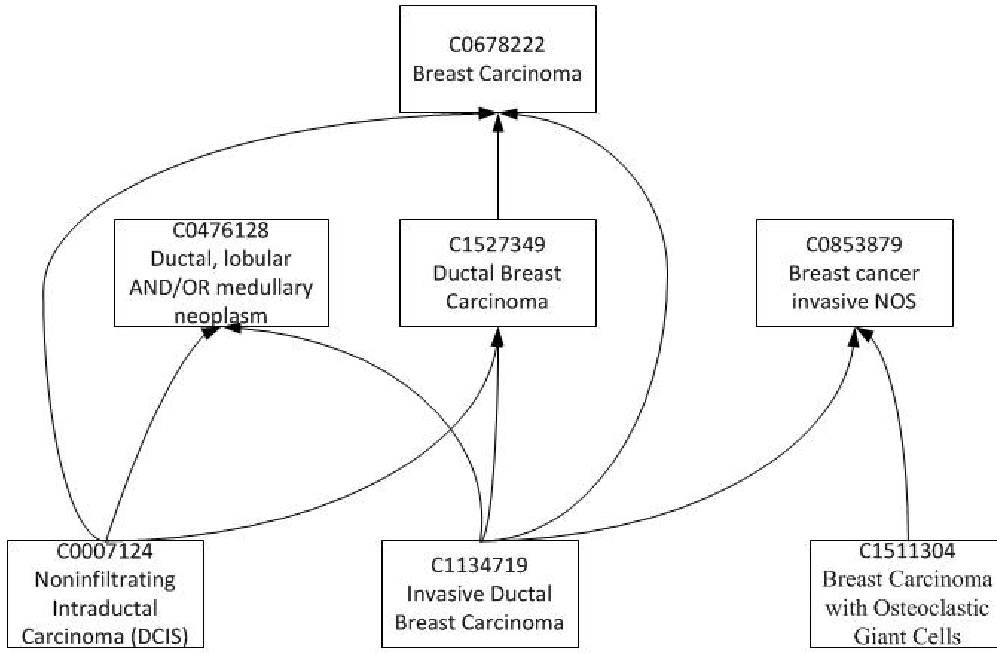 Figure 1: This diagram illustrates how specific diagnosis codes (CUIs) found in the data are generalized into parent concepts using the UMLS hierarchy, while pruning branches that contradict the training data.
Experiments and Results
To prove the concept, the authors tested the system on a breast cancer dataset. The primary goal was to see if the system could discover predictors for 5-year survival rates.
Performance Gains
The system generated rules that were not only statistically robust but also human-readable. For instance, a discovered rule grouped three distinct carcinoma codes into a more general parent concept, Ductal Breast Carcinoma, effectively increasing the rule's coverage without losing accuracy.
Key Result:
- A rule for
[Survival = Yes]achieved a 90% confidence level by correctly identifying that younger patients (Age <= 41) with specific ductal/neoplasm diagnosis codes had higher survival rates. - The system successfully avoided "illegal generalizations" (like including non-invasive cases in an invasive rule) by checking the UMLS structure during the learning phase.
Critical Analysis & Future Outlook
Takeaway
The true value of this work lies in Constraint-Based Learning. By using the UMLS to guide the search space, the algorithm avoids exploring thousands of medically impossible hypotheses, making the learning process more efficient and the results more trustworthy for clinicians.
Limitations
- Scalability: The UMLS is massive. If the "search distance" in the ontology is set too high, the memory requirements explode.
- Manual Effort: Mapping raw data to CUIs still requires significant domain expertise and pre-processing.
The Future of Clinical ML
As we move toward Evidence-Based Medicine (EBM), the authors suggest that this approach could be adapted for Meta-analysis. Instead of just learning from individual patients, the ontology-guided AQ21 could ingest aggregated data from published papers (mean, standard deviation) and combine it with patient-level records to form a "Global Medical Knowledge Model."
This paper was published at CIKM'12 and serves as a foundational bridge between Knowledge Representation and Data Mining in the clinical domain.