
Cloning Social Networks: A New Frontier for Decentralized P2P Bootstrapping
A clone of social networks to decentralized bootstrapping P2P networks
The paper proposes a novel decentralized bootstrapping mechanism for Peer-to-Peer (P2P) networks by "cloning" existing social network connections. Specifically, it leverages packet sniffing of Instant Messaging (IM) traffic (e.g., MSN, QQ) to discover active remote IP addresses, enabling peers to join a network without relying on centralized trackers or vulnerable static peer lists.
TL;DR
To solve the vulnerability of centralized P2P trackers, this paper proposes a method to bootstrap networks by "cloning" the connectivity of existing social networks. By sniffing Instant Messaging (IM) packets (like QQ or MSN), a new peer can discover active neighbors without a central server, ensuring a truly decentralized and robust entry into P2P ecosystems.
Problem & Motivation: The Fragility of Centralized Entry
The Achilles' heel of any P2P network is the Bootstrapping phase—the moment a new node tries to find its first neighbor.
Currently, P2P networks rely on two flawed methods:
- Centralised Trackers (e.g., BitTorrent): Vulnerable to legal crackdowns and server failures.
- Static Peer Lists (e.g., Gnutella): Easily blocked by ISPs and frequently contain outdated, offline IP addresses.
The authors argue that for a P2P network to be "pure," it must find a way to discover neighbors that is as decentralized as the network itself.
Methodology: Leveraging the "Social Overlay"
The core insight is that millions of users are already connected via Instant Messaging (IM) services. These IM networks represent a massive, active social graph.
1. Packet Sniffing as Discovery
Instead of asking a server for a peer list, a new node monitors its own network traffic. By analyzing IM packets (MSN/QQ), the node extracts the IP addresses of the remote hosts it is communicating with.
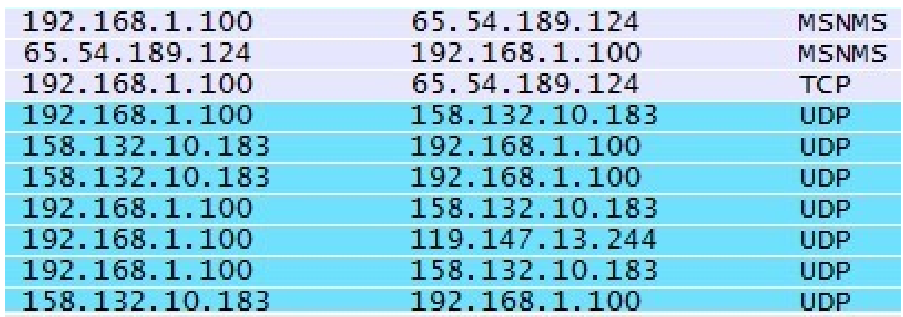 Figure: Wireshark capture showing identified remote IP addresses from IM protocols.
2. The Volunteer Mechanism
Since not every social contact will be running the targeted P2P software, the authors propose a Volunteer System. Existing P2P users publish their IM IDs (which are persistent) rather than their IP addresses (which are dynamic). A new user adds these IDs, triggers an IM exchange, and instantly "sniffs" the volunteer's current IP to bootstrap.
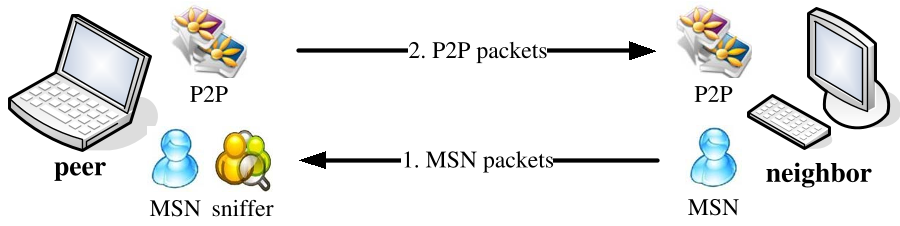 Figure: The process of joining the P2P network via social connection cloning.
Strengthening the Network: Robustness through Shallow Flooding
Once the first connection is established via the "cloned" social link, the peer must find more neighbors to ensure network stability. The paper suggests a Shallow Flooding approach:
- Ping with Small TTL: Send discovery messages with a low Time-To-Live to avoid network congestion.
- Pong Response: Neighbors reply with their own known peer lists, allowing the new node to quickly populate its routing table.
Critical Insight: Why This Works
The brilliance of this approach lies in Identity vs. Address. Centralized P2P fails because it maps identity to a fragile IP. By using Social IDs (QQ/MSN) as an intermediary, this method leverages the high availability of social networks to resolve the dynamic nature of P2P IPs.
Conclusion & Future Outlook
While this paper was written in an era of unencrypted IM traffic (QQ/MSN), the logic remains highly relevant. Today, as we move toward Web3 and decentralized communications, the "social bootstrapping" concept could potentially be adapted to secure, encrypted discovery layers, reducing our reliance on static infrastructure.
Limitations: The primary challenge is the shift toward encrypted and proxied IM traffic (TLS/P2P-blocking NATs), which makes simple packet sniffing more difficult today than it was in 2010. However, the conceptual bridge between social graphs and P2P topology remains a powerful area for decentralized research.